Streamsong Red
Coore and Crenshaw built a heaving sand masterpiece at Streamsong, a links in the Florida interior with a Biarritz over water and a round that defines the resort.
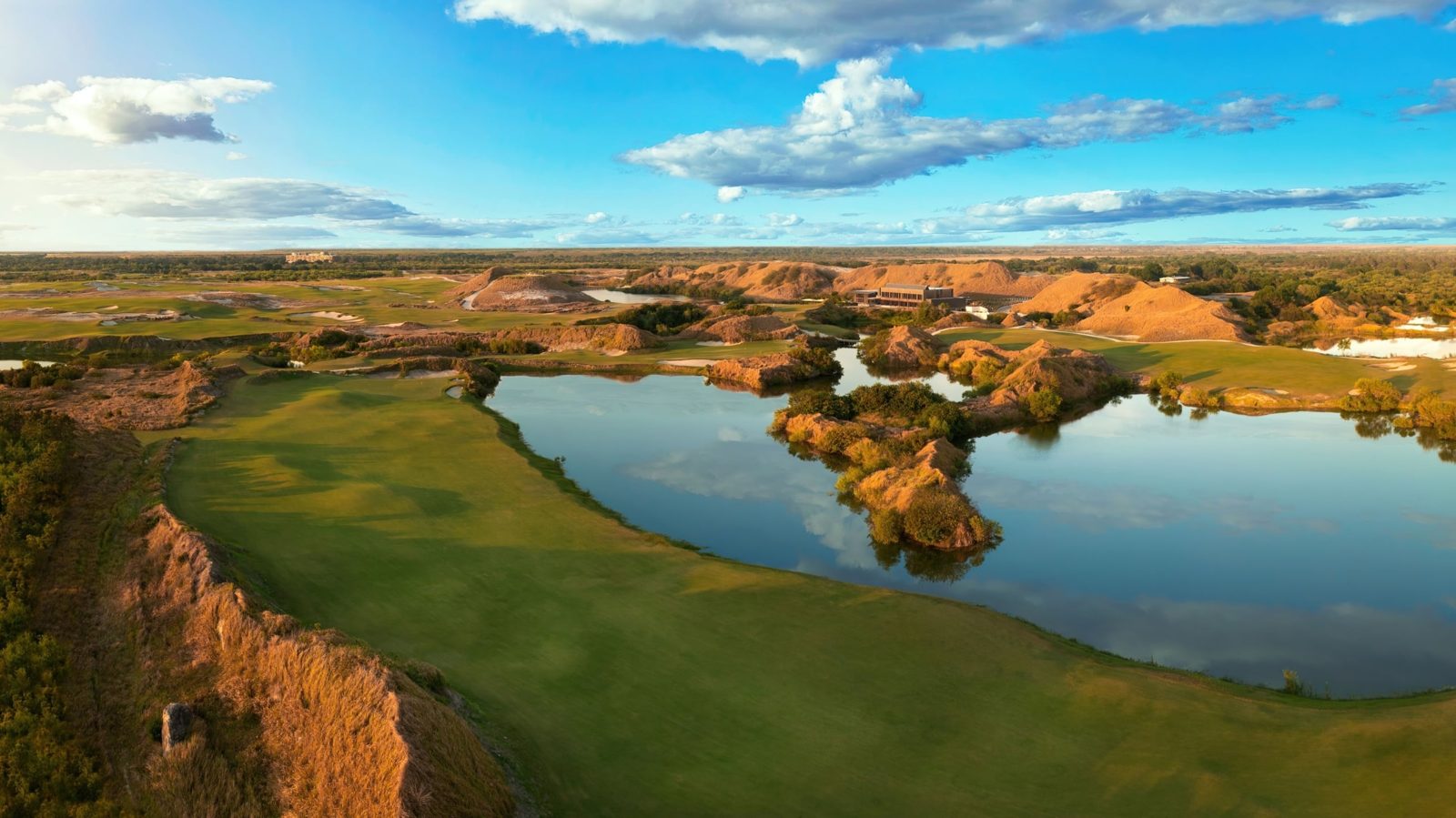
The drive gives nothing away. Leaving the Tampa to Orlando corridor behind, the road rolls through phosphate country and citrus groves before the ground itself starts to move. Enormous sand dunes rise up. Deep lakes sit in the hollows a century of mining gouged out. On top of it all sits a golf course that looks transplanted from the Australian Sandbelt. Streamsong Red, by Bill Coore and Ben Crenshaw, announced in 2013 that Florida golf could be something entirely other than palm trees and pond-lined fairways. Golfweek's panel ranks it the No. 2 public-access course in Florida, behind only the Stadium Course at Sawgrass.
The routing works around the outside of the property the two original courses share, and the ground does most of the talking. Fairways spill over dune ridges. Bunkers bleed into native sand. Greens sit where the land suggests they should, large and quietly contoured. Walking comes first here, and rightly so. This is a ground-game examination where the running approach is a genuine weapon and the wind off the lakes works as a full design partner. First-timers spend the front nine taking photographs. By the back nine they are studying the card, because the Red saves its sternest questions for late.
The Scorecard
Start with the longest card the Red publishes. The card below gives the Green tee figures carried in Greenskeeper's scorecard account of the course, and they build the round the way Coore and Crenshaw stretched it, 3,387 yards out and 3,761 home for 7,148 in all against par 72. One honest note belongs with them. Published figures for this set split on rating and slope, with one account printing 74.2 and 130 and another printing 74.1 and 137, so the card below leaves rating and slope off rather than borrow a pair that does not hold up.
By the Numbers
From the scorecard below: Green tees.
| Front nine | Par | Yards |
|---|---|---|
| Hole 1 | 4 | 474 |
| Hole 2 | 5 | 555 |
| Hole 3 | 4 | 404 |
| Hole 4 | 4 | 330 |
| Hole 5 | 4 | 453 |
| Hole 6 | 3 | 185 |
| Hole 7 | 5 | 527 |
| Hole 8 | 3 | 147 |
| Hole 9 | 4 | 312 |
| Total | 36 | 3,387 |
| Back nine | Par | Yards |
|---|---|---|
| Hole 10 | 4 | 486 |
| Hole 11 | 4 | 434 |
| Hole 12 | 4 | 500 |
| Hole 13 | 5 | 535 |
| Hole 14 | 3 | 181 |
| Hole 15 | 4 | 474 |
| Hole 16 | 3 | 208 |
| Hole 17 | 4 | 403 |
| Hole 18 | 5 | 540 |
| Total | 36 | 3,761 |
The shape of the card is the shape of the land. Going out brings a gentle handshake of short fours and a 147-yard par 3. The inward half runs nearly 400 yards longer and stacks the 500-yard 12th, the 535-yard 13th and a 540-yard finishing par 5 on top of each other. Four par 5s and four par 3s frame ten par 4s, and the two nines play like two different treaties with the same dunes. The front asks for position. The back demands power to go with it.
Green Fees
- Resort guest, October 1 to December 14, 2026$375
- Resort guest, peak season, January 14 to April 30, 2027$395
- Day guest, peak season, January 14 to April 30, 2027$445
- Resort guest, summer, June 24 to September 14, 2027$170
- LocationBowling Green, Florida
- Par / Yardage72 / 7,148 yards (Green tees)
From Streamsong's own published Golf Fees page, which prices all of the resort's championship courses on one seasonal card; the $375 resort-guest figure is corroborated by Golf Trip Index's Streamsong guide. Rates exclude the $35 cart fee where a cart is taken, and caddie fees are separate, from $60 per player for a group caddie to $150 plus gratuity for a single-bag walking caddie, per the same resort page.
The Story
Streamsong exists because the Mosaic Company, the world's largest phosphate producer, owned some 16,000 acres of reclaimed mining land in Polk County and chose to build a destination resort on it in the Bandon Dunes mold. The first two courses would share one clubhouse and one extraordinary piece of sandy ground. Mosaic hired the two architecture teams at the very top of the modern game and let them work the same land at the same time. Coore and Crenshaw took one routing and Tom Doak took the other, and the courses were named for the color of pen each team used on the plans. Red went to Coore and Crenshaw. Blue went to Doak.
The Red opened for play in late 2012 and ranked among America's finest public courses from its first season. Best-new-course honors followed, along with a permanent place in the national top 25 public lists. That acclaim helped justify everything that came next at the resort. Gil Hanse's Black Course arrived in 2017 and the Coore and Crenshaw Chain short course followed in 2023, while a lodge, spa and bass-fishing operation turned a remote mining tract into one of the essential American golf trips.
What endures is how completely the Red trusts its site. Coore and Crenshaw moved little earth by modern standards and let the mining era's dunes and spoil ridges dictate the strategy. The result has matured into the connoisseur's choice at the resort. It is the most dramatic of the original pair, the one architecture travelers name first, and the round around which Streamsong itineraries are built.
Signature Holes
Hole 7 - Par 5 - 527 yards
The great lakeside three-shotter of the Red. The hole runs along the water with the lake in play the full length of the left side, so the brave line off the tee and again on the layup hugs the shore to shorten the hole and open the green. Bail right and the angle closes. The bunkering takes over, and a birdie hole becomes a salvage operation. This is where the links costume drops for a moment and the Florida setting, water and wind and all, takes center stage.
Hole 15 - Par 4 - 474 yards
The No. 1 handicap hole on the card earns the number. At 474 yards from the Green tees it is a full-blooded two-shotter played across the high ground of the property, where the wind is strongest and the width of the fairway feels like a rumor once the drive is in the air. The approach has to be struck purely to hold a green that accepts only properly flighted shots. On a course that hands out its favors early, the 15th is the toll booth on the way home. Par here feels like a birdie anywhere else.
Hole 16 - Par 3 - 208 yards
Few modern American par 3s get talked about more. The tee sits on one slope of the giant dune the two original courses share, and the shot carries a pond to a Biarritz green some 70 yards deep, split by the deep swale that gives the style its signature. A pin in the front section, a pin in the back section or a pin down in the swale itself makes three entirely different holes hide inside one tee shot of 208 yards. It is a Golden Age template rebuilt at Florida scale, and it photographs like a dream.
Where the Round Turns Late
The Red is two rounds stitched together by the same dunes. Outward, the card breathes. Short fours at 330 yards and 312 yards sit beside a 147-yard par 3, and position matters more than force. The fairways spill over dune ridges and the bunkers bleed into native sand, so a drive placed on the correct side opens a running approach that can chase onto large and quietly contoured greens. That ground game is the early dividend. It lets a player flight the ball low, use the slopes, and keep the wind off the lakes from turning a solid shot into a held breath.
Coming home, the treaty changes. The inward half stretches to 3,761 yards against 3,387 out, and the weight arrives in a pack. The 500-yard 12th, the 535-yard 13th and the 540-yard finishing par 5 stack on top of each other while the 474-yard 15th carries the No. 1 handicap on the card. By then the wind is strongest across the high ground and width feels narrower than the fairway plan suggests. A par at the 15th is presented in the review as feeling like a birdie elsewhere, and the card explains why.
Between those halves sits the hinge. The 527-yard 7th runs along a lake in play down the full left side, rewarding the brave line that hugs the shore and punishes the bail to the right by closing the angle. Later, the 208-yard 16th carries a pond to a Biarritz green some 70 yards deep and split by a deep swale, so front, swale or back pin makes three different holes from one tee. The Red rewards the patient ground player early and the committed ball striker late. It punishes anyone who tries to play the back nine with front-nine manners.
Practical Info
Streamsong Resort sits at 1000 Streamsong Drive, Bowling Green, FL 33834, in rural Polk County roughly 55 miles southeast of Tampa and 77 miles southwest of Orlando. A rental car is essential, and most guests simply stay on property at the lakeside Lodge. The Red and Blue share a clubhouse and the Restaurant Fifty-Nine dining room, and the resort runs a strong caddie program. Walking is the house style. Carts take a $35 fee, and a group caddie is required with a riding cart.
Book the Red early in a multi-day stay if the dates allow. Its combination of drama and playability makes it the perfect orientation round, and a late tee time is worth saving for the golden hour on the dunes at least once. Winter and spring bring the peak card and the firmest turf. Summer rates fall by more than half on the resort's published card, trading heat and afternoon storms for a quiet course. Pair the Red with the Blue from the same clubhouse on a 36-hole day and settle the sibling argument on the course.
Questions, Answered
Which Streamsong course should a first-time visitor play first?
The Red, for most golfers. It is the highest-ranked course on the property, its drama arrives early and often, and it shares a clubhouse with the Blue, so a first day can hold both. Players who love bold greens may end up preferring the Black or the Blue, but the Red is the resort's signature round and the right introduction.
Why is the 16th hole called a Biarritz?
For its green. A Biarritz is a classic template green, very deep and bisected by a pronounced swale, named for a famous French original. The Red's 16th plays 208 yards over a pond to a green some 70 yards deep, so the day's pin position, front, swale or back, completely changes the shot required.
How much does it cost to play Streamsong Red?
On the resort's published seasonal card, resort guests pay $375 in the October to mid-December 2026 window and $395 in the January to April 2027 peak, while day guests pay $445 at peak. Summer resort-guest rates fall to $170. Carts add $35 and caddie fees are separate.
Keep Exploring Florida
Read our Florida Golf Guide for more top courses, green fees, and trip planning across the state.
Streamsong Red features in our ranking of the 20 Best Golf Courses in Florida.
More Florida course guides: Streamsong Blue, Streamsong Black, The Park West Palm, Cabot Citrus Farms (Karoo), Bay Hill Club & Lodge, PGA National (Champion Course), Innisbrook (Copperhead), Seminole Legacy Golf Club, Cabot Citrus Farms (Roost), Hammock Beach (Ocean Course), Trump National Doral (Blue Monster), Camp Creek, PGA Golf Club (Dye Course), Hammock Beach (Conservatory), TPC Sawgrass (Dye's Valley), Southern Dunes, Juliette Falls, Mission Inn (El Campeon) and TPC Sawgrass - Stadium Course.