Streamsong Blue
Tom Doak's rolling companion piece at Streamsong, with the highest tee in Florida golf country, vast greens and the dune-framed 7th everyone photographs.
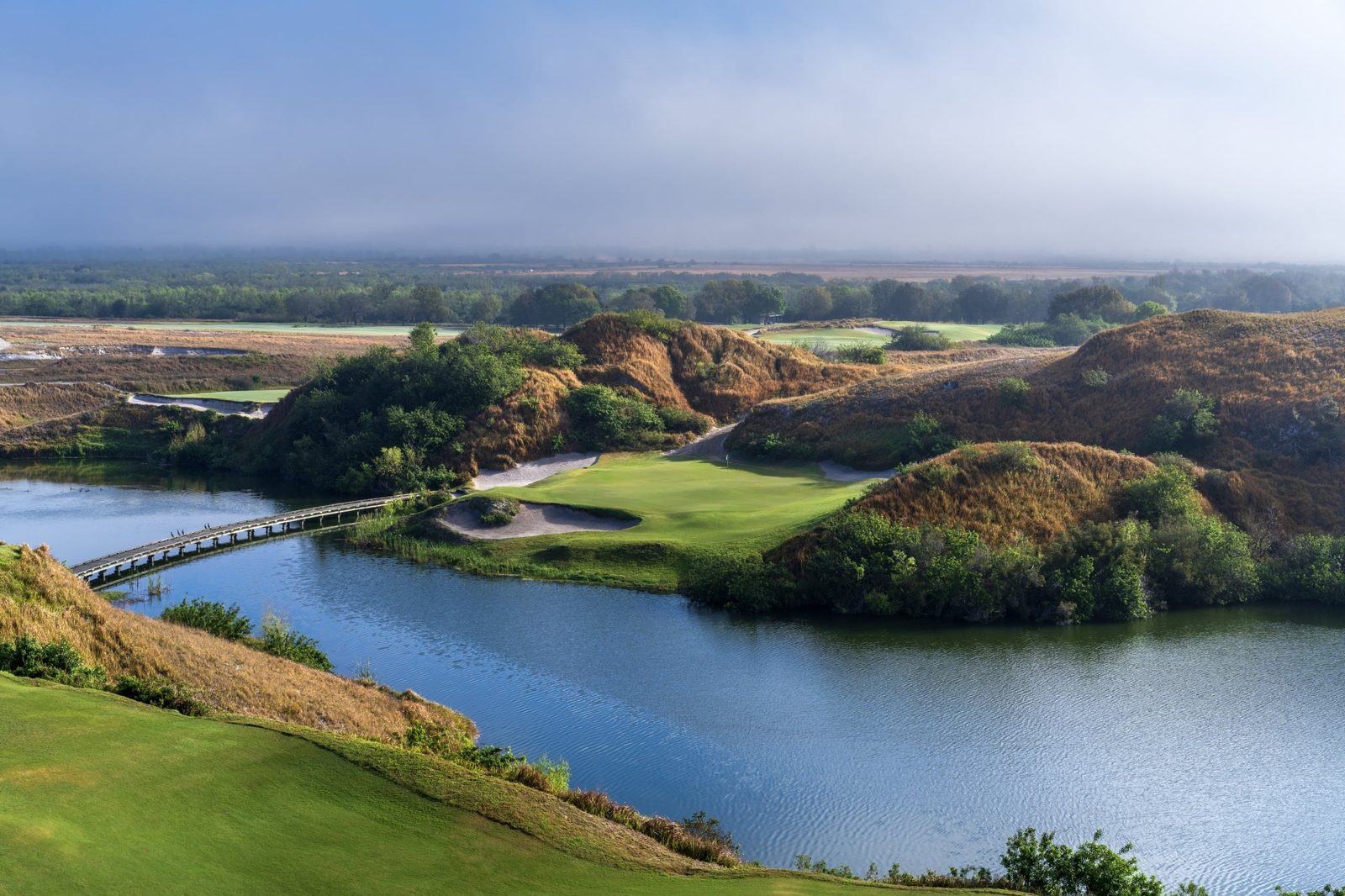
The round begins with a climb. From the clubhouse the Blue's first tee sits atop the highest point on the whole Streamsong property, a sand mound with views across both original courses, and the hole tumbles away downhill from there. That is Tom Doak's idea of a welcome, generous, scenic and quietly full of decisions. The Blue opened alongside Coore and Crenshaw's Red in 2013, the two routings intertwining across the same reclaimed phosphate dunes, and golfers have argued the sibling order ever since, which is exactly what a great resort pairing should produce.
Where the Red is the more dramatic tee-to-green test, the Blue saves its boldest statements for the greens. Doak and his associates at Renaissance Golf Design shaped putting surfaces of real size and swing, so a drive in the short grass is only the start of the work. The approach must find the right section, on the right side of the day's contours, or the two-putt becomes a negotiation. The fairways run wide, the bunkering is placed to frame rather than to punish, and the whole round rolls across open, windswept ground that could pass for a links a continent away.
The Scorecard
The card below is the full-length Green-tee card, and its arithmetic is Doak at full stretch. The outward nine runs 3,486 yards and keeps its powder in the 575-yard 9th, then the course comes home in 3,690 yards, for 7,176 in total at par 72.
By the Numbers
From the scorecard below: Green tees.
| Front nine | Par | Yards |
|---|---|---|
| Hole 1 | 4 | 338 |
| Hole 2 | 5 | 554 |
| Hole 3 | 4 | 418 |
| Hole 4 | 4 | 442 |
| Hole 5 | 3 | 157 |
| Hole 6 | 4 | 345 |
| Hole 7 | 3 | 203 |
| Hole 8 | 4 | 454 |
| Hole 9 | 5 | 575 |
| Total | 36 | 3,486 |
| Back nine | Par | Yards |
|---|---|---|
| Hole 10 | 3 | 187 |
| Hole 11 | 4 | 487 |
| Hole 12 | 4 | 408 |
| Hole 13 | 4 | 312 |
| Hole 14 | 5 | 545 |
| Hole 15 | 4 | 446 |
| Hole 16 | 3 | 237 |
| Hole 17 | 5 | 590 |
| Hole 18 | 4 | 478 |
| Total | 36 | 3,690 |
Four par 5s do the heavy lifting, and they escalate, with 554 yards at the 2nd, 575 at the 9th, 545 at the 14th and the 590-yard 17th as the crescendo. Against them the par 3s run long as a set, the shortest of the four still 157 yards and the 16th stretching to 237, so the Blue asks for properly struck long irons all afternoon. The inward nine outweighs the outward by more than 200 yards, a back-loaded card for a course whose greens grow bolder as the round goes on.
Green Fees
- Resort guest, October 1 to December 14, 2026$375
- Resort guest, peak season, January 14 to April 30, 2027$395
- Day guest, peak season, January 14 to April 30, 2027$445
- Resort guest, summer, June 24 to September 14, 2027$170
- LocationBowling Green, Florida
- Par / Yardage72 / 7,176 yards (Green tees)
Streamsong prices all of its championship courses on one seasonal card, and the rows above are drawn from the resort's own published Golf Fees page. The resort-guest figure in the October 1 to December 14, 2026 window is $375. Rates exclude the $35 cart fee where a cart is taken, and caddie fees are separate, running from $60 per player for a group caddie to $150 plus gratuity for a single-bag walking caddie.
The Story
When the Mosaic Company built Streamsong on its reclaimed Polk County mining land, it made an architect's dream of a commission, two elite firms on one shared site with simultaneous construction. Tom Doak's Renaissance Golf Design took the routing that became the Blue, named, like its sibling, for the color of pen the team used on the plans. Doak's crew shaped the course with the light-touch, lay-of-the-land philosophy that had made Pacific Dunes famous, working the mining era's dune ridges and lakes into a routing that crosses and recrosses its neighbor's ground.
The Blue opened in 2013 to the same chorus as the Red, slotting straight into the national public-course rankings. It has held a distinction no other Streamsong course can claim, because in 2016 it hosted a national championship, the U.S. Women's Amateur Four-Ball, proof that Doak's green complexes test elite players as happily as they entertain resort guests. The resort around it has grown, with Hanse's Black in 2017 and The Chain short course in 2023, but the original pairing remains the heart of the place.
Panelists tend to split by temperament. The Red wins on drama, while the Blue wins converts on charm, variety and the sheer pleasure of its putting surfaces, and plenty of well-traveled golfers quietly rank it first of the three big courses. What is not argued is the setting, two modern masterpieces by two different hands, visible from each other's fairways, on land that was a phosphate mine within living memory.
Signature Holes
Hole 1 - Par 4 - 338 yards
A postcard with a strategy problem inside it. The tee is the highest point at Streamsong, the fairway falls away below, and at 338 yards the green is almost in range for the longest hitters, except that massive bunkers guard the direct line and the putting surface is one of Doak's most contoured. Start the trip with a birdie chance or a recovery from the sand. The Blue announces its terms, width with consequences, on the very first swing.
Hole 7 - Par 3 - 203 yards
The most photographed hole on the property. The green sits in a bowl of towering dunes on the far side of a lake, tucked below the same great dune whose other slope holds the Red's famous Biarritz 16th, so the two courses share a landmark and a photo opportunity. At 203 yards the shot is no token. Carry the water, hold a green framed by sand on every side, and take a moment on the tee, because this is the view that sells Streamsong to the world.
Hole 17 - Par 5 - 590 yards
The longest hole on the Blue is saved for the penultimate test. At 590 yards the 17th is a genuine three-shot hole for nearly everyone, climbing through the dunes with the day's wind usually asking questions, and its length sets up the Blue's stern closing argument alongside the long par-4 18th. Doak gives you room to swing and then grades the approaches strictly, and a par here, late in the round, with the clubhouse in sight, is a scorecard line worth circling.
The Greens Are the Examination
Width is the invitation here, not the verdict. The Blue plays wider off the tee than its sibling, with bunkering placed to frame rather than to punish, and that generosity can lull a player into thinking the work is done once the ball finds short grass. It is not. Tom Doak saved the boldest statements for greens of real size and swing, where the approach must find the right section and the right side of the contours or a routine two-putt becomes a negotiation. A safe drive to the wrong side is still a miss in everything but the fairway count.
The card builds that lesson slowly, then all at once. Four par 5s escalate through the round at 554 yards, 575 yards, 545 yards and finally 590 yards at the 17th, while the par 3s run long as a set with the shortest still 157 yards and the 16th stretching to 237 yards. The back nine outweighs the front by more than 200 yards, and the closing pair is deliberately stern. The 590-yard 17th is a genuine three-shot hole for nearly everyone, and the long par-4 18th at 478 yards gives no soft landing after it.
Two early holes announce the terms with unusual clarity. The 338-yard 1st tumbles downhill from the highest point on the whole Streamsong property, almost in range for the longest hitters yet guarded by massive bunkers on the direct line and one of the most contoured greens on the course. The 203-yard 7th then asks for a full carry over water to a green set in a bowl of towering dunes. The Blue rewards precise iron play and patient putting above all else. It punishes the casual approach, the shot that lands on the green and assumes the hole is over.
Practical Info
The Blue shares the Red and Blue clubhouse at Streamsong Resort, 1000 Streamsong Drive, Bowling Green, FL 33834, about 55 miles southeast of Tampa and 77 miles southwest of Orlando, with the resort Lodge the natural base. It is a walking-first course with a deep caddie bench. Carts carry a $35 fee, a group caddie is required with a riding cart, and single-bag walking caddies run $150 plus gratuity.
The classic Streamsong day pairs the Blue in the morning with the Red in the afternoon, or the reverse, since the routings intertwine and the contrast is the lesson. If your group plays one course twice, make it this one on different tee sets. From the Black tees at 6,692 yards the same greens play friendlier, and Doak's contours reward a second look. Winter and spring are peak season on the resort's card, and the summer window, at $170 for resort guests, is the connoisseur's value play if you start early against the heat.
Questions, Answered
Is Streamsong Blue easier than Streamsong Red?
Friendlier off the tee, sterner on the greens is the usual verdict. The Blue's fairways are wider and its forced carries fewer, but its putting surfaces are the boldest of the original pair, so scores leak away around the hole instead. From the back tees the two cards are within 30 yards of each other, and most golfers find their totals closer than the reputations suggest.
What championship has Streamsong Blue hosted?
The 2016 U.S. Women's Amateur Four-Ball, the only national championship held at the resort to date. Doak's green complexes, which reward the precise approach and punish the lazy one, are a large part of why the USGA chose the Blue for elite match play.
How much does it cost to play Streamsong Blue?
The resort prices all its championship courses on one seasonal card. Resort guests pay $375 in the October to mid-December 2026 window and $395 in the January to April 2027 peak, day guests pay $445 at peak, and summer resort-guest rates fall to $170. Carts add $35 and caddie fees are separate.
Keep Exploring Florida
Read our Florida Golf Guide for more top courses, green fees, and trip planning across the state.
Streamsong Blue features in our ranking of the 20 Best Golf Courses in Florida.
More Florida course guides: Streamsong Red, Streamsong Black, The Park West Palm, Cabot Citrus Farms (Karoo), Bay Hill Club & Lodge, PGA National (Champion Course), Innisbrook (Copperhead), Seminole Legacy Golf Club, Cabot Citrus Farms (Roost), Hammock Beach (Ocean Course), Trump National Doral (Blue Monster), Camp Creek, PGA Golf Club (Dye Course), Hammock Beach (Conservatory), TPC Sawgrass (Dye's Valley), Southern Dunes, Juliette Falls, Mission Inn (El Campeon) and TPC Sawgrass - Stadium Course.