PGA Golf Club (Dye Course)
Pete Dye at his most Pete Dye in 1999, all pot bunkers and pine straw and coquina waste areas and small greens with a lot of fight in them at the home club of the PGA of America.
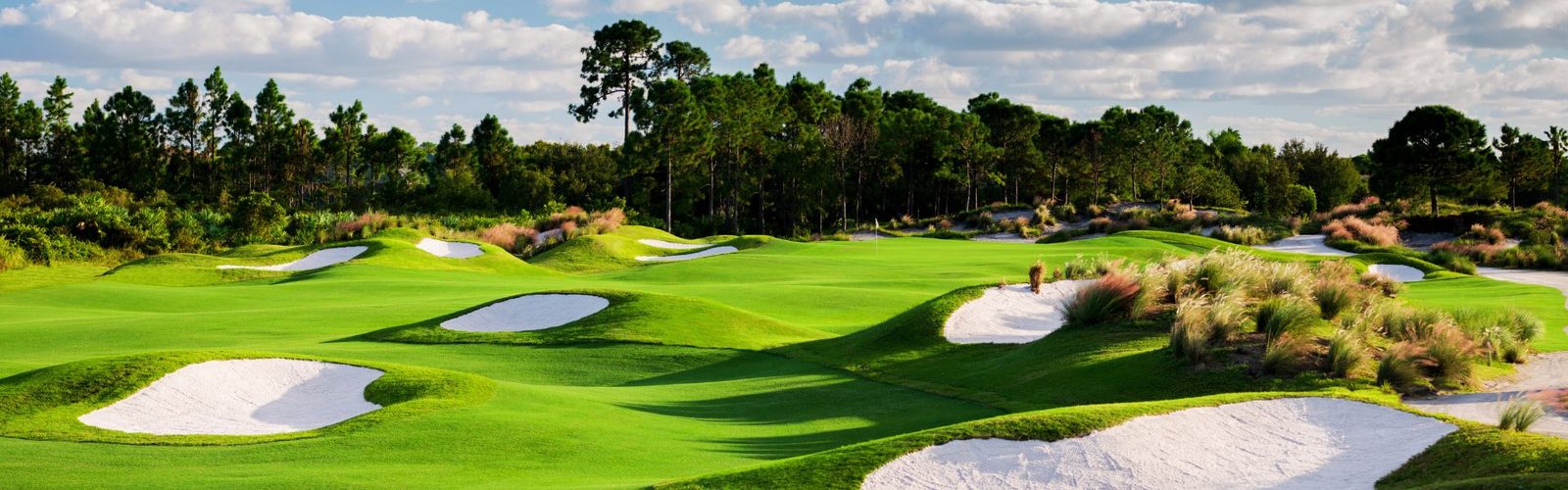
At the home club of the PGA of America, Pete Dye got to be fully himself. The Dye Course at PGA Golf Club in Port St. Lucie opened in 1999 alongside Tom Fazio's Wanamaker and Ryder courses, and it is the most characterful of the three. Expect target golf threaded through Florida wetlands and pine forest. Expect pot bunkers and grass bunkers, pine straw rough, waste areas of crushed coquina shell, and modest contoured greens that somehow look smaller when you are playing well.
Anyone expecting the island greens and stadium mounding from his famous work will find something rawer here. This is links flavored golf where the ground game matters and every tee shot hands you a picture to decode before you dare attack it. From the Medal tees it stretches to 7,221 yards with a 75.7 rating and a 142 slope, a proper championship test. And it is fully public, the PGA's own club open to any golfer who books a tee time.
The Scorecard
Below is the Pro set, the Medal tees, and its totals match the club's own published stats table exactly. The full card runs 7,221 yards with a 75.7 rating and a 142 slope. The nines split unevenly in the best way, 3,536 yards out against 3,685 yards back, and the par 5s carry the length with all four of them between 520 and 575 yards. Just as telling is what the card leaves out. No par 4 dips under 340 yards, so the challenge on the two-shotters is placement and nerve rather than any driveable temptation.
By the Numbers
From the scorecard below: Medal tees.
A slope of 142 from the Medal tees, rating 75.7 puts it ahead of about 64% of the 182 courses in our database with a published slope.
| Front nine | Par | Yards |
|---|---|---|
| Hole 1 | 4 | 380 |
| Hole 2 | 4 | 496 |
| Hole 3 | 3 | 190 |
| Hole 4 | 4 | 365 |
| Hole 5 | 5 | 520 |
| Hole 6 | 3 | 165 |
| Hole 7 | 5 | 575 |
| Hole 8 | 4 | 395 |
| Hole 9 | 4 | 450 |
| Total | 36 | 3,536 |
| Back nine | Par | Yards |
|---|---|---|
| Hole 10 | 5 | 540 |
| Hole 11 | 4 | 430 |
| Hole 12 | 4 | 340 |
| Hole 13 | 3 | 200 |
| Hole 14 | 4 | 430 |
| Hole 15 | 4 | 480 |
| Hole 16 | 3 | 225 |
| Hole 17 | 5 | 565 |
| Hole 18 | 4 | 475 |
| Total | 36 | 3,685 |
That finish has earned its reputation. The 15th runs 480 yards, the 16th is the 225 yard par 3, the 17th stretches to a 565 yard par 5, and the home hole asks for a 475 yard par 4. Add it up and you get a closing run of 1,745 yards where scoring chances and disasters sit side by side. The relief comes early instead. The 165 yard sixth is the shortest hole on the course, and the 340 yard 12th is as close as Dye comes to a gift.
Green Fees
- LocationPort St. Lucie, Florida
- Par / Yardage72 / 7,221 yards (Medal tees)
There is no fixed rate card for the Dye Course. Third party directory estimates wander so far apart, from the twenties to well over 200 dollars, that quoting one would not be honest. The club prices by season and by day, so check the live tee sheet at pgavillagegolf.com for the date you want. Two things are set in print. Range balls come with a round, and Callaway rental sets run 50 dollars.
The Story
PGA Golf Club was built as the flagship home of the PGA of America, a 54 hole facility in Port St. Lucie where nearly 30,000 of the association's professionals come to play and train and learn. Tom Fazio's Wanamaker and Ryder courses carry the names of the association's founding figures and its famous cup. The third course went to Pete Dye, and the plaques along its tees honor Dye himself, a World Golf Hall of Fame member whose design language defines modern American golf architecture.
Dye delivered the connoisseur's course. The Fazio courses move through Carolina style pines in generous corridors. His course narrows every question instead, with visually intimidating tee shots, waste areas of crushed coquina shell, pine straw in place of conventional rough, and greens kept deliberately modest in size and full of contour. Reviewers have called it diabolical, in the fond way golfers reserve that word for Dye, and the club's own good players tend to call it the toughest and most interesting test on the property.
The rest of the property rounds out the visit. The learning and performance center ranks among the most complete practice facilities in the country, a six hole short course sits beside the championship layouts, and the PGA's museum and hall of fame heritage runs through the markers and plaques, including Ryder Cup and PGA Championship story markers along the courses. For a golfer who loves the game's institutions, playing Dye at the PGA's own house really has no equal.
Signature Holes
Hole 7 - Par 5 - 575 yards
Nothing here asks for just two big swings and a prayer. At 575 yards this is the longest hole on the course, a par 5 threading the wetlands that demands three decisions. Pot bunkers, waste areas and water are scattered so each shot changes the angle of the next one, and the modest green complex rewards the golfer who planned the whole hole backward from the flag.
Hole 2 - Par 4 - 496 yards
An early warning, delivered at full length. At 496 yards the second is the longest par 4 on the card, and the Dye Course is plainly not here to ease you in. The tee shot has to be placed rather than merely hit, with pine straw and waste areas waiting on the casual line, and the approach finds one of those small contoured greens that define the place.
Hole 16 - Par 3 - 225 yards
One swing, the whole Dye menace distilled. This 225 yard par 3 is the longest one-shotter on the card, and there is no bailout that does not bring trouble of its own. The contour on the green can turn an adequate long iron into a long afternoon. A par here feels like a birdie, which is exactly how Dye liked his long par 3s to feel.
Practical Info
Find the club just off I-95 in Port St. Lucie at 1916 Perfect Drive, about 45 minutes north of West Palm Beach. It is a genuinely public facility. Book the Dye Course through pgavillagegolf.com and arrive early, because range balls are included with the round and the practice facility is a destination in itself. Callaway rental sets are 50 dollars. Warm up properly, too. Dye's target golf punishes a cold first tee swing more than most.
A weekend of 54 holes makes the natural itinerary. Take the Dye Course for the examination, Fazio's Wanamaker for championship polish, and the Ryder for a friendlier Carolina flavored round, with the six hole short course saved for an evening loop. The tee plaques along the Dye Course honor Pete Dye's career, and the PGA Championship and Ryder Cup story markers reward anyone who builds in time to read them. It is the rare public facility where the history lesson comes free with the green fee.
Questions, Answered
Is the Dye Course open to the public?
Yes. PGA Golf Club is the home facility of the PGA of America, and all three championship courses are open to public play booked through the club. That means the Dye alongside the Wanamaker and the Ryder.
What sets the Dye Course apart from the Fazio courses?
Dye built target golf in a links flavored style, with pot, grass and sand bunkers, pine straw rough and coquina waste areas, plus small contoured greens threaded through wetlands and pine forest. The Fazio courses are broader and more parkland in character, so together the three make a genuinely varied 54 hole facility.
How long is the Dye Course?
From the Medal tees it measures 7,221 yards at par 72, rated 75.7 with a slope of 142, per the club's published stats table. The back nine is the longer half at 3,685 yards, and it finishes with a 565 yard par 5 and a 475 yard par 4.
Keep Exploring Florida
Read our Florida Golf Guide for more top courses, green fees, and trip planning across the state.
PGA Golf Club (Dye Course) features in our ranking of the 20 Best Golf Courses in Florida.
More Florida course guides: Streamsong Red, Streamsong Blue, Streamsong Black, The Park West Palm, Cabot Citrus Farms (Karoo), Bay Hill Club & Lodge, PGA National (Champion Course), Innisbrook (Copperhead), Seminole Legacy Golf Club, Cabot Citrus Farms (Roost), Hammock Beach (Ocean Course), Trump National Doral (Blue Monster), Camp Creek, Hammock Beach (Conservatory), TPC Sawgrass (Dye's Valley), Southern Dunes, Juliette Falls, Mission Inn (El Campeon) and TPC Sawgrass - Stadium Course.