Soldier Hollow (Gold Course)
Gene Bates's mountain course on the 2002 Winter Olympic venue, with 7,719 yards of Gold tees above the Heber Valley.
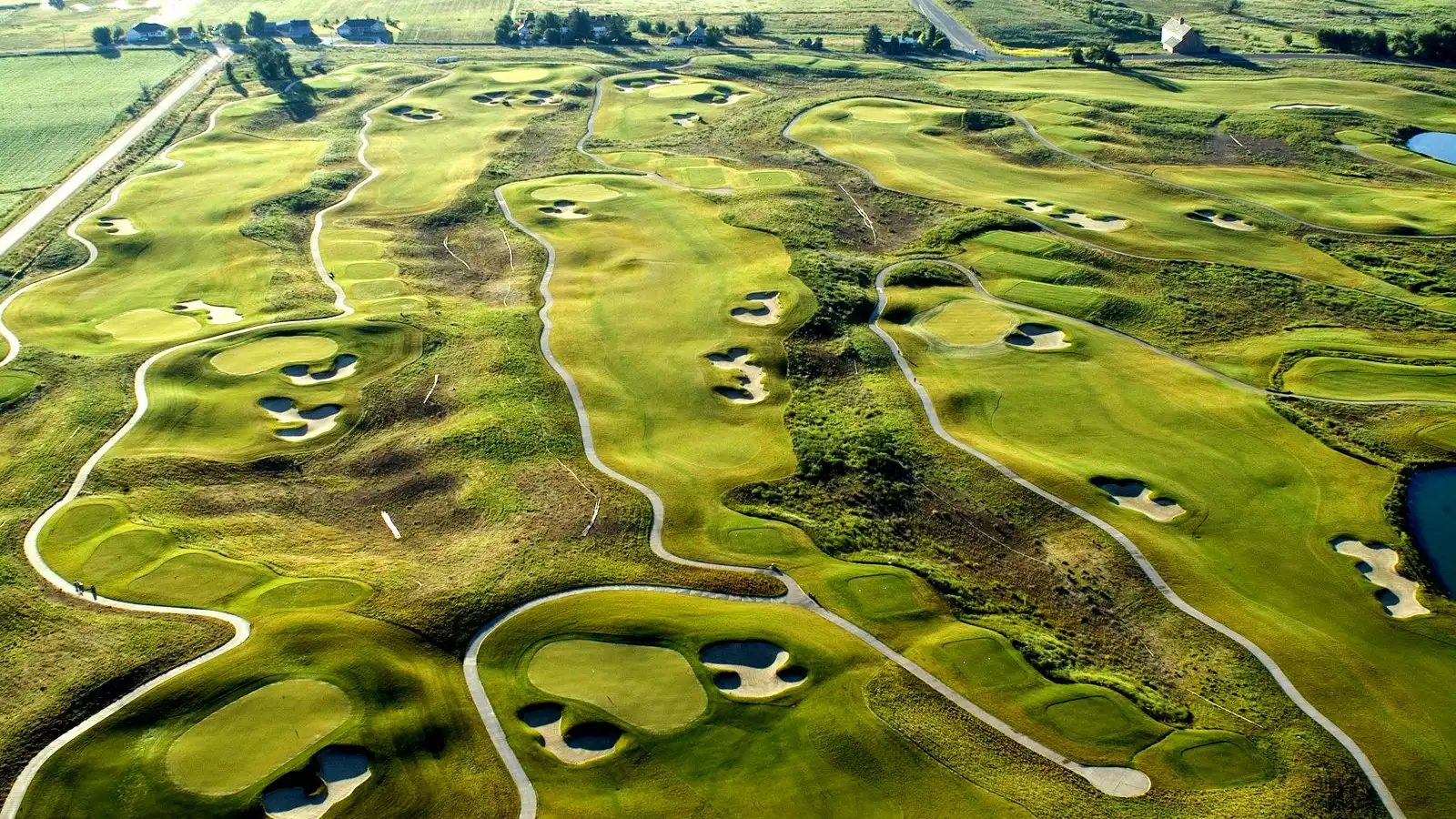
Soldier Hollow holds a distinction no other American course can claim. It is built on a Winter Olympics venue. The Gold Course climbs the mountainside where the biathlon and cross-country skiing events of the 2002 Salt Lake City Games were staged, inside Wasatch Mountain State Park above Midway, and Gene Bates used every foot of that mountainside. From the Gold tees the course stretches 7,719 yards, the longest full examination in this Utah ranking, with Mount Timpanogos filling the skyline and the Heber Valley spread out below the elevated tees.
This is the championship half of a 36-hole state park facility, with the Silver Course playing the gentler ground below, and the Gold owns the tournament record to prove its standing. In 2012 it hosted the U.S. Amateur Public Links, the first USGA championship ever held in Utah. It did so at altitude, on slopes, in mountain weather that can change by the hole, and that is precisely the charm. Soldier Hollow is public golf at state park prices with a championship course's bones, and its fourth place in the Mulliganist Utah ranking understates how distinctive the experience feels.
The two courses divide the mountain by temperament. The Gold is the climber, routed across the upper slopes where the Olympic ski trails switchbacked, with elevation change on nearly every hole and the long views to match. The Silver stays on the lower meadow ground, friendlier off the tee and the local choice for an everyday game. Playing the Gold means accepting the terms mountain golf sets. Uneven lies. Approaches that play a club or two differently than their yardage suggests. Greens whose borrow runs toward the valley whether the putt looks that way or not. None of it is trickery. It is the honest conversion of a Nordic ski venue into a golf course, and the conversion is so complete that the surprise is remembering the Olympics were ever the point of the place.
The Scorecard
The card below shows the Gold tees. It goes out in 3,801 and comes home in 3,918, for 7,719 yards at par 72, and the Gold tees carry a rating of 75.4 with a slope of 141. The Black set on the same card totals 7,197 yards, a full step down in length for golfers who want the mountain at a friendlier stretch.
By the Numbers
From the scorecard below: Gold.
From the Gold it plays to a slope of 141, rating 75.4, steeper than about 59% of the 182 courses in our database with a published slope.
| Front nine | Par | Yards |
|---|---|---|
| Hole 1 | 4 | 445 |
| Hole 2 | 5 | 589 |
| Hole 3 | 3 | 177 |
| Hole 4 | 4 | 459 |
| Hole 5 | 4 | 448 |
| Hole 6 | 4 | 408 |
| Hole 7 | 5 | 589 |
| Hole 8 | 3 | 222 |
| Hole 9 | 4 | 464 |
| Total | 36 | 3,801 |
| Back nine | Par | Yards |
|---|---|---|
| Hole 10 | 4 | 434 |
| Hole 11 | 4 | 490 |
| Hole 12 | 5 | 568 |
| Hole 13 | 4 | 400 |
| Hole 14 | 3 | 195 |
| Hole 15 | 4 | 511 |
| Hole 16 | 3 | 233 |
| Hole 17 | 5 | 606 |
| Hole 18 | 4 | 481 |
| Total | 36 | 3,918 |
This is the longest card in this group, and it reads like a mountain. The back nine outweighs the front by 117 yards, 3,918 against 3,801, carried by the 606-yard 17th, the 568-yard 12th and par 4s of 490, 511 and 481 yards that would be the longest holes on most courses. The front answers with its twin 589-yard par 5s and the 222-yard 8th. Four par 5s average 588 yards, the par 3s average 207, and nothing on the card is a pushover. Even the shortest par 4, the 400-yard 13th, plays into mountain ground, and altitude is the silent partner on every number, adding carry the card does not print.
Green Fees
- 18 holes with cart, Utah resident, weekday$72
- 18 holes with cart, Utah resident, weekend$77
- 18 holes with cart, non-resident$82
- 18 holes with cart, senior, weekday$67
- LocationMidway, Utah
- Par / Yardage72 / 7,719 yards (Gold)
The rows above follow the 2026 rates from the Utah Division of State Parks, and the ceiling tells the story. Eighteen holes with cart tops out at $82, junior resident weekday golf costs $44, and pass holders pay less again. The same figures cover the Silver Course. Championship length and pedigree at state park prices, twenty minutes from Park City, add up to some of the best value golf in the American West. Check the current rate when you book.
The Story
The site lived an Olympic life first. Soldier Hollow was built in the Wasatch foothills as the Nordic venue for the 2002 Winter Games, hosting biathlon and cross-country events on trails cut across the mountainside. When the Games ended, Utah State Parks turned the venue toward summer with an idea no other Olympic host has matched, a 36-hole golf facility on the same ground. Gene Bates, Florida-based and one of the most prolific architects in the mountain West, designed both courses, and they opened in 2004. The Gold climbed high on the old Olympic slopes while the Silver took the lower meadow.
The Gold announced its ambitions early and confirmed them in July 2012, when the USGA brought the U.S. Amateur Public Links to Midway for the first national championship the association had ever staged in Utah. The USGA fashioned a composite routing for the week, seventeen Gold holes joined by the Silver's 11th, and the mountain test held up beautifully on television and in person. Golf Digest gave the facility design honors in its 2007-08 awards cycle, and Golfweek has kept the Gold on its best-in-state and best-municipal lists ever since. Few courses live a double life this happily, championship venue one week and a $72 state park round the next.
The Olympic legacy still shares the property in ways golfers can see. The Nordic center that hosted the world in 2002 never closed, and Soldier Hollow remains a working cross-country ski venue in winter, its trail network threading the same mountainside the fairways occupy in summer. The biathlon range sits a short walk from the clubhouse. Wasatch Mountain State Park, which operates the golf, also runs the nearby Wasatch Mountain Golf Course in Midway, and that makes this corner of the Heber Valley an unlikely municipal golf empire. Four distinct eighteen-hole courses sit within a few minutes of each other, all publicly priced, and the Gold is the flagship of that system. It is the course the park points to when it wants to show what public golf can be.
Signature Holes
Hole 17 - Par 5, 606 yards
The longest hole on the card is the mountain's final statement. At 606 yards from the Gold tees, the 17th is a genuine three-shot par 5 played across the high ground, with the Heber Valley opening out beside it and Timpanogos on the horizon. Altitude thins the air and helps the ball fly, but 606 yards is still 606 yards, and length at the end of a climbing round tests stamina and strategy alike. Par here feels earned in a way few public-course pars do.
Hole 7 - Par 5, 589 yards
The 7th carries the No. 1 handicap on the card, a 589-yard par 5 that anchors the front nine. It works across the Olympic mountainside with elevation in play on every shot, and the ranking reflects the full package of length, slope and the mountain wind that finds this exposed stretch of the property. It pairs with the 589-yard 2nd to give the front nine two par 5s of identical length and entirely different character, a quirk of the card that regulars debate happily.
Hole 16 - Par 3, 233 yards
Right before the monster comes a one-shotter of real size. At 233 yards the 16th is the longest short hole on the card, played to a green sitting in the mountain air with the valley beyond. Elevation makes the shot play shorter than its number, and that is exactly the trap. Golfers who believe the altitude too completely watch a well-struck long iron sail the green, while golfers who club for the full yardage come up short. Judged perfectly, it is the most satisfying tee shot on the back nine. The hole also carries the mountain's signature trick, a false reading that pulls putts and approaches toward the Heber Valley. A tee shot aimed at the flag with the valley breeze behind it can finish in country the card never mentions. The regulars advise flighting the ball down and trusting the number rather than the eye, because at 6,000 feet the eye keeps insisting the green is closer than the yardage says. None of that dims the theater. A long iron against a wall of Wasatch peaks, the whole valley as backdrop and the 606-yard 17th waiting its turn, is mountain golf distilled into a single swing.
Practical Info
Soldier Hollow sits inside Wasatch Mountain State Park at 1370 West Soldier Hollow Ln in Midway, about twenty minutes from Park City and an hour from Salt Lake City. Because it is a state park operation, booking stays refreshingly plain. Reserve through the park, pay the rates in the fee table above with cart included, and pick a course, the Gold for the full championship examination or the Silver for a friendlier loop on the lower ground. The season runs roughly from March to November depending on snow, and the massive clubhouse, built in an Olympic lodge style, handles the rest.
Play the Gold early in a mountain trip if the itinerary allows. The course sits around 6,000 feet and climbs from there, so the ball flies noticeably further than at sea level and the weather can turn within a single round. Layers are not optional equipment. Afternoon thunderstorms are a genuine Wasatch pattern in summer, which argues for morning tee times. Pair the round with the rest of the Olympic venue, where the cross-country trails now serve hikers and mountain bikers, and with Midway's small-town dining a few minutes down the hill.
The connoisseur's move is the 36-hole day. Play the Gold in the morning, take lunch in the clubhouse, then spend the afternoon on the Silver or on one of the state park's Wasatch Mountain courses just across Midway. Park system pricing makes the double cheaper than a single round at most resort courses in neighboring Park City, and the contrast between Bates's two Soldier Hollow designs is a genuine education in how one architect handles two pieces of ground. GolfCourseGurus calls a Soldier Hollow and Wasatch weekend one of the best value golf weekends in America, and the arithmetic in the fee figures above makes the case without any help.
One more pleasure of the place is that the venue never really closes. It just changes sports. When the golf season ends, Soldier Hollow returns to its first identity, with groomed cross-country trails and one of Utah's favorite winter tubing hills on the same ground, so a family that golfs the Gold in October can be back on the snow by January. That continuity is part of the charm for golfers. This is a working public landscape, maintained by the state for whoever shows up in every season, and it explains the atmosphere on the first tee. The feel is less a resort transaction and more a town amenity that happens to be spectacular, with locals holding season passes, visitors in rental clubs, and a mountain that treats them all exactly the same.
Questions, Answered
What is the difference between the Gold and Silver courses at Soldier Hollow?
The Gold is the championship course, 7,719 yards from the back tees on the higher and steeper Olympic mountainside. The Silver plays the lower and gentler ground at 7,355 yards. Both are Gene Bates designs in Wasatch Mountain State Park, and both share the same state park rate schedule.
Did Soldier Hollow really host the Olympics and a USGA championship?
Yes to both. The venue staged biathlon and cross-country skiing at the 2002 Winter Olympics, the only United States golf course built on a Winter Olympic site, and the Gold Course hosted the 2012 U.S. Amateur Public Links, the first USGA championship held in Utah.
How much does it cost to play the Gold Course?
Under the 2026 state park rates, a Utah resident pays $72 on a weekday and $77 on a weekend. A non-resident pays $82, and a senior pays $67 on a weekday, each for 18 holes with cart.
Keep Exploring Utah
Read our Utah Golf Guide for more top courses, green fees, and trip planning across the state.
Soldier Hollow (Gold Course) features in our ranking of the 15 Best Golf Courses in Utah.
More Utah course guides: Black Desert Resort, Sand Hollow (Championship Course), Copper Rock, The Ledges, Coral Canyon, Thanksgiving Point and Hobble Creek.