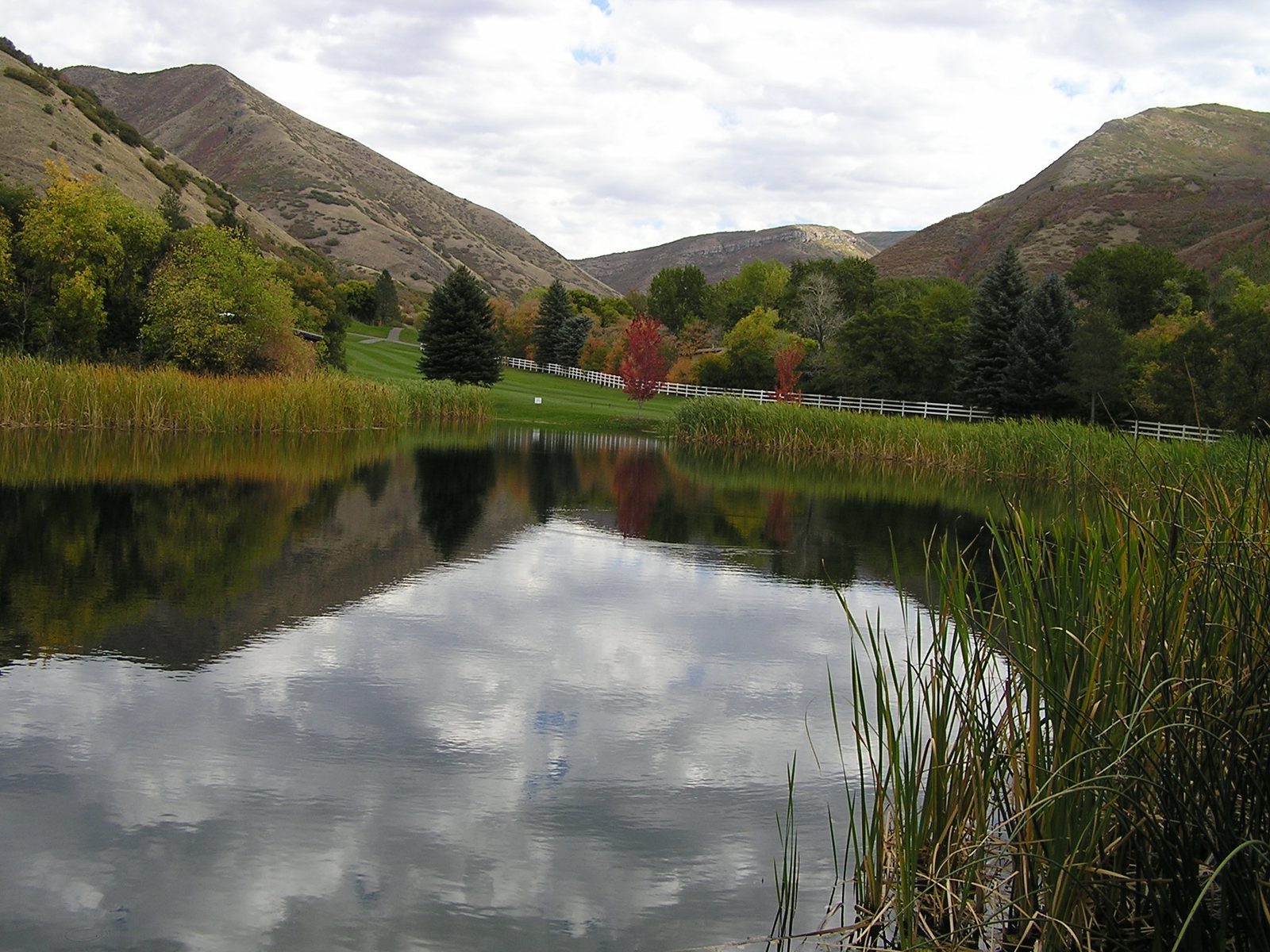
Hobble Creek is the City of Springville's municipal course, set up the canyon of the same name in the Wasatch foothills about fifteen minutes southeast of Provo. It is old-school Utah golf in the best sense. A tight, tree-lined routing where the fairways are cut through mature canyon timber, the greens are quick and honestly sloped, and the creek that gives the course its name is a genuine strategic presence rather than a decoration. Links Magazine has singled Hobble Creek out among Utah's best public courses, and Golf Digest's Places to Play once awarded it four and a half stars, remarkable company for a city-owned layout whose weekday green fee sits under forty dollars.
The creek crosses the 2nd, 12th, 13th and 17th holes, so water shapes decisions on both nines, and the canyon setting does the rest of the work. Elevation changes make several holes play shorter than the card suggests, the ball flies at canyon altitude, and in autumn the maples along the fairways and the canyon walls turn gold and red, a show that has made Hobble Creek one of the most beloved fall rounds in Utah County. At 6,050 yards from the Back tees it is not a long course by modern standards. It rewards placement, local knowledge and a putter that can handle slope, which is exactly the test William F. Bell drew here in 1967.
Reviewers have been describing the same experience for decades. An old-style, traditional walk where nearly every tee offers a postcard view of green fairways under the canyon walls, and where the golf feels a world away from the valley floor even though Springville is minutes behind you. GolfPass's course summary calls it probably the most popular course in Utah County, and the tee sheet agrees. This is the rare municipal that golfers plan a day around.
The two nines ask different questions. The front is the longer side, 3,160 yards on the card below, with two par 5s and room to swing. The back gives back 270 yards but tightens everything, threading three par 3s and the creek crossings at the 12th, 13th and 17th into a corridor where the canyon walls feel close on both sides. Five par 3s in total is an unusual count for a par-71 course, and it shapes the round. Iron play, more than driving, is what Hobble Creek examines.
The Scorecard
The card below is the Back set, the blue-banded row, from Hobble Creek's own published scorecard, issued by the City of Springville. It is the set on that card whose holes foot exactly. The figures run 3,160 yards out and 2,890 yards back, 6,050 yards in total at par 71, matching the card's printed Back totals, and a published played-course tee table lists the identical 3,160, 2,890 and 6,050 figures for its Blue set. The same card's longest set needs a disclosure. It prints a 6,406-yard total, but its own back-nine hole figures sum to 3,052 yards against a printed 3,032, so the Tournament card as printed does not foot and is not reproduced here. Course rating and slope are likewise omitted. The club card prints 68.4 and 120 for this set, while the played-course table lists 68.1 and 126 for the same yardage, and the two published figures disagree, so neither figure is carried on the card below.
By the Numbers
From the scorecard below: Back.
| Front nine | Par | Yards |
|---|---|---|
| Hole 1 | 4 | 380 |
| Hole 2 | 4 | 370 |
| Hole 3 | 5 | 475 |
| Hole 4 | 3 | 175 |
| Hole 5 | 4 | 390 |
| Hole 6 | 3 | 165 |
| Hole 7 | 4 | 340 |
| Hole 8 | 4 | 370 |
| Hole 9 | 5 | 495 |
| Total | 36 | 3,160 |
| Back nine | Par | Yards |
|---|---|---|
| Hole 10 | 3 | 150 |
| Hole 11 | 4 | 370 |
| Hole 12 | 4 | 365 |
| Hole 13 | 5 | 450 |
| Hole 14 | 3 | 130 |
| Hole 15 | 4 | 385 |
| Hole 16 | 3 | 160 |
| Hole 17 | 4 | 400 |
| Hole 18 | 5 | 480 |
| Total | 35 | 2,890 |
The shape of the card is pure Bell-era municipal golf. Five par 3s, an unusual count that puts a premium on iron play, and four par 5s, one of them crossed by the creek. The front nine is the longer side at 3,160 yards, anchored by the 495-yard 9th. The back nine gives back 270 yards but adds a third par 3 and brings the creek into play at the 12th, 13th and 17th. The shortest hole on the card, the 130-yard 14th, and the longest par 4, the 400-yard 17th, sit three holes apart, a tidy summary of a course that tests touch and nerve in the same breath.
Green Fees
- 18 holes, Monday to Thursday$39
- 18 holes, Friday to Sunday and holidays$44
- LocationSpringville, Utah
- Par / Yardage71 / 6,050 yards (Back)
Rates are the City of Springville's published schedule on its official green fees page, adult rates plus tax. Junior rates for ages 6 to 17 for 18 holes are $27 Monday to Thursday and $33 Friday to Sunday. The published veteran rate for 18 holes is $36. Nine-hole adult rates are $19.50 and $22 on the same weekday and weekend split. Tee times are prepaid and can be booked up to four days in advance.
The Story
Hobble Creek began as a nine-hole course in 1967, laid out by William F. Bell, the California architect whose name appears on the club's own scorecard masthead alongside the words 'Architect' and 'Established 1967.' Five years later the course grew to its full eighteen holes, and the routing golfers play today was set. A front nine that works its way along the canyon and a back nine where the creek and the narrowing corridor tighten the test. The clubhouse carries the marks of that long history, and reviewers have noted photographs on its walls of Johnny Miller, Billy Casper and other touring professionals who played here in the course's early decades.
The course has been a fixture of Utah amateur golf ever since. It hosts the Sonny Braun Art City Amateur and the Hobble Creek Senior Amateur, and its reputation has repeatedly travelled beyond Utah County. Links Magazine's verdict, quoted in this site's Utah ranking, calls it 'quirky and sporty, a throwback to the architecture of a bygone era, and a nice way to spend a morning or afternoon,' singling it out among the best public courses in the state. Craig Norman serves as the club's PGA Professional and Jay Geise as superintendent, the two names printed at the head of the current scorecard. Through it all Hobble Creek remains, happily, a municipal at heart. City-owned, city-priced, and kept in a condition that suggests a much larger budget.
The striking thing about the record is how little of it has needed updating. The routing Bell completed in 1972 is the routing on today's card, his name still heads the scorecard masthead more than half a century on, and the praise has arrived in every era. The Golf Digest stars at the turn of the century, the Links Magazine verdict quoted above, and a steady stream of reviewers since, all describing the same tight, tree-lined canyon test. Courses that stay this loved for this long, without lengthening or reinvention, are rare in American public golf.
Signature Holes
Hole 17 - Par 4, 400 yards
The creek crosses the 17th, and the card marks it the No. 2 handicap hole, the second-hardest test on the course arriving just as the round comes down to its last holes. At 400 yards from the Back tees it is the longest par 4 on the card below, with the club's Tournament tees stretching it to 420, played through the canyon corridor with Hobble Creek waiting to punish a loose approach. Position off the tee decides whether the green is reachable in regulation, and a drive leaked left or right turns the creek from scenery into arithmetic. It is the hole this course's ranking case points to first, and it earns the billing.
Hole 9 - Par 5, 495 yards
The 9th is the longest hole on the card below, a 495-yard par 5 that closes the front nine and brings the round back to the clubhouse. It is also the most hospitable hole in Utah golf. The club's scorecard carries a phone number inviting players to call the Sand Trap Cafe from the 9th tee so that food is waiting at the turn, a small ritual that says a great deal about how this municipal treats its golfers. As golf, the hole is the front nine's last scoring chance, long enough to demand two full shots before the approach even comes into view, and from the club's Tournament tees it stretches to 517 yards.
Hole 13 - Par 5, 450 yards
The 13th is the creek-crossed par 5, 450 yards on the Back card, and the hole where the back nine's character announces itself. It is narrower and more intimate than the front, with the water in play and the canyon walls close on both sides. The longest hitters who thread the tee shot can think about reaching in two, with the Tournament tees stretching the hole to 470 yards. For most players it is a three-shot hole where the layup position matters as much as the drive. Birdies here are earned honestly, and the walk from the 13th green, creek alongside, is one of the prettiest stretches of the round.
Practical Info
Hobble Creek sits at 94 Hobble Creek Canyon Road in Springville, up the canyon east of town. From Provo the drive is roughly fifteen minutes. The City of Springville runs the course and publishes its rates and tee-time policies on the city website. Tee times are prepaid and can be booked up to four days in advance. The Sand Trap Cafe operates on site, and the club's own scorecard invites players to phone an order in from the 9th tee for pickup at the turn. A driving range sits across the road from the course and a practice green serves the first tee, welcome extras at a municipal.
Play it in autumn if you can choose only one season. The canyon's maples turn in October and the course is famous locally for its fall color, and regulars report that the course stays playable deep into the fall. One practical warning travels with the beauty, since fallen leaves on the fairways can hide even a well-struck ball. In summer the canyon runs cooler than the valley floor below, one reason the tee sheet fills early on hot days. The modest yardage makes Hobble Creek a friendly venue for juniors, who receive their own published rate on the city's schedule, and the walk through the canyon is half the pleasure of the round. Because every tee time is prepaid and the booking window opens only four days out, the practical move is to set the round up as soon as the window opens, especially for summer weekends and October Saturdays, when the canyon is at its busiest and its most beautiful at the same time.
Questions, Answered
How much does it cost to play Hobble Creek?
The City of Springville's published schedule lists adult 18-hole green fees at $39 Monday to Thursday and $44 Friday to Sunday and holidays, plus tax. Nine holes cost $19.50 and $22 on the same weekday and weekend split. Juniors ages 6 to 17 pay $27 or $33 for 18 holes, and the published veteran rate for 18 holes is $36. Rates are set by the city and posted on its official green fees page.
Who designed Hobble Creek, and when did it open?
William F. Bell designed Hobble Creek. The course opened as nine holes in 1967, the year printed on the club's own scorecard, and was expanded to eighteen holes five years later. Bell's routing remains the course golfers play today, a tight, tree-lined canyon layout in which Hobble Creek itself crosses the 2nd, 12th, 13th and 17th holes.
Which scorecard is shown here, and why?
The scorecard below is the Back set from the club's own scorecard, 6,050 yards at par 71, because its 18 holes foot exactly to the card's printed totals of 3,160 yards out and 2,890 back. The same card's Tournament set prints a 6,406-yard total that its own back-nine figures do not sum to, so that set is described in the scorecard notes rather than reproduced. No course rating and slope is given for the Back set either, because the club card and a published played-course table print different pairs; both versions are given in the notes above the card.
Keep Exploring Utah
Read our Utah Golf Guide for more top courses, green fees, and trip planning across the state.
Hobble Creek features in our ranking of the 15 Best Golf Courses in Utah.
More Utah course guides: Black Desert Resort, Sand Hollow (Championship Course), Soldier Hollow (Gold Course), Copper Rock, The Ledges, Coral Canyon and Thanksgiving Point.