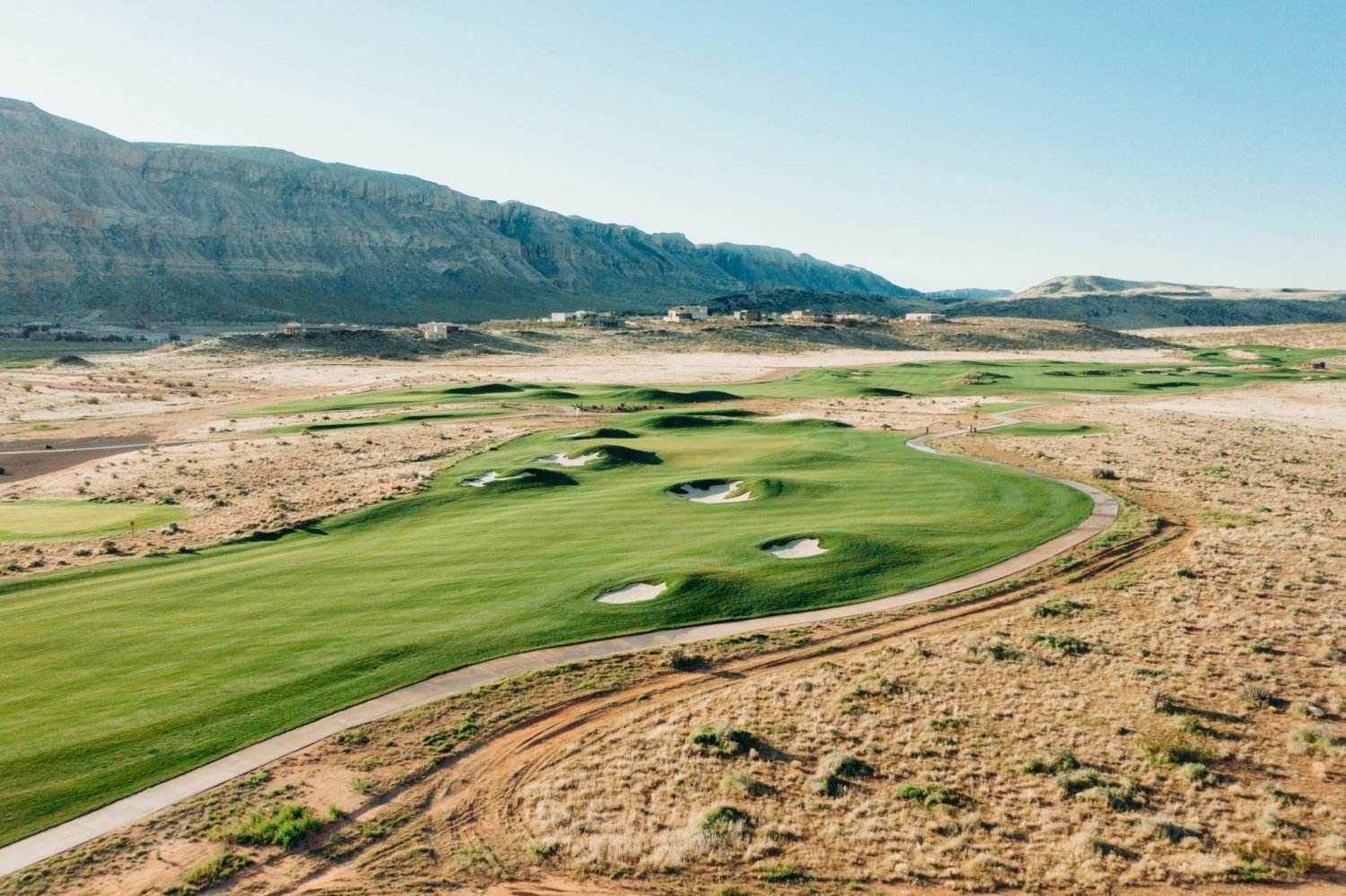
New school and happily so, Copper Rock arrived in 2020 as the fresh face of the St. George corridor, a Dale Beddo design spread across copper coloured dunes on the opposite shore of Sand Hollow Reservoir from its famous neighbour. Sand Hollow owns the cliff. Copper Rock owns the long view, with the Hurricane Cliffs walling off the east, the Pine Valley Mountains rising to the north and open dune country rolling away with hardly a house in sight. It feels wilder and emptier than the resort courses around it, and locals have voted it the best course in Southern Utah four years running.
The professionals arrived almost as quickly as the locals did. The Epson Tour, the developmental circuit of the LPGA, brought the Copper Rock Championship here in 2021 and has made it a fixture, which tells any reader what the card below confirms. From the back Copper tees this is a 7,283 yard par 72 test rated 75.8 with a slope of 146, numbers that belong to a serious championship venue. Every hole carries a name on the club scorecard, from Cottonwood at the 1st to Duck Soup at the 18th, and the routing saves its drama for a back nine full of elevation and nerve.
Space defines the playing experience. The dunes roll in long wavelengths rather than the chopped up contours of manufactured desert golf, so the course breathes through wide corridors and big skies, with green sites sitting down in the natural low spots. Beddo kept native sagebrush and grasses as the rough, which keeps the visuals in bands of copper, silver and green, and the elevation changes arrive as climbs and plunges rather than steps. It is a walker landscape served by carts, a modern championship course that feels older than its 2020 birthday because the land was allowed to lead. Even the scorecard leans into the personality, with every hole named, from Cottonwood and Coyote Call on the front to SkyDive and Duck Soup at the finish.
The Scorecard
The card below comes from the scorecard of the club itself, the October 2026 card published at the club site, with Copper tees going out in 3,691 and home in 3,592 for 7,283 yards at par 72, and the hole figures sum exactly to the printed nines. The rating and slope, 75.8 and 146, are printed on the card itself for the Copper set and match the published course directory of the Utah Golf Association, two solid sources in agreement. Older listings in circulation carry shorter totals of 6,823 and 6,901 yards, and a 7,227 headline elsewhere. The current card of the club governs, and it is the card the Epson Tour venue plays from.
By the Numbers
From the scorecard below: Copper.
From the Copper it plays to a slope of 146, rating 75.8, steeper than about 83% of the 182 courses in our database with a published slope.
| Front nine | Par | Yards |
|---|---|---|
| Hole 1 | 5 | 528 |
| Hole 2 | 4 | 484 |
| Hole 3 | 4 | 344 |
| Hole 4 | 3 | 246 |
| Hole 5 | 5 | 607 |
| Hole 6 | 4 | 377 |
| Hole 7 | 3 | 215 |
| Hole 8 | 4 | 479 |
| Hole 9 | 4 | 411 |
| Total | 36 | 3,691 |
| Back nine | Par | Yards |
|---|---|---|
| Hole 10 | 4 | 478 |
| Hole 11 | 4 | 413 |
| Hole 12 | 5 | 495 |
| Hole 13 | 4 | 510 |
| Hole 14 | 4 | 423 |
| Hole 15 | 3 | 149 |
| Hole 16 | 5 | 559 |
| Hole 17 | 3 | 135 |
| Hole 18 | 4 | 430 |
| Total | 36 | 3,592 |
Contrast shapes the two nines. The front goes out in 3,691 yards on the strength of the 607 yard 5th and a set of par 4s that includes the 484 yard 2nd, the No. 2 handicap hole of the card, while the back comes home in 3,592 with its length stacked at the 12th, 13th and 16th. The par 3s tell the variety story on their own, stretching to 246 yards at the 4th, the longest on the card, against 135 yards at the skydiving 17th. Four par 5s and four par 3s fill the card, and a double green waiting at the end of the home holes of both nines, the 9th and 18th, closes the show.
Green Fees
- LocationHurricane, Utah
- Par / Yardage72 / 7,283 yards (Copper)
Copper Rock books dynamically and publishes no fixed rate card, so no single figure tells the story. The Utah Golf Association course directory listed a $93 green fee for 2025, GolfLink puts its estimate at $160, and played accounts from Epson Tour weeks describe a premium desert rate. Those reference points do not agree, and that disagreement is the honest summary. Expect a strong season price in the low to mid hundreds, with real relief in summer heat and at twilight, and confirm the live figure in the club booking engine when setting the tee time.
The Story
Copper Rock opened in February 2020, the product of a Hurricane family with deep roots in the valley who spent years assembling the dune country along Copper Rock Parkway and brought in Dale Beddo to shape it. Restraint guided the design. Fairways were draped over the natural dunes, sagebrush and native grasses stayed in place between the holes, and greens use the contours the terrain already offered. The 5th green, which runs some 210 feet from front to back, announced the personality early, a huge target that still manages to be hard to hit in the right section.
Tournament golf began almost immediately. After the inaugural 2020 edition was lost to the pandemic shutdown, the Epson Tour Copper Rock Championship debuted in 2021 and has returned each spring, bringing the future of the LPGA to Hurricane and giving the young course a national television identity. The 9th and 18th share a double green divided by a pond, an old world flourish that has become the emblem of the property, and the surrounding development has grown up around the golf rather than over it. In six years Copper Rock has gone from local secret to the second headline act of the corridor.
That Epson Tour chapter deserves a closer look because it shaped the identity of the course. The Copper Rock Championship sits early on the tour calendar, when fields are full of players chasing LPGA cards, and the venue has earned a reputation among them as a fair but revealing test. The dunes and the wind sort the field without gimmicks, and the double green at the 9th and 18th gives the event a finish unlike any other on the schedule. For the host community the week is a point of pride, the moment each spring when the hometown course at Hurricane appears on national coverage, and for visiting golfers it is a guarantee of conditioning. A course maintained for a professional tour every spring keeps its standards all year.
Signature Holes
Hole 5 - Par 5, 607 yards
Sidewinder is the longest hole on the card at 607 yards, and it is home to the most talked about green on the course, a putting surface roughly 210 feet long and about 75 yards from front to back. A par 5 this size is a three shot puzzle in which layup position decides everything, because an approach from the wrong third of the hole leaves a putt measured in zip codes. The hole earns its name in the dunes, bending through the copper sand, and it is the hole visiting golfers describe first when they get home.
Hole 16 - Par 5, 559 yards
Bobcat Run opens the closing stretch, a 559 yard par 5 that tumbles through the most dramatic elevation on the back nine. The tee shot plays over a shoulder of dune, the second moves toward a green set in a natural amphitheatre of rock and sage, and the Hurricane Cliffs fill the background the whole way. Coming where it does, with the 135 yard drop shot 17th and the double green 18th behind it, the 16th is the last full swing of the round and the one that decides whether the finish becomes a victory lap or a salvage job.
Hole 17 - Par 3, 135 yards
SkyDive is the shortest hole on the course and its most photographed tee shot, a drop of a par 3 at just 135 yards from the Copper tees, plunging off the dune ridge to a green far below. The local rules of the club give the hole a drop area for lost balls, an admission of how the desert swallows anything wide, and the elevation makes club selection a guessing game the first time around. It is the purest fun on the card, thirty seconds of hang time and a green that looks closer than it plays. The drop is the whole design. From the elevated tee the shot is played almost entirely on trajectory, the ball falling out of the sky rather than running in, so the usual desert calculus of bounce and release disappears and a single question of carry replaces it. Into the afternoon wind the little hole can demand two clubs more than the morning version of itself, and the green, generous enough when found, is ringed by the kind of desert that swallows balls whole, which is why the drop area rule on the scorecard exists. It is the hole the Epson Tour field talks about, the one the cameras love, and the one any group will still be arguing about at dinner.
Practical Info
Copper Rock sits at 1567 W Copper Rock Pkwy in Hurricane, on the south side of the Sand Hollow area, about half an hour from St. George and an easy pairing with a Sand Hollow round for a two course day. It is fully public with the polish of a resort. Book through the club, take the earliest time available in summer, and build in time for the practice facility before the round. The community around the course offers vacation rentals for stay and play trips, and the clubhouse restaurant handles the post round hour with the cliffs in view.
Two notes serve first timers well. The elevation and the open dune country mean wind is a constant playing partner, especially in the afternoon, so a morning tee time is worth real strokes. The named holes on the card are worth reading before play begins, and the local rule for the drop area on the 17th, printed on the scorecard of the club, exists because the desert around that little green is hungry. Extra balls, sunscreen and a rangefinder for the elevation changes are the whole packing list.
If a trip allows only two rounds in the corridor, the pairing locals favour is Copper Rock with Sand Hollow. The two properties sit on opposite sides of the same reservoir country, fifteen minutes apart, and the contrast between the cliff at Sand Hollow and the dunes at Copper Rock is the whole southern Utah argument in miniature. Golfers arriving in Epson Tour week in spring can watch the championship and play the course in the same trip, a rare chance to compare lines with the professionals on consecutive days. Hurricane itself supplies the practical base, with lodging and dining that have grown up alongside the golf, and the larger scene at St. George a short drive west.
Staying over changes the experience for the better. Vacation rentals in the Copper Rock community put guests inside the dunes, close enough to watch the light change on the Hurricane Cliffs from a patio and to be on the first tee before the heat of the day builds, and the stay and play pattern suits this course particularly well because the back nine begs for a second playing once the hiding places of the dunes are known. The local verdict behind those four straight best course votes is really about completeness. Championship bones, a tour on the calendar, scenery that competes with the national parks up the road and a welcome that still feels hometown. New courses are not supposed to assemble all of that by age six.
Questions, Answered
What professional event does Copper Rock host?
The Copper Rock Championship on the Epson Tour, the LPGA's developmental tour, held here each spring since 2021 after the 2020 edition was cancelled in the pandemic. The field plays a forward setup of the same Dale Beddo layout this page cards from the Copper tees.
How much does it cost to play Copper Rock?
Pricing is dynamic with no published rate card. The Utah Golf Association directory listed $93 for 2025 while GolfLink estimates $160, so expect a season-dependent figure and confirm the live rate in the club's booking engine for your date.
What is the longest green story at Copper Rock?
The 5th hole, the 607-yard par 5 named Sidewinder, has a green about 210 feet long (roughly 75 yards), so a ball on the surface can still leave a putt of well over 100 feet. Position on the approach matters more here than raw distance.
Keep Exploring Utah
Read our Utah Golf Guide for more top courses, green fees, and trip planning across the state.
Copper Rock features in our ranking of the 15 Best Golf Courses in Utah.
More Utah course guides: Black Desert Resort, Sand Hollow (Championship Course), Soldier Hollow (Gold Course), The Ledges, Coral Canyon, Thanksgiving Point and Hobble Creek.