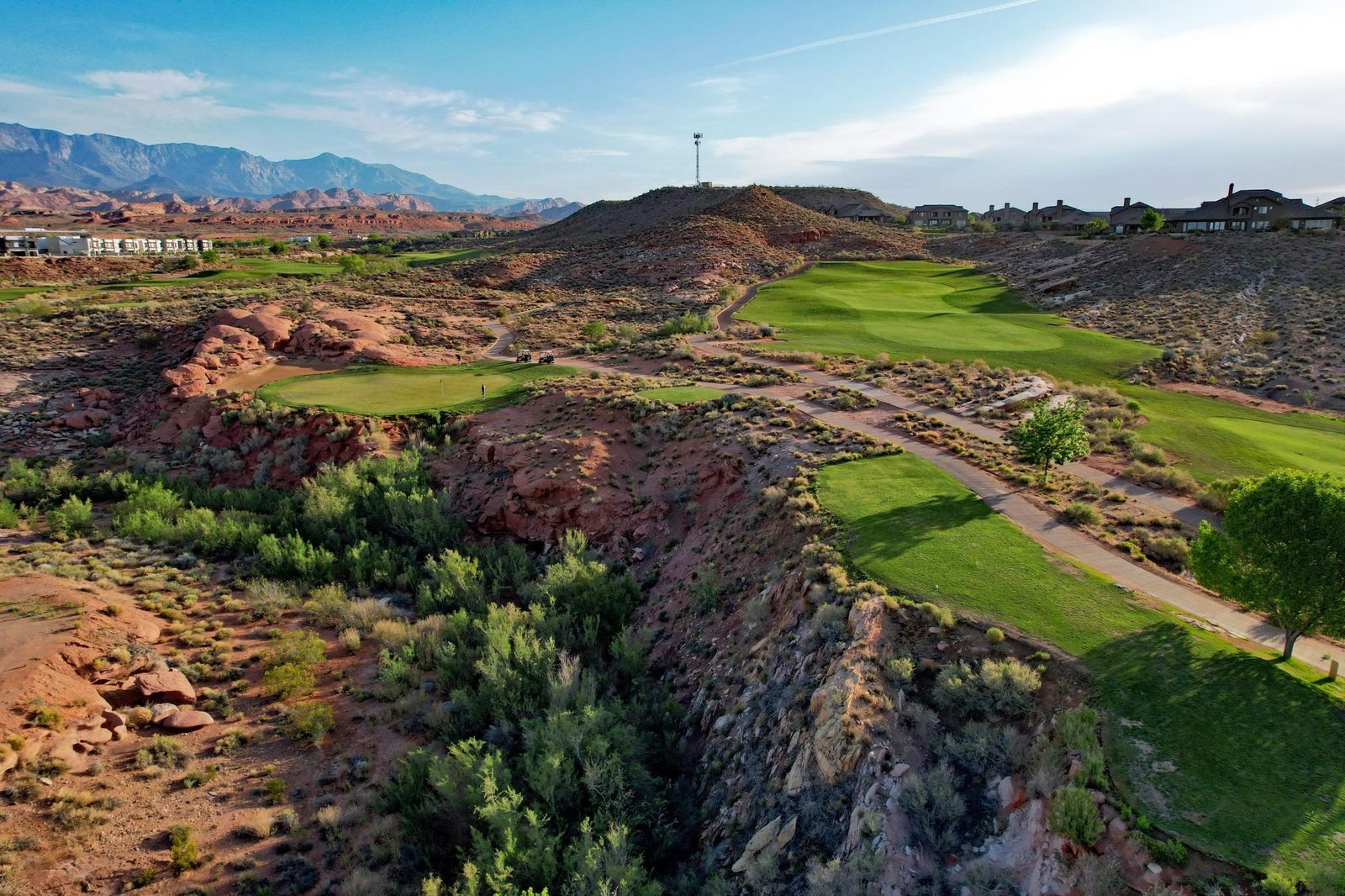
Gateway golf is the Coral Canyon job, a Keith Foster design in Washington, minutes off Interstate 15 at the exit where the road turns toward Zion National Park. Foster, one of the most respected traditionalists in American architecture, opened the course in 2000 inside a master planned community of coral coloured hills, and the golf carries the polish his name promises, with about 80 acres of turf threaded through desert washes, 55 bunkers, two lakes and long views to the Pine Valley Mountains and the cliffs of Zion country.
Golfers who know the course from older guides will find a surprise waiting. The current scorecard of the club, the 2025 card published in full below, renumbers the routing that older descriptions made famous, so the tiny par 3 that used to be the 6th now plays as the 15th at 114 yards, and the 6th is today a 496 yard par 4 carrying the No. 1 handicap. The golf itself is unchanged in character, a 7,146 yard par 72 from the Black tees that rewards positioning over power, but the card in the cart is the new one, and the card below follows it.
As a playing experience it fills a niche none of its neighbours quite occupies. It is more manicured than the desert tracks at Sand Hollow and Copper Rock, more strategic than a typical community course and gentler on the scorecard than the lava at Black Desert, while asking better questions than its friendly face suggests. The bunkering by Foster does the asking, with 55 traps placed to change decisions rather than decorate them, cross bunkers on the long holes that turn layups into commitments, and green side sand that guards the correct side of every green. Add the two lakes, the washes that cross the fairways at thinking distance and a near constant view of the coral hills that give the course its name, and the result is the most complete all round test in the corridor at a community course address.
The Scorecard
The card below is the 2025 scorecard of the club itself, published on the course tour page at the club site, with Black tees going out in 3,706 and home in 3,440 for 7,146 yards at par 72, and the hole figures sum exactly to the printed nines. Two disclosures matter. The routing on this card is renumbered against older published guides, as the 6th and 15th in the signature holes show, so hole by hole fragments from sources before 2025 describe the same golf under different numbers. The printed pair for the Black set is 75.2 and 148, while older published pairs for the back tees of the course, at 74.2 and 136 and at 73.5 and 142, conflict with it and with each other, so those older figures are left aside rather than guessed at.
By the Numbers
From the scorecard below: Black.
| Front nine | Par | Yards |
|---|---|---|
| Hole 1 | 4 | 458 |
| Hole 2 | 3 | 151 |
| Hole 3 | 4 | 438 |
| Hole 4 | 3 | 251 |
| Hole 5 | 5 | 615 |
| Hole 6 | 4 | 496 |
| Hole 7 | 5 | 525 |
| Hole 8 | 3 | 214 |
| Hole 9 | 5 | 558 |
| Total | 36 | 3,706 |
| Back nine | Par | Yards |
|---|---|---|
| Hole 10 | 4 | 520 |
| Hole 11 | 5 | 580 |
| Hole 12 | 3 | 177 |
| Hole 13 | 4 | 399 |
| Hole 14 | 4 | 386 |
| Hole 15 | 3 | 114 |
| Hole 16 | 5 | 524 |
| Hole 17 | 4 | 312 |
| Hole 18 | 4 | 428 |
| Total | 36 | 3,440 |
The front nine is the heavyweight at 3,706 yards, with three par 5s at 615, 525 and 558 and the No. 1 handicap 6th, while the back comes home in 3,440 with its interest spread differently, through the 580 yard 11th, the short 312 yard 17th and the 114 yard 15th tucked between two full length par 4s. Five par 5s on the card is one more than the classic four, and five par 3s keep the short game busy, from the 251 yard 4th down to the tiny 15th. It is an unusually varied card, which is exactly what the fans of Foster expect from him.
Green Fees
- LocationWashington, Utah
- Par / Yardage72 / 7,146 yards (Black)
Coral Canyon sells its tee times dynamically and publishes no fixed rate card, so no single figure is quoted. The $195 at GolfLink is a lone estimate rather than a published rate, and the booking channel of the club itself sets the real number by date, day and demand. Expect the usual St. George corridor pattern, with premium pricing in the spring and fall windows and genuine bargains in the summer heat and at twilight. Check the booking page of the club for the live figure for any round.
The Story
Coral Canyon opened in 2000 as the recreational heart of one of the largest master planned communities in Washington County, some 2,600 acres of coral sandstone hills between Washington and Hurricane. Keith Foster was a deliberate choice of architect, a designer known for classical restraint, firm surfaces and bunkering with real strategic intent, and he delivered a course that felt older than its years, with the layout sitting naturally in the washes and along the two lakes of the community at about 2,800 feet of elevation.
Early fame belonged to a single hole, the old 6th, a par 3 of barely 120 yards over a rock walled chasm that became one of the most photographed short holes in Utah and a fixture of state golf lore. The routing has since been renumbered on the modern scorecard of the club, and that famous little shot now plays as the 15th, but the hole itself still waits out there with its 114 yards of terror. Coral Canyon has matured into the steady local favourite of the corridor, with the Bistro 72 in the clubhouse feeding golfers and neighbours alike, while the championship card underneath the community golf remains a Foster test of 7,146 yards.
The presence of Foster in Washington County was itself a statement about the ambitions of the corridor at the turn of the century. He arrived as one of the most respected traditionalists in American golf, an architect sought after for classical new designs and for sensitive work on classic courses, in an era when the St. George boom was mostly hiring bigger names and louder styles. Coral Canyon got the quieter masterpiece instead, a course that trusted contour, angle and sand to make its interest, and that has rewarded the choice by aging gracefully while flashier contemporaries needed renovation. Growth in Washington County since then, among the fastest of any county in America through long stretches of the 2000s and 2020s, has filled the community around it, and the course has settled into its role as the hometown championship layout of the east side of the metro.
Signature Holes
Hole 6 - Par 4, 496 yards
On the current card the 6th is the hardest hole on the course, the No. 1 handicap and the longest par 4 at 496 yards. It is a full blooded two shotter across the desert washes, with the bunkering by Foster pinching the landing area and a green that asks the long approach to arrive on the correct tier. Golfers who remember the old routing should recalibrate before the round, because the hole wearing number 6 today is not a pitch over a chasm but the sternest examination on the front nine, and par is a genuinely good score.
Hole 15 - Par 3, 114 yards
The famous one wears a new number. The tiny par 3 that older Utah golf guides celebrated as the signature of Coral Canyon, a shot of barely 120 yards over rock and trouble, plays as the 15th on the 2025 card of the club, at 114 yards from the Black tees. Nothing about the shot has softened. It is a wedge or short iron to a small green with disaster on every side, the shortest hole on the course and the one nobody forgets. Yardage is not the test here. Nerve is.
Hole 5 - Par 5, 615 yards
The longest hole on the card is a 615 yard par 5 that gives the front nine its muscle. The 5th unfolds in three acts across the open ground of the community, with the layup position on the second shot deciding whether the approach is a birdie bid or a scramble, and the cross bunkering by Foster keeps all three shots honest. On a course celebrated for a 114 yard hole, the 615 yard 5th is the counterweight, proof that Coral Canyon tests the whole bag and not just the wedge game. The pleasures here are cumulative rather than dramatic, with a drive that must find the correct half of a wide fairway to open the layup, a second shot that has to be laid to a number rather than merely advanced, and an approach played to a green whose sections are separated by enough contour to turn a careless wedge into a three putt. None of it photographs like the 114 yard 15th, and all of it satisfies in the deeper way, the feeling of a hole completely solved by three good decisions in a row. On a course whose fame rests on a tiny par 3, the big par 5s are the counter argument for connoisseurs, and the 5th is the strongest of them.
Practical Info
Coral Canyon sits at 1925 N Canyon Greens Dr in Washington, a few minutes off I-15 at Exit 16, on the SR-9 corridor that runs from the interstate to Zion National Park, which makes it the natural first or last round of a southern Utah trip. The clubhouse runs the Bistro 72 restaurant, the practice facilities are full service, and the community setting means vacation rentals line some holes for stay and play trips. Book through the club, since the Washington and St. George courses fill together in the spring and fall windows.
Play it as the thinking round of the trip. The desert washes punish the stray ball less severely than the lava at Black Desert but more than the card suggests, and the 2,800 feet of elevation adds a few yards of carry that help most on the long par 5s of the front nine. Summer strategy follows the corridor standard of the earliest tee time, a cart, water and shade at the turn. If Zion is on the itinerary, the course sits close enough to pair a morning round with an afternoon in the park, the perfect southern Utah double.
A few practical graces deserve note. The card offers six tee sets running from the 7,146 yards of the Black tees down to a 4,676 yard Red set, with combination sets in between, so mixed groups can each play a sensible course, a genuine virtue in a community setting. The elevation, about 2,800 feet, is enough to add a touch of carry without the altitude calculations the mountain courses demand. The light at the end of the day is the local secret, as the coral hills west of the course catch the sunset and give the closing holes a glow that explains the name on the gate. Book the last tee times of a fall afternoon once and the reason Washington keeps this course for itself becomes clear.
Build a corridor itinerary around it and Coral Canyon plays the role of the thinking middle round. Open the trip at Sand Hollow for the cliff edge spectacle, give Coral Canyon the second day when the swing is grooved and the angles and bunkering by Foster will get the examination they deserve, and save Black Desert for the finale. The three courses sit within about forty minutes of each other, the driving between them is half the pleasure as the SR-9 corridor runs through some of the finest desert scenery in the Southwest, and the contrast in design languages, from the framing of Fought to the classicism of Foster to the lava modernism of Weiskopf, amounts to a short education in American golf architecture. Coral Canyon is the round of the three that golfers most often say they want to play again immediately, which is the highest compliment a course can earn.
Questions, Answered
Is the famous tiny par 3 at Coral Canyon still there?
Yes, but check the scorecard. The hole older guides call the 6th, at barely 120 yards over the rocks, plays as the 15th on the current 2025 card of the club, at 114 yards from the Black tees. The shot itself is unchanged, and the current 6th is a 496 yard par 4, the No. 1 handicap hole of the course.
How much does it cost to play Coral Canyon?
Rates are dynamic with no published card, and the $195 figure at GolfLink is an estimate and not a rate. Expect season dependent pricing typical of the St. George corridor and confirm the live figure in the booking channel of the club.
Which scorecard is shown for Coral Canyon?
The 2025 scorecard of the club itself, with Black tees at 7,146 yards and par 72. Older totals in circulation, at 7,029 and 7,200 yards, come from earlier cards and tee tables and do not match the current published card of the club.
Keep Exploring Utah
Read our Utah Golf Guide for more top courses, green fees, and trip planning across the state.
Coral Canyon features in our ranking of the 15 Best Golf Courses in Utah.
More Utah course guides: Black Desert Resort, Sand Hollow (Championship Course), Soldier Hollow (Gold Course), Copper Rock, The Ledges, Thanksgiving Point and Hobble Creek.