PGA West (Stadium Course)
Pete Dye's desert stadium at full theatrical throttle, with the island green Alcatraz 17th, a bunker named for the San Andreas Fault and a PGA Tour stage every January.
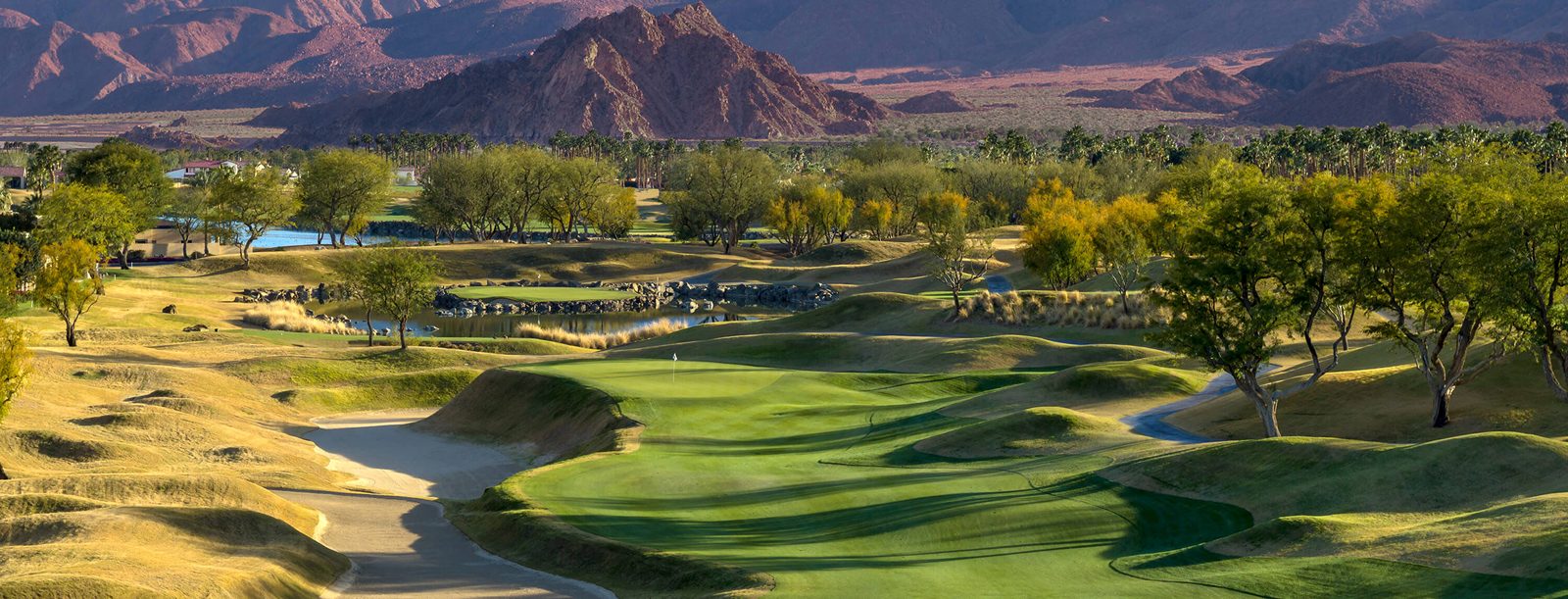
Beneath the Santa Rosa Mountains in the eastern Coachella Valley sits the most theatrical golf course Pete Dye ever built for public play. The Stadium Course at PGA West opened in 1986 as the centerpiece of a desert golf empire, ringed by spectator mounding in the stadium style Dye pioneered, and it was engineered from the first stake to test the best players alive. Every January it hosts The American Express on the PGA Tour, and the rest of the year it belongs to any golfer willing to book it. That is the marvel here, a Tour torture chamber with a public tee sheet.
Dye filled the desert floor with his full vocabulary. Railroad-tie bulkheads hold up greens above deep bunkers, water guards the finishing holes, and the ground moves in bold contours that reject timid shots. Two holes have entered the permanent lexicon of American golf. The 16th hides a bunker some 20 feet deep named for the San Andreas Fault, ready to swallow approaches, and the 17th, Alcatraz, is an island green modeled on Dye's famous 17th at TPC Sawgrass and ringed by rocks instead of bulkheads. Pick the right tees and it is a thrilling examination. Pick the wrong ones and it is a long and wonderful story.
The Scorecard
For the Stadium, the honest card is the longest one. The Black tee figures below are the ones published in the USGA-affiliated BlueGolf course database, and GolfPass's tee table repeats them hole for hole, down to the same 3,626 yards out and 3,674 home. That gives 7,300 yards and par 72, with a rating of 76.0 and a slope of 148 that both sources also share. Five more tee sets step the same examination down through 7,005 and 6,739 yards to the Silver tees at 4,084, which is the set most first time visitors will enjoy most.
By the Numbers
From the scorecard below: Black tees.
A slope of 148 from the Black tees, rating 76.0 puts it ahead of about 90% of the 182 courses in our database with a published slope.
| Front nine | Par | Yards |
|---|---|---|
| Hole 1 | 4 | 445 |
| Hole 2 | 4 | 371 |
| Hole 3 | 4 | 471 |
| Hole 4 | 3 | 192 |
| Hole 5 | 5 | 535 |
| Hole 6 | 3 | 255 |
| Hole 7 | 4 | 346 |
| Hole 8 | 5 | 559 |
| Hole 9 | 4 | 452 |
| Total | 36 | 3,626 |
| Back nine | Par | Yards |
|---|---|---|
| Hole 10 | 4 | 416 |
| Hole 11 | 5 | 617 |
| Hole 12 | 4 | 363 |
| Hole 13 | 3 | 214 |
| Hole 14 | 4 | 389 |
| Hole 15 | 4 | 468 |
| Hole 16 | 5 | 600 |
| Hole 17 | 3 | 168 |
| Hole 18 | 4 | 439 |
| Total | 36 | 3,674 |
Read the card's extremes and you have read Dye's intent. A 617-yard par 5 at the 11th and a 600-yard par 5 at the 16th, par 3s that stretch to 255 yards at the 6th, and then Alcatraz at just 168, the shortest full swing on the course carrying the largest consequence. The front nine is the longer warm up at 3,626 yards, while the back saves the water, the Fault and the island for the final hour, when legs and nerve are both spoken for. Few cards in golf are this deliberately sequenced.
Green Fees
- LocationLa Quinta, California
- Par / Yardage72 / 7,300 yards (Black tees)
PGA West sells the Stadium Course through a seasonal and date based tee sheet, so no static rate card holds for long. A tee time seller's seasonal table tops out at $215 in the December to April window, while Golf Digest and GolfLink both carry a $448 estimate for the same round. With the club pricing dynamically by season and day and the published figures that far apart, the live tee sheet for your date is the only reliable place to check.
The Story
PGA West began in the mid-1980s as an ambitious desert development in La Quinta, and its first and defining course was given to Pete Dye, then at the height of his powers after TPC Sawgrass and Harbour Town. Dye, working with his wife Alice's counsel as on so many of his projects, carved the Stadium Course out of flat desert in 1986, digging lakes and piling the excavated earth into the spectator mounds that give the course its name and its amphitheater feel.
The course announced itself immediately. Its original USGA course rating of 77.1 was the highest the association had ever issued at the time, and the Stadium hosted the Skins Game from 1986 to 1991, the Bob Hope Chrysler Classic rotation, and PGA Tour Qualifying School finals, where it earned a fearsome reputation among professionals. Lee Trevino aced Alcatraz during the 1987 Skins Game, winning a famous prize and sealing the hole's legend. After a spell away from the Bob Hope rota, reportedly at the pros' own request, the course returned to the tournament that is now The American Express in 2016 and has hosted it every year since.
In 2024, architect Tim Liddy, a longtime Dye protege, led a restoration that returned the putting surfaces and bunker complexes to their original dimensions and regrassed the greens in TifEagle bermuda, sharpening the 1986 examination for its modern Tour life. The Stadium remains the flagship of PGA West's nine courses, five of them open to resort and public play, and the one round every desert golf trip is measured against.
Signature Holes
Hole 16 - Par 5 - 600 yards
A 600-yard par 5 saves its terror for the final approach. The green sits elevated above one of the deepest bunkers in American golf, a pit named for the San Andreas Fault that drops some 20 feet below the putting surface. Shots that leak left tumble into it, and the recovery, played nearly straight up a wall of sand to a green you cannot see, is a rite of passage. The hole is the fullest expression of Dye's gift for making one feature dominate a golfer's thinking for three straight shots.
Hole 17 - Par 3 - 168 yards
Alcatraz needs no build up. The island green sits in a lake ringed by rocks, with nothing around the putting surface but water and a small fringe of safety, and at 168 yards from the back tees the shot is pure commitment. There is no bailout and no collection area, only the island or the lake. Dye modeled it on his 17th at TPC Sawgrass and named it for the prison island, and Lee Trevino's ace here in the 1987 Skins Game made it immortal. It arrives as the penultimate hole, exactly where a match is most fragile.
Hole 18 - Par 4 - 439 yards
The home hole runs along the lake that guards its entire left side, with the mountains framing the approach and the clubhouse waiting beyond the green. Water is in play on both shots. The drive must hold the fairway against the lake's pull on the eye, and the approach plays to a green tucked against the water's edge. It is a closer in the classic Stadium mold, demanding two full and committed swings after seventeen holes of Dye's questions, and it has decided its share of American Express Sundays.
Practical Info
The Stadium Course is at 56150 PGA Boulevard, La Quinta, CA 92253, inside the PGA West complex in the eastern Coachella Valley, about 30 minutes from Palm Springs International Airport. It is one of PGA West's resort courses, open to the public with advance booking strongly advised in the October to April season when desert golf demand peaks. The showpiece clubhouse holds Ernie's Bar and Grill, and the practice grounds are extensive, with the PGA West Golf Academy on site.
Choose your tees with real honesty. The Black set at 7,300 yards with a 148 slope is a professional examination, and the same architecture delights from the Blue tees at 6,739 or the White at 6,166. Summer brings serious desert heat along with the year's gentlest rates and emptiest tee sheets, a trade many golfers happily make with a dawn start. A desert trip pairs the Stadium naturally with PGA West's Nicklaus Tournament and Greg Norman courses on the same grounds, or with the Mountain and Dunes courses across the valley floor.
Questions, Answered
Why is the 17th hole called Alcatraz?
The name comes from the island it sits on. Pete Dye modeled the hole on his famous island green 17th at TPC Sawgrass, set the green on a rock-ringed island in a lake, and named it after the San Francisco Bay prison island. Lee Trevino made a hole-in-one there during the 1987 Skins Game.
How hard is the Stadium Course, really?
By the numbers, it is as hard as public golf gets, with 7,300 yards from the Black tees, a rating of 76.0 and a slope of 148. Its original 1986 rating of 77.1 was the highest the USGA had ever issued. From the forward tee sets the same holes play far more kindly, which is why tee selection matters here more than almost anywhere.
Can anyone book the Stadium Course?
Yes. The Stadium is one of PGA West's resort courses and sells public tee times through its seasonal tee sheet, alongside the Nicklaus Tournament, Greg Norman, Mountain and Dunes courses. Book well ahead in the winter season, when The American Express brings the Tour to the course each January.
Keep Exploring California
Read our California Golf Guide for more top courses, green fees, and trip planning across the state.
PGA West (Stadium Course) features in our ranking of the 20 Best Golf Courses in California.
More California course guides: Rustic Canyon, Pelican Hill (Ocean South), The Links at Spanish Bay, Poppy Hills, CordeValle, Poppy Ridge, Bayonet, Half Moon Bay (Ocean Course), TPC Harding Park, Yocha Dehe, Maderas, Aviara, Omni La Costa (North Course), Monarch Beach, Rams Hill, Pebble Beach Golf Links, Torrey Pines - South Course, Spyglass Hill and Pasatiempo.