Bayonet
A general's 1954 Fort Ord original reborn under Gene Bates, all bentgrass and cypress corridors on the Monterey Peninsula's toughest test.
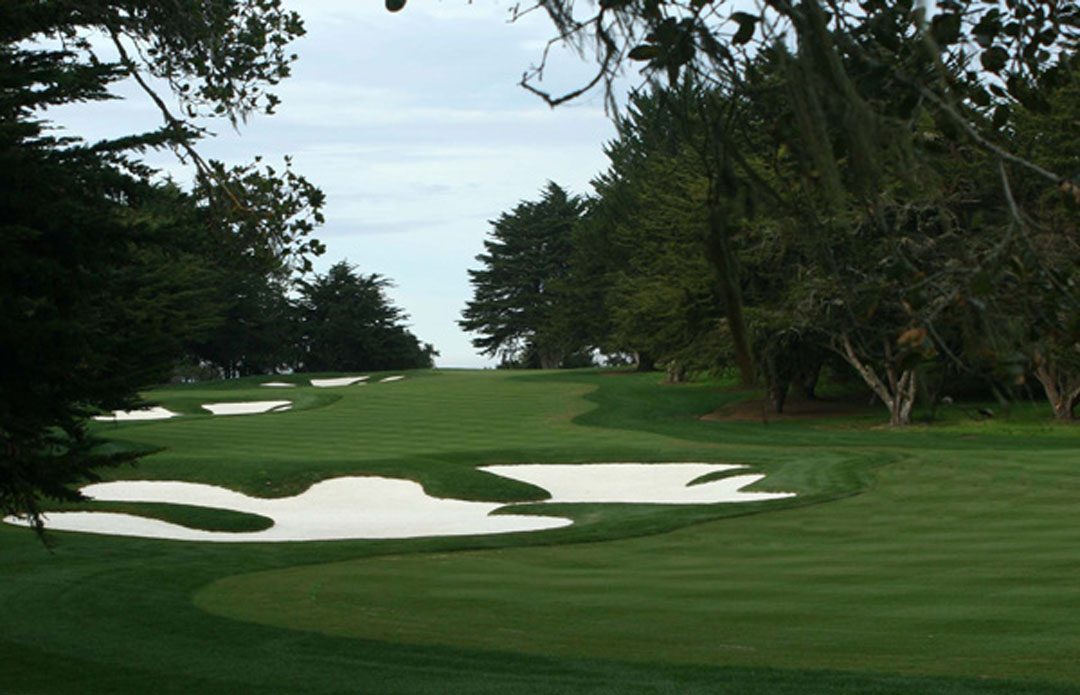
Most golf courses were built by architects. Bayonet was built by a commanding general. The course opened in 1954 on the grounds of Fort Ord, laid out under General Robert B. McClure and named for the 7th Infantry Division, the Bayonet Division, whose soldiers trained on this ground above Monterey Bay. The military bones still show in the best way. Straight, honest corridors run through Monterey cypress, oak and pine, greens sit guarded by deep bunkering, and the club itself states the reputation plainly. This is the most difficult test of golf on the Monterey Peninsula.
A second life lifts Bayonet well beyond a tough old Army course. Architect Gene Bates re-sculpted the layout in a renovation whose front nine debuted in May 2007, reordering holes, building a spectacular new ninth and replacing every blade of Kikuyu and poa annua with Jacklin T1 bentgrass from tee to green. The combination is rare. A 1954 routing now plays on a modern surface, at championship length from the Black tees, with expanded views of the bay that the original soldiers never got to enjoy.
The Scorecard
Read the Black tee card as a study in honest length. Nothing gimmicky, just 7,104 yards of par 72 where the par 4s keep arriving at 419, 436, 476 and 479 yards and the par 5s stretch to 613. The figures are the club's own, from the Bayonet course page, whose tee table rates this set at 74.8 with a slope of 139. Notice the architecture of the front nine, where the 613-yard eighth and the 476-yard ninth stack 1,089 yards back to back just before the turn.
By the Numbers
From the scorecard below: Black tees.
From the Black tees it plays to a slope of 139, rating 74.8, steeper than about 50% of the 182 courses in our database with a published slope.
| Front nine | Par | Yards |
|---|---|---|
| Hole 1 | 5 | 548 |
| Hole 2 | 4 | 436 |
| Hole 3 | 4 | 365 |
| Hole 4 | 3 | 201 |
| Hole 5 | 4 | 343 |
| Hole 6 | 3 | 221 |
| Hole 7 | 4 | 392 |
| Hole 8 | 5 | 613 |
| Hole 9 | 4 | 476 |
| Total | 36 | 3,595 |
| Back nine | Par | Yards |
|---|---|---|
| Hole 10 | 5 | 517 |
| Hole 11 | 4 | 387 |
| Hole 12 | 4 | 419 |
| Hole 13 | 4 | 479 |
| Hole 14 | 3 | 192 |
| Hole 15 | 4 | 370 |
| Hole 16 | 4 | 393 |
| Hole 17 | 3 | 225 |
| Hole 18 | 5 | 527 |
| Total | 36 | 3,509 |
The back nine opens with a friendly 517-yard par 5 and then tightens again, the 479-yard 13th standing as the longest par 4 on the card. Relief, such as it is, comes in the one-shotters, four par 3s between 192 and 225 yards, each a full swing and each exposed to the ocean breeze. The 527-yard home hole offers a genuine birdie chance to finish, provided the layup stays short of the fairway bunkers, a fittingly sporting end to the Peninsula's hardest public round.
Green Fees
- LocationSeaside, California
- Par / Yardage72 / 7,104 yards (Black tees)
Bayonet prices its tee times dynamically, and the club's own rates page says so outright. There is no single fixed green fee. The only fixed figures on that page are the junior rates, at 50 dollars walking and 75 dollars riding, plus a 5 dollar Youth on Course rate. Check the live tee sheet at bayonetblackhorse.com for the price of your day and hour.
The Story
Fort Ord was one of the great Army posts of the West, and its golf began as recreation for the troops stationed there. General McClure, the post commander and an avid golfer, drove the creation of the course in 1954 and christened it for the 7th Infantry Light Fighter Division. A second course, Black Horse, followed next door, and together the two gave Fort Ord 36 holes that generations of servicemen and women played between deployments.
Fort Ord closed in the 1990s and the courses passed into public hands, and Bayonet's championship ambitions grew with the change. PGA Tour Qualifying School stages have been held here, and the proudest scoring footnote hangs in the clubhouse record. Andres Gonzales shot 62 on November 17, 2010, during the second stage of PGA Tour Q-School, a number that still stands as the course record. The PGA Professional National Championship, the club professionals' national title, has twice chosen Bayonet, in 2012 and 2018.
The Bates renovation is the modern chapter. Par did not change on a single hole and the total length grew by only 16 yards, yet everything feels sharpened. Snow-white bunkering in a classic style, fairways and greens converted entirely to bentgrass, new drainage and irrigation across all 36 holes, and a new front-nine finish that pairs the 613-yard eighth with the new 476-yard ninth, a 1,089-yard one-two combination the club happily warns you about. Bayonet kept its famous bite and gained polish, which is precisely the trade every great old course hopes to make.
Signature Holes
Hole 9 - Par 4 - 476 yards
The renovation's showpiece closes the front nine, an uphill dogleg right where a cluster of transplanted cypress, oak and pine cuts off the right corner and a bunker pinches the fairway on the left. The approach is all carry, up the crest of the hillside to a broad green fronted by three staggered bunkers. The club calls it the hole that exemplifies Bayonet's challenge, and standing on the tee with the bay behind you, it is hard to argue.
Hole 8 - Par 5 - 613 yards
Shortened from 626 yards in the renovation and still the longest hole on the course, the eighth demands three solidly struck shots. Three well-placed fairway bunkers govern the layup, and the green runs more than 40 paces deep yet stays very narrow, so the same hole can play a full club differently from one pin to the next. It arrives immediately before the new ninth, and together they form the sternest consecutive examination on the Peninsula.
Hole 2 - Par 4 - 436 yards
The No. 1 handicap hole at Bayonet is a masterclass in restraint. Accuracy matters above all off the tee, the smart line favors the left side for the best angle in, and the second shot plays about half a club downhill to a green where anything struck long runs away and keeps running. It is the second hole of the day, which tells you everything about the examination Bayonet intends to give.
Practical Info
Bayonet and its sister course Black Horse sit in Seaside at the former Fort Ord, minutes from Monterey, Carmel and the rest of the Peninsula's famous golf, which makes the pair an appealing way to play 36 holes of serious golf in one place. Book through the club's site and expect bentgrass surfaces throughout, tree-lined corridors and a coastal breeze that can add a club or two by afternoon. The two courses share a pro shop, and the club is proud of its military heritage, so allow a few minutes for the memorabilia and the course-record plaque.
Fees move with demand, and juniors are genuinely welcomed at 50 dollars walking, 75 dollars riding and 5 dollars through Youth on Course. If your trip includes Pebble Beach down the road, Bayonet is the locals' answer to the same examination at a fraction of the ceremony, with championship length, a tour qualifying pedigree and the hardest-earned par on the Peninsula.
Questions, Answered
Why is the course called Bayonet?
General Robert B. McClure created the course in 1954 at Fort Ord and named it in honor of the 7th Infantry Division, nicknamed the Bayonet Division, which was associated with the post. The sister course next door is Black Horse, giving the facility 36 holes.
How hard is Bayonet, really?
The club itself calls Bayonet the most difficult test of golf on the Monterey Peninsula, and the Black tee numbers back that up at 7,104 yards with a 74.8 rating and a 139 slope. The course has hosted PGA Tour Qualifying School stages and the PGA Professional National Championship in 2012 and 2018. Yet the course record is a startling 62, shot by Andres Gonzales in 2010 Q-School.
What did the Gene Bates renovation change?
Bates re-sculpted the course without changing par on any hole. The front nine, which debuted in May 2007, plays in a new order and finishes with a brand-new 476-yard ninth. The longest par 5 was shortened from 626 to 613 yards, and all turf was converted to Jacklin T1 bentgrass with new drainage and irrigation.
Keep Exploring California
Read our California Golf Guide for more top courses, green fees, and trip planning across the state.
Bayonet features in our ranking of the 20 Best Golf Courses in California.
More California course guides: Rustic Canyon, PGA West (Stadium Course), Pelican Hill (Ocean South), The Links at Spanish Bay, Poppy Hills, CordeValle, Poppy Ridge, Half Moon Bay (Ocean Course), TPC Harding Park, Yocha Dehe, Maderas, Aviara, Omni La Costa (North Course), Monarch Beach, Rams Hill, Pebble Beach Golf Links, Torrey Pines - South Course, Spyglass Hill and Pasatiempo.