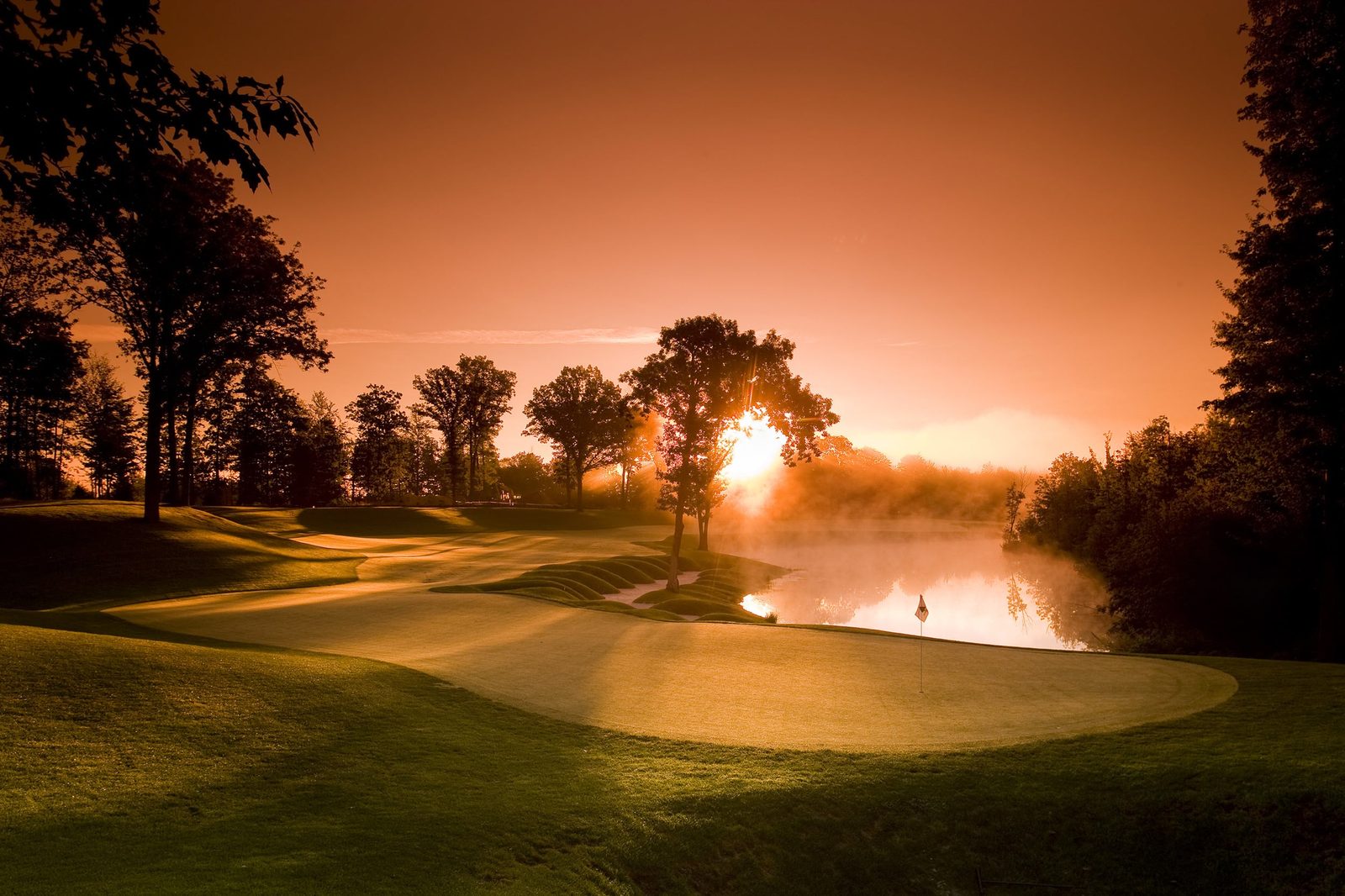
Tullymore is what happens when a golf architect with a sculptor's instincts gets 800 acres of central Michigan woods, meadows and wetlands and permission to be brave. Jim Engh's 2002 design is the most flamboyant course in this ranking. Fairways flow like ribbons between muscle-bound mounds, bunkers snake and swirl in shapes no other architect draws, and the scorecard breaks every convention, offering five par 3s and five par 5s in a par-72 routing. The front nine plays to par 35 with three of the par 3s, two of them back to back at the 4th and 5th, while the back nine plays to par 37 with three par 5s, so a round here changes rhythm every few holes in a way no other Michigan course attempts.
The acclaim arrived immediately and has never really left. Golf Digest ranked Tullymore on its 100 Greatest Public list for 18 years, debuting at No. 14 in 2003, and still places it among America's 70 best public courses and Michigan's finest. Yet for all the national attention, the experience stays intimate. The course moves through quiet wetlands and hardwood forest in the Canadian Lakes country near Stanwood, less than an hour from Grand Rapids, and most holes feel like private clearings discovered one at a time. From the Black tees below it measures 6,547 yards, with six sets of tees running from 4,668 to 7,250 yards, so the examination can be dialed from friendly to ferocious.
And then there are the greens, which Golf Digest's panelists describe with unusual unanimity. All 18 putting surfaces are completely different, boomerang, double-tiered, punchbowl, long and skinny in one panelist's summary, no two alike, with enough undulation that a change of pin position can change the character of a hole entirely. On a course where the fairways are generous and the scenery serene, the greens are where Tullymore keeps its teeth. They explain why good players speak of the place with respect while high handicappers speak of it with affection, a combination very few bold designs manage.
The Scorecard
The card below is the Black set from a published hole-by-hole played account of Tullymore, played in spring 2017 with all distances taken from the Black markers. It goes out in 3,039 at par 35 and comes home in 3,508 at par 37, for 6,547 yards at par 72, and the hole figures sum exactly to the account's printed Black total. The tee ladder around it is well documented, with Silver at 7,250, Blue at 6,210, White at 5,550 and Gold at 4,668 yards. No course rating or slope is printed for the Black set, because the Golf Association of Michigan publishes 71.2 and 142 for these tees while the played account prints 72.9 and 146, and with two solid sources in direct conflict the page omits both figures rather than choose between them.
By the Numbers
From the scorecard below: Black.
| Front nine | Par | Yards |
|---|---|---|
| Hole 1 | 5 | 535 |
| Hole 2 | 4 | 405 |
| Hole 3 | 4 | 313 |
| Hole 4 | 3 | 205 |
| Hole 5 | 3 | 182 |
| Hole 6 | 4 | 337 |
| Hole 7 | 3 | 186 |
| Hole 8 | 5 | 539 |
| Hole 9 | 4 | 337 |
| Total | 35 | 3,039 |
| Back nine | Par | Yards |
|---|---|---|
| Hole 10 | 4 | 414 |
| Hole 11 | 4 | 364 |
| Hole 12 | 3 | 183 |
| Hole 13 | 5 | 553 |
| Hole 14 | 4 | 404 |
| Hole 15 | 3 | 164 |
| Hole 16 | 5 | 560 |
| Hole 17 | 4 | 375 |
| Hole 18 | 5 | 491 |
| Total | 37 | 3,508 |
No card in this ranking is shaped like this one. The front nine's 35 is built from three par 3s arriving in a rush, the 205-yard 4th, the 182-yard 5th and the 186-yard 7th, with the 539-yard 8th as its only par 5. The back nine answers with three par 5s of 553, 560 and 491 yards stacked around the Dell-like 183-yard 12th and the short 164-yard 15th. The two nines differ by nearly 470 yards, 3,039 out and 3,508 home, and the longest par 4 on the card is only 414 yards, because Tullymore's length lives in its five par 5s and its defense lives in Engh's shaping. Choose the right set of tees and the card reads as an adventure. Choose wrong and it reads as a warning.
Green Fees
- LocationStanwood, Michigan
- Par / Yardage72 / 6,547 yards (Black)
Tullymore prices by date, season and stay-and-play package, so there is no single green fee to quote honestly. The published figures in circulation give the shape of it. Golf Digest lists $185 for the course and GolfLink estimates $195 with cart, and the resort's own packages, bundling golf with its on-site lodging and its sister course St. Ives, are usually the practical way to play for less than the rack rate. Confirm the live figure for your dates with the resort when you book.
The Story
Tullymore opened in 2002 as the second course of the Resorts of Tullymore and St. Ives, joining Jerry Matthews's St. Ives layout five miles away and giving the Canadian Lakes area a pair of nationally ranked courses at one resort address. Where St. Ives rides hilly, tree-lined ground, Tullymore took the flatter wetland country and turned its apparent limitations into a style. Engh's earthworks, his serpentine bunkering and his wild green shapes made the young course an instant conversation piece in American golf architecture, and the rankings followed, with Golf Digest's panel putting it straight onto the national public list.
Tournament golf found it too. Tullymore hosted the Tullymore Classic on the Symetra Tour, the LPGA's developmental circuit, bringing professional fields to Stanwood, and the resort has grown around the golf with the Inn at St. Ives, the Hideaway at Tullymore, cottages and the Lodge at Tullymore for groups. Two decades on, the course's identity is secure. It is the Michigan entry in every argument about bold modern design, a course golfers describe as a sculpture garden or as the most fun they have had being beaten by a golf course, and frequently both in the same sentence.
Signature Holes
Hole 3 - Par 4, 313 yards
Only Jim Engh would put a tree in the middle of a fairway and make it the best decision on the hole. The 3rd is a short par 4 of 313 yards whose fairway is split by a single standing tree, turning a routine drive into a genuine choice. Play left of it, play right of it, or try to fly the whole problem and hold the green. It is playful, photogenic and absolutely characteristic of Tullymore, a course that treats a short par 4 as an invitation to think rather than a breather between harder holes.
Hole 12 - Par 3, 183 yards
The 12th is Tullymore's most talked-about one-shotter, a long par 3 that golf writers have compared to the famous Dell Hole at Lahinch in Ireland for the way the green hides behind its mound, so the target is partly a matter of faith and yardage trust. At 183 yards from the Black tees, stretching to 257 from the Silver markers, it is a full shot played semi-blind to a green you cannot fully see. Links golf has celebrated that kind of hole for a century, and Engh planted one, delightfully, in the middle of Michigan.
Hole 18 - Par 5, 491 yards
The finisher is a par 5 of 491 yards that published accounts single out as one of the most photogenic holes in Michigan golf. The 18th is the third par 5 of the back nine and the fifth of the round, and at under 500 yards from the Black tees it dangles an eagle chance in front of every golfer who has kept the round together, with the resort spread beyond the green. Ending a five-and-five scorecard with a reachable par 5 is the most Tullymore decision imaginable. The last word belongs to possibility, not punishment.
Practical Info
Tullymore is at 11969 Tullymore Drive in Stanwood, in the Canadian Lakes area roughly 45 minutes north of Grand Rapids, with the Gerald R. Ford International Airport about 50 miles away. It is a resort course in the full sense. The Inn at St. Ives offers 36 rooms and suites, the Hideaway at Tullymore has 24 rooms, and cottages, condos and the ten-bedroom Lodge at Tullymore cover groups of every size. The Tap Room handles the post-round hours, the resort has even added a TopGolf Swing Suite for the evenings, and a tennis court and two new pickleball courts cover the non-golfers in the group. Book golf and lodging together where you can, because the packages are the value route.
The essential pairing is the sister course, Jerry Matthews's St. Ives, five miles away at the other end of Canadian Lakes. St. Ives is itself a nationally regarded design, and a Tullymore trip that plays both gets two genuinely different Michigan courses, Engh's wetland sculpture and Matthews's hill country, inside one resort stay. With six tee sets from 4,668 to 7,250 yards, the standing advice at Tullymore is to pick the set by honest driving distance rather than ego. The course's drama scales with the tees, and the Black set below at 6,547 yards is the sweet spot for most strong club golfers.
Questions, Answered
How much does it cost to play Tullymore?
The resort prices dynamically by date and package, so there is no fixed green fee. Published figures put a peak round in the $185 to $195 range, with Golf Digest listing $185 and GolfLink estimating $195 with cart, and stay-and-play packages with the resort's lodging and the St. Ives course usually work out better than the standalone rate.
Why does Tullymore have five par 3s and five par 5s?
Because Jim Engh designed it that way. The unconventional balance is the course's signature, with three par 3s on the par-35 front nine, including back-to-back one-shotters at the 4th and 5th, and three par 5s on the par-37 back nine. It gives the round a rhythm unlike any other course in Michigan and is a large part of why Tullymore has held a place on Golf Digest's 100 Greatest Public list for most of its life.
What other course can I play on a Tullymore trip?
St. Ives, the resort's sister course five miles away, a Jerry Matthews design through hillier, tree-lined ground with water on 11 holes. The two courses are sold together in resort packages and make one of Michigan's best two-course stays.
Keep Exploring Michigan
Read our Michigan Golf Guide for more top courses, green fees, and trip planning across the state.
Tullymore features in our ranking of the 20 Best Golf Courses in Michigan.
More Michigan course guides: Arcadia Bluffs (Bluffs Course), Marquette Golf Club (Greywalls), Forest Dunes (The Loop), Arcadia Bluffs (South Course), Forest Dunes (Weiskopf Course), Bay Harbor (Links/Quarry), Eagle Eye, American Dunes, University of Michigan Golf Course, Harbor Shores, Boyne Highlands (Arthur Hills), Hidden River Golf & Casting Club, Timber Stone (Pine Mountain) and Treetops (Smith Signature).