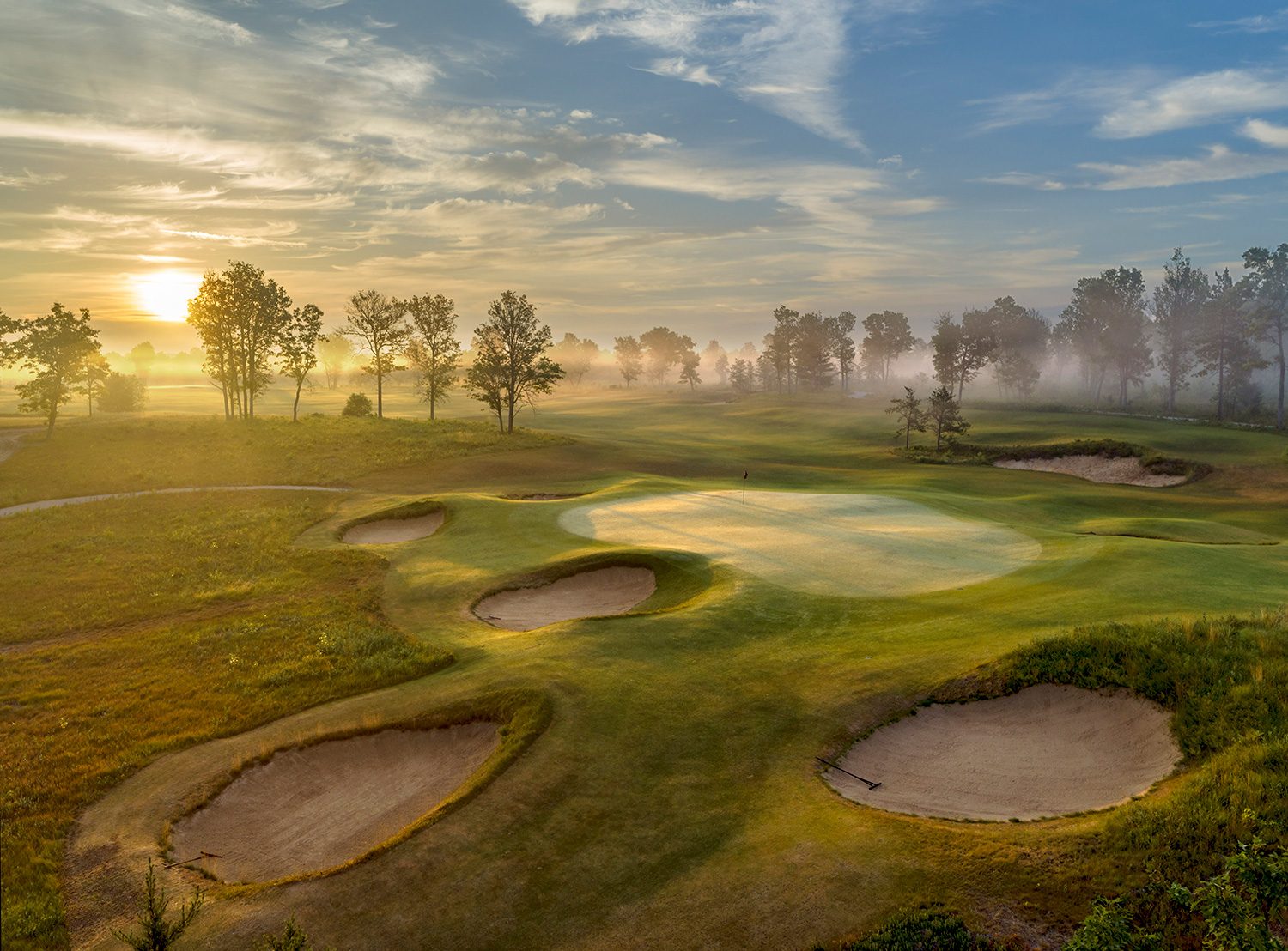
Ingenious ideas are common in golf. Fully built ones are not. The Loop is the rare case, a single 18-hole course at Forest Dunes in the Huron National Forest that plays in two directions. Tom Doak routed the Black course clockwise around the property one day, then sent the Red course counterclockwise over the same ground the next, alternating daily across the same fairways, the same bunkers and the same 18 greens. Every green had to work from two directions. Every bunker had to defend two holes at once. What emerged is two genuinely different Top 100 public courses sharing one piece of sandy, fescue-lined ground, and the result may be the most ingenious idea in modern American golf, executed completely.
The card below shows the Black routing, the clockwise course at 6,704 yards and par 70 from the back tees. Its front nine runs just 3,073 yards at par 34 and lulls a golfer nicely before a back nine of 3,631 yards does the heavy lifting. Golf Digest named The Loop its Best New Public Course when it opened in 2016, and GOLF Magazine called it the best new course in America you can play. Both directions have since been ranked among America's 100 greatest public courses at once, an unprecedented panel result. The correct trip plays both routings on consecutive days and argues about them all the way home.
Then comes the strangest pleasure of the place, watching recognition fail. Play the Black course on Tuesday and the Red on Wednesday and the same green, approached from the other side, reads as a stranger. Bunkers that threatened yesterday's drive guard today's approach. Slopes that fed the ball in now shed it away. Most golfers, as one course guide cheerfully warns, will have difficulty remembering how a given green played in the other direction the day before. That double life is why The Loop is no novelty. It is a landmark, the rare experiment that turned out to be a great course twice.
The Scorecard
The card below covers the Black routing only, the clockwise course played from the back tees. It heads out in 3,073 yards at par 34 and comes home in 3,631 yards at par 36, for 6,704 yards and par 70 in all. The Red routing covers the same ground counterclockwise the following day at about 6,805 yards. The two cards share greens and fairways, yet no hole plays the same way twice.
By the Numbers
From the scorecard below: Black (clockwise).
| Front nine | Par | Yards |
|---|---|---|
| Hole 1 | 4 | 469 |
| Hole 2 | 3 | 179 |
| Hole 3 | 4 | 438 |
| Hole 4 | 4 | 348 |
| Hole 5 | 3 | 187 |
| Hole 6 | 5 | 514 |
| Hole 7 | 4 | 308 |
| Hole 8 | 3 | 146 |
| Hole 9 | 4 | 484 |
| Total | 34 | 3,073 |
| Back nine | Par | Yards |
|---|---|---|
| Hole 10 | 5 | 613 |
| Hole 11 | 4 | 414 |
| Hole 12 | 4 | 381 |
| Hole 13 | 3 | 222 |
| Hole 14 | 4 | 489 |
| Hole 15 | 3 | 193 |
| Hole 16 | 4 | 428 |
| Hole 17 | 5 | 529 |
| Hole 18 | 4 | 362 |
| Total | 36 | 3,631 |
Two nines, two temperaments. The front side offers the round's scoring chances at par 34 and 3,073 yards, with three par 3s and only one par 5, and the 308-yard 7th and 146-yard 8th bunched together as an open invitation. The back side answers at par 36 and 3,631 yards, leaning on the 613-yard 10th, a par 5 again at the 17th and par 4s of 489, 428 and 414 yards that keep the driver and the long iron busy all the way home. Three par 5s, five par 3s and ten par 4s make par 70, and the same arithmetic dealt in reverse makes a different course tomorrow.
Green Fees
- LocationRoscommon, Michigan
- Par / Yardage70 / 6,704 yards (Black (clockwise))
Loop pricing moves with the season, so the rate shifts across the year rather than sitting on one fixed card. Summer fees in 2026 ran from $185 to $215 before cart fees, putting a peak season round in the same bracket as the resort's Weiskopf course and a shoulder season round below it. Check the current rate when you book. One rule shapes every trip. Play is reserved for guests staying at the resort, in the Lake AuSable Lodge, the cottages or the villas, so the round is booked as part of a stay.
The Story
Doak had carried the reversible idea for years. It nods to the Old Course at St Andrews, played in reverse for part of its history, and to the handful of early courses designed to run both ways. What the idea needed was the right client and the right land, and Forest Dunes supplied both. The Roscommon resort's Weiskopf course had already made the national lists, and beside it sat a flat, sandy, lightly treed parcel. Doak's Renaissance Golf Design team, with Brian Slawnik, Brian Schneider and Eric Iverson doing much of the shaping, finally got to build the experiment at full scale.
The Loop opened to limited play in 2016 and the acclaim arrived at once. Golf Digest named it Best New Public Course. GOLF Magazine named it Best New U.S. Course You Can Play. A permanent argument started in American golf about which direction plays better, and Golf Digest's panel eventually ranked Black and Red as separate entries in its 100 Greatest Public list. The resort has grown around the experiment since, adding the Bootlegger short course and the HillTop putting course, but The Loop remains the headline. A flat piece of Michigan sand, thought about hard enough, turned out to hold two masterpieces at once.
The two routings have lived genuinely separate competitive lives ever since. Golf Digest's panel rates the Black course the 11th best in Michigan and ranks both directions in its national public top 100, a first in the history of that list. The Top 100 Golf Courses ranking treats Black and Red as distinct courses, for exactly the reason Fergal O'Leary gave after walking both. In his words, these are two totally separate and unique courses sharing one footprint. Golfers split the same way. Some swear the clockwise Black is the sterner test, others insist the counterclockwise Red flows better, and the argument remains the resort's favorite dinner table sport.
Signature Holes
Hole 10 - Par 5, 613 yards
The Black routing turns for home with its longest hole, a 613-yard par 5 that opens a back nine built on an entirely grander scale than the front. Where the outward half offered birdie chances, the 10th demands three full and placed shots across the open fescue country. It also sets the tone for a closing stretch in which the Black course asks every question the Red course asked the day before, in reverse and at greater length.
Hole 1 - Par 4, 469 yards
No gentle handshake here. The Black course begins with a 469-yard par 4, a full opening statement across flat and firm ground, and the card offers nothing shorter until a full drive and a full approach are already in the books. The opener also teaches the essential Loop pleasure on the spot. The turf runs. Shots land short and release, and the ground game is not a nostalgia act here. It is simply the correct strategy.
Hole 8 - Par 3, 146 yards
The shortest hole on the Black card may be its most debated. The 8th plays just 146 yards, a flick of a par 3, yet the green slopes significantly away from the tee. Holding it asks for a shot judged to the yard and spun or landed with real delicacy. In the other direction this same green serves a different hole entirely, and that is the Loop in miniature. One surface, two examinations, and no agreement among golfers about which one is harder.
Two Courses in One Skin
The strangest strategic fact at The Loop is that memory only half helps. The Black routing runs clockwise at 6,704 yards and par 70, and the Red routing covers the same ground counterclockwise the following day at about 6,805 yards, over the same fairways, the same bunkers and the same 18 greens. Every green had to work from two directions. Every bunker had to defend two holes at once. Slopes that fed the ball in one day shed it away the next, and a green approached from the other side reads as a stranger. That double life turns course knowledge into a daily discipline rather than a souvenir from the previous round.
Within the Black card, the two nines carry opposite temperaments. The front offers the scoring chances at par 34 and just 3,073 yards, with three par 3s and only one par 5, and the 308 yard 7th and 146 yard 8th bunched together as an open invitation. The back answers at par 36 and 3,631 yards, opening with the 613 yard 10th and leaning on a par 5 again at the 17th plus par 4s of 489, 428 and 414 yards that keep the driver and the long iron busy all the way home. Three par 5s, five par 3s and ten par 4s make the par 70 total, and the same arithmetic dealt in reverse makes a different course tomorrow.
Even the shortest examination carries the reversible idea inside it. The 146 yard 8th plays as a flick of a par 3, yet the green slopes significantly away from the tee, so holding it asks for a shot judged to the yard and landed with real delicacy, and in the other direction that same surface serves a different hole entirely. The 469 yard 1st teaches the companion lesson at full length, that the turf runs, shots land short and release, and the ground game is simply the correct strategy on firm and fast fescue. The Loop rewards the golfer who reads the direction of the day and plays the ground in front of the flag. It punishes the golfer who replays yesterday out of habit.
Practical Info
Forest Dunes sits at 6376 Forest Dunes Drive outside Roscommon, in the Huron National Forest in Michigan's northern Lower Peninsula, reached from I-75 at Grayling. The Loop is reserved for guests staying at the resort, in the Lake AuSable Lodge, the golf cottages or the villas, and that makes planning simple. Book the stay, and the golf office will say which routing is in play on which day. Most Loop devotees book two days at minimum, one for each direction, then add the Weiskopf course and the Bootlegger short course to fill out the trip.
Doak designed The Loop for walking, and it remains an easy and flat walk. Carts have been permitted since 2019, and a professional caddie fleet operates at the resort. The turf is deliberately firm and fast, fescue-framed and nearly treeless, so the round changes character completely with the wind. Summer fees in 2026 ran from $185 to $215 before cart fees. The season runs from late spring into the fall, and the shoulder months offer the same two courses with more of the place to yourself.
The supporting cast around the main event is strong. The Bootlegger, a 10-hole short course by Keith Rhebb and Riley Johns of about 1,135 yards, is made for late-light second rounds. The HillTop putting course runs 18 holes over two acres of natural undulation tucked into the pines. A professional caddie fleet serves the resort, and on a course where every green must be understood from the direction of the day, paying an expert to read The Loop the first time through is money sensibly spent.
Questions, Answered
How does a reversible golf course work?
One set of 18 fairways and greens forms a single loop. On Black days play runs clockwise, and on Red days it runs counterclockwise, so every hole is approached from the opposite direction with different tee shots, angles and hazards. The direction alternates daily.
Which routing is shown for The Loop?
The Black routing, the clockwise course at 6,704 yards and par 70 from the back tees. The Red routing plays the same ground the other way at about 6,805 yards, and the two are ranked separately on national lists.
Can anyone book a tee time on The Loop?
Play on The Loop is reserved for guests staying at Forest Dunes, in the Lake AuSable Lodge, cottages or villas. The Weiskopf course at the same resort is the one open to outside visitors.
Keep Exploring Michigan
Read our Michigan Golf Guide for more top courses, green fees, and trip planning across the state.
Forest Dunes (The Loop) features in our ranking of the 20 Best Golf Courses in Michigan.
More Michigan course guides: Arcadia Bluffs (Bluffs Course), Marquette Golf Club (Greywalls), Arcadia Bluffs (South Course), Forest Dunes (Weiskopf Course), Bay Harbor (Links/Quarry), Eagle Eye, American Dunes, University of Michigan Golf Course, Tullymore, Harbor Shores, Boyne Highlands (Arthur Hills), Hidden River Golf & Casting Club, Timber Stone (Pine Mountain) and Treetops (Smith Signature).