Forest Dunes (Weiskopf Course)
Tom Weiskopf's original Forest Dunes runs forest and wetlands on the front nine and open duneland on the back, with a bonus 19th hole to settle bets.
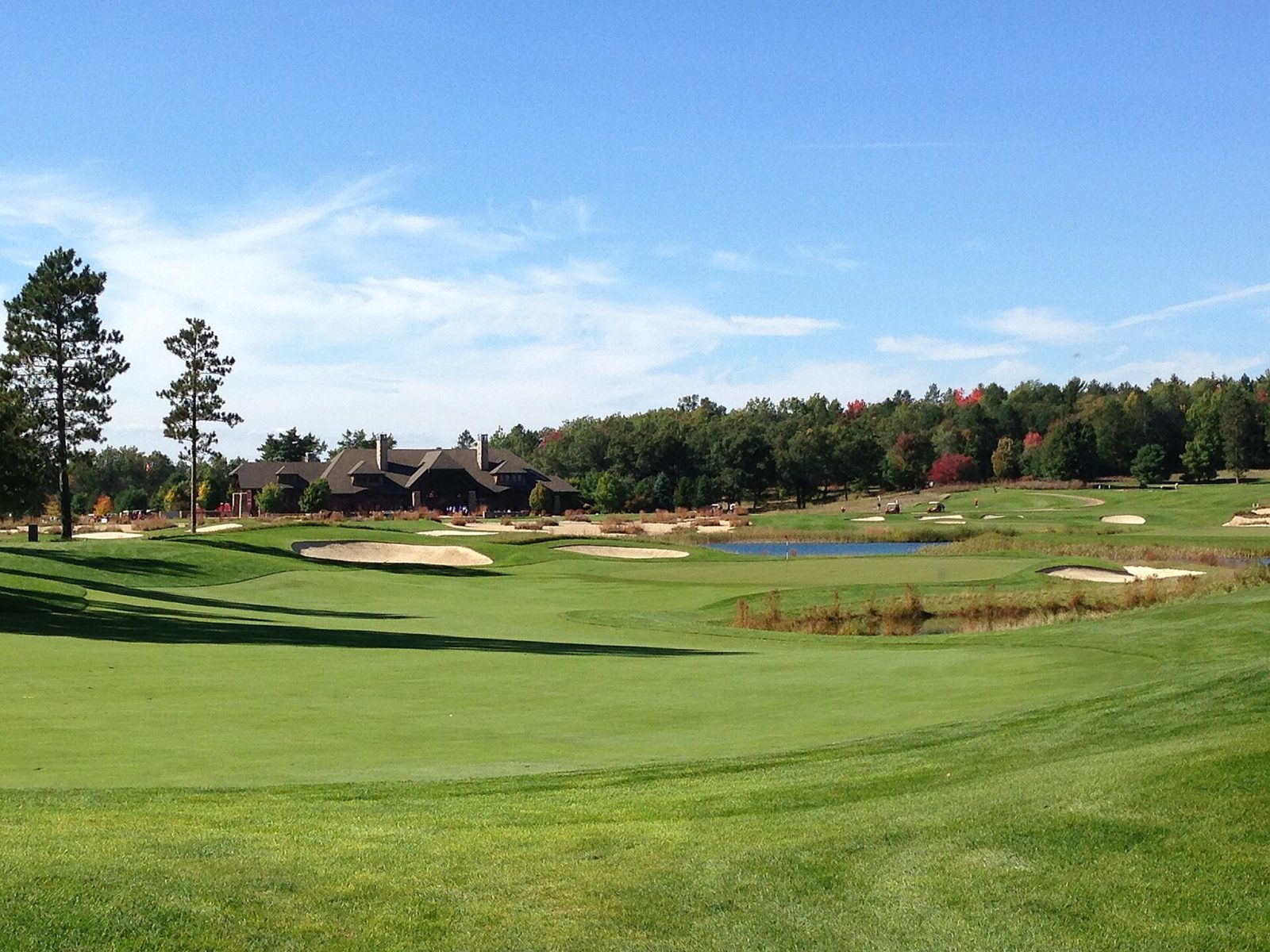
Before there was a Loop, there was this. Tom Weiskopf's original Forest Dunes course is a design of two personalities set in the Huron National Forest outside Roscommon. The front nine winds through tall forest and wetlands, holes with names like Lone Pine, Aspen and Table Top playing between the pines. Then the back nine bursts out into open duneland, where the wind arrives and the golf turns linksy and wide. It is a round that changes its mind halfway through, deliberately, and golfers have been making the pilgrimage up I-75 for it since 2002.
The card published here is the Combo II/III set at 6,330 yards and par 72, the blended tee combination the resort regulars favor, rated 71.3 with a slope of 135. The back tees, the I set, stretch to 7,116 yards for those who want the full examination. Golf Digest ranked Forest Dunes the Best New Course in the Country when it opened and has kept it in the top 25 of its public list ever since, with comparisons to Pine Valley and Augusta National that the conditioning, all bentgrass and white sand, works hard to deserve. And when the 18 are done, a bonus 19th bye hole waits by the clubhouse to settle whatever is left unsettled.
The conditioning is a large part of the legend. Forest Dunes is kept to a private-club standard, all crisp turf and white sand, with pristine playing surfaces set against roughly hewn bunkering and natural dunescapes, a contrast the national writers noticed from the first season. The 9th green sits in front of the clubhouse beside the lake, so the forest nine ends in a little amphitheater, and the home stretch crosses the open ground in full view of the terrace. It is a resort course that behaves like a members' club, and that members' club feel is exactly what keeps its tee sheet full.
The Scorecard
The card below is the Combo II/III set, the resort's blended tee combination. It goes out in 3,214 and comes home in 3,116, for 6,330 yards at par 72, and the hole figures sum exactly to the combo total the club publishes for the set. The full tee ladder runs I at 7,116 with a 75.2 rating and 146 slope, II at 6,550, the Combo at 6,330, III at 5,888 and IV at 4,993. From the combo tees the course rates 71.3 with a slope of 135, the pair two published accounts of combo-tee rounds agree on.
By the Numbers
From the scorecard below: Combo II/III.
Slope 135 from the Combo II/III, rating 71.3 - harder than about 29% of the 182 courses in our database with a published slope.
| Front nine | Par | Yards |
|---|---|---|
| Hole 1 | 4 | 375 |
| Hole 2 | 4 | 387 |
| Hole 3 | 3 | 178 |
| Hole 4 | 4 | 372 |
| Hole 5 | 5 | 521 |
| Hole 6 | 4 | 344 |
| Hole 7 | 5 | 499 |
| Hole 8 | 4 | 375 |
| Hole 9 | 3 | 163 |
| Total | 36 | 3,214 |
| Back nine | Par | Yards |
|---|---|---|
| Hole 10 | 4 | 360 |
| Hole 11 | 3 | 163 |
| Hole 12 | 4 | 371 |
| Hole 13 | 4 | 344 |
| Hole 14 | 4 | 375 |
| Hole 15 | 5 | 531 |
| Hole 16 | 3 | 198 |
| Hole 17 | 4 | 278 |
| Hole 18 | 5 | 496 |
| Total | 36 | 3,116 |
The combo card is a study in variety rather than length. Four par 5s are spread evenly, the 521-yard 5th and 499-yard 7th going out, the 531-yard 15th and 496-yard 18th coming home, and the par 3s run from the twin 163-yard shots at the 9th and 11th to the 198-yard 16th, named Hell's Acre in open homage to Pine Valley. The par 4s ask every question between the 278-yard temptation of the 17th and the 387-yard 2nd, and the two nines, 3,214 through the forest and 3,116 across the dunes, play like two courses that happen to share a clubhouse.
Green Fees
- 18 holes, peak season$215
- LocationRoscommon, Michigan
- Par / Yardage72 / 6,330 yards (Combo II/III)
Golf Digest and GolfLink both put the Forest Dunes green fee at $215. The resort prices seasonally in practice, with spring and fall play below the peak figure, and stay-and-play packages bundle the round with the Lake AuSable Lodge, cottages and villas. Unlike The Loop, the Weiskopf course is open to outside visitors as well as resort guests, which makes it the front door to one of America's great golf properties.
The Story
Forest Dunes was built on glacial deposits left by the Au Sable River, on 1,300 acres inside the Huron National Forest. The course was substantially complete by the turn of the century, but its financing collapsed before it ever opened, and the layout sat overgrowing for two years until one of the original investors, the Detroit Carpenters Pension Trust Fund, stepped in, restored the work and opened the course in 2002 with a founding membership of 56. Weiskopf, the 1973 Open champion turned architect, gave the project a design worthy of the rescue.
The honors arrived immediately. Golf Digest named it Best New Course in the Country for 2002, and the course has held a permanent place in the national top 100 public lists ever since, where it now sits in Golf Digest's top 30 alongside its own younger sibling. The Loop's arrival in 2016 made Forest Dunes one of only a handful of American resorts with three courses in the national top 50, and the Weiskopf original remains the anchor, the course that proved championship golf could hide in the northern Michigan pines and draw the whole country to find it.
The architect's own story runs through the design. Weiskopf, the 1973 Open champion, won a host of PGA Tour titles and a Senior major before turning to architecture, and his solo portfolio, Loch Lomond in Scotland, Troon Country Club in Scottsdale and The Ridge at Castle Pines North among it, is built on the same instincts Forest Dunes shows. Handsome, playable golf with one unforgettable short par 4 and greens that reward imagination over brute force. Players who know his other work will recognize the hand immediately. Players who do not are meeting one of the player-architect era's defining voices at his Michigan best.
Signature Holes
Hole 8 - Par 4, 375 yards
Forest's Edge, the hole in this page's photograph, is where the front nine steps out of the trees. At 375 yards from the combo tees the drive is open, but the hole turns at the corner and the approach opens onto water waiting to the right of the green, so the pushed second shot finds a wet finish. It is the hinge of the front nine, parkland shade giving way to light and hazard, and the most photographed hole on the course for good reason.
Hole 17 - Par 4, 278 yards
Wild Dunes is Tom Weiskopf's signature statement, the drivable short par 4 he built into nearly every great course he designed. At 278 yards the green can be reached with one bold swing, but sand guards every route and the putting surface sits elevated, turning the greedy play into a genuine wager and the pitch from beside the green into a delicate business. Birdies and doubles live side by side here, two holes from home.
Hole 18 - Par 5, 496 yards
Eagle Chance earns its name. The home hole is a 496-yard par 5, reachable in two for the golfer who avoids the fairway bunkers, but water juts in front of the green and down its left side while a bunker guards the right, so the second shot is a real commitment rather than a formality. It finishes the duneland nine in front of the clubhouse with a genuine eagle opportunity on the card, and the 19th bye hole, a 117-yard par 3 over the lake with a bunker in the middle of its green, waits to settle any match still alive.
Practical Info
Forest Dunes stands at 6376 Forest Dunes Drive outside Roscommon, in the Huron National Forest, reached from I-75 at Grayling. A word of local wisdom passed along by more than one visiting account is to follow the resort's own directions for the final miles rather than trusting a GPS into the forest roads. The Weiskopf course is open to outside visitors on weekdays and weekends through the season, roughly late April to October, with advance booking the rule, and Golf Digest and GolfLink both list the green fee at $215.
The full Forest Dunes day is a small festival of golf. The Weiskopf 18, the bonus 19th bye hole by the clubhouse, the HillTop putting course and the Bootlegger short course all wait on site, with The Loop reserved for guests staying in the Lake AuSable Lodge, cottages or villas. Practice facilities are comprehensive, caddies are available through the resort's professional fleet, and the clubhouse sits over the 9th green and the lake. Stay on property if you can. The forest quiet at the end of the day is part of the design.
The practice ground is a full resort operation with a range of some 60 stations, putting greens and short-game areas, and the clubhouse restaurant overlooks the 9th green and the lake for the post-round hour. Riding carts are the norm, walking is permitted, and the course's five tee sets, from the 7,116-yard I tees down to the 4,993-yard IVs, mean a mixed-ability group can each find an honest game. Book the Weiskopf course as the anchor of the trip and treat The Loop lodge-guest rule as the reason to stay the second night.
Questions, Answered
What is the 19th hole at Forest Dunes?
A bonus bye hole beside the clubhouse, a par 3 of about 117 yards played over the lake to a green with a bunker in its middle. It exists to settle matches and wagers that survive the 18th, and it is one of the most beloved extra holes in American golf.
Which scorecard is shown for the Weiskopf course?
The Combo II/III set at 6,330 yards and par 72, rated 71.3 with a slope of 135, with holes summing exactly to the published combo total. The back tees, the I set, measure 7,116 yards at 75.2 and 146.
How much does it cost to play Forest Dunes?
Golf Digest and GolfLink both list the green fee at $215. The resort prices seasonally, with shoulder-season play below the peak figure and stay-and-play packages bundling golf with lodging.
Keep Exploring Michigan
Read our Michigan Golf Guide for more top courses, green fees, and trip planning across the state.
Forest Dunes (Weiskopf Course) features in our ranking of the 20 Best Golf Courses in Michigan.
More Michigan course guides: Arcadia Bluffs (Bluffs Course), Marquette Golf Club (Greywalls), Forest Dunes (The Loop), Arcadia Bluffs (South Course), Bay Harbor (Links/Quarry), Eagle Eye, American Dunes, University of Michigan Golf Course, Tullymore, Harbor Shores, Boyne Highlands (Arthur Hills), Hidden River Golf & Casting Club, Timber Stone (Pine Mountain) and Treetops (Smith Signature).
Photos: Benscripps (CC BY-SA 4.0, via Wikimedia Commons)
