Troy Burne Golf Club
A stadium links in the St. Croix Valley with 120 bunkers, a wandering burne and a championship test anyone can book.
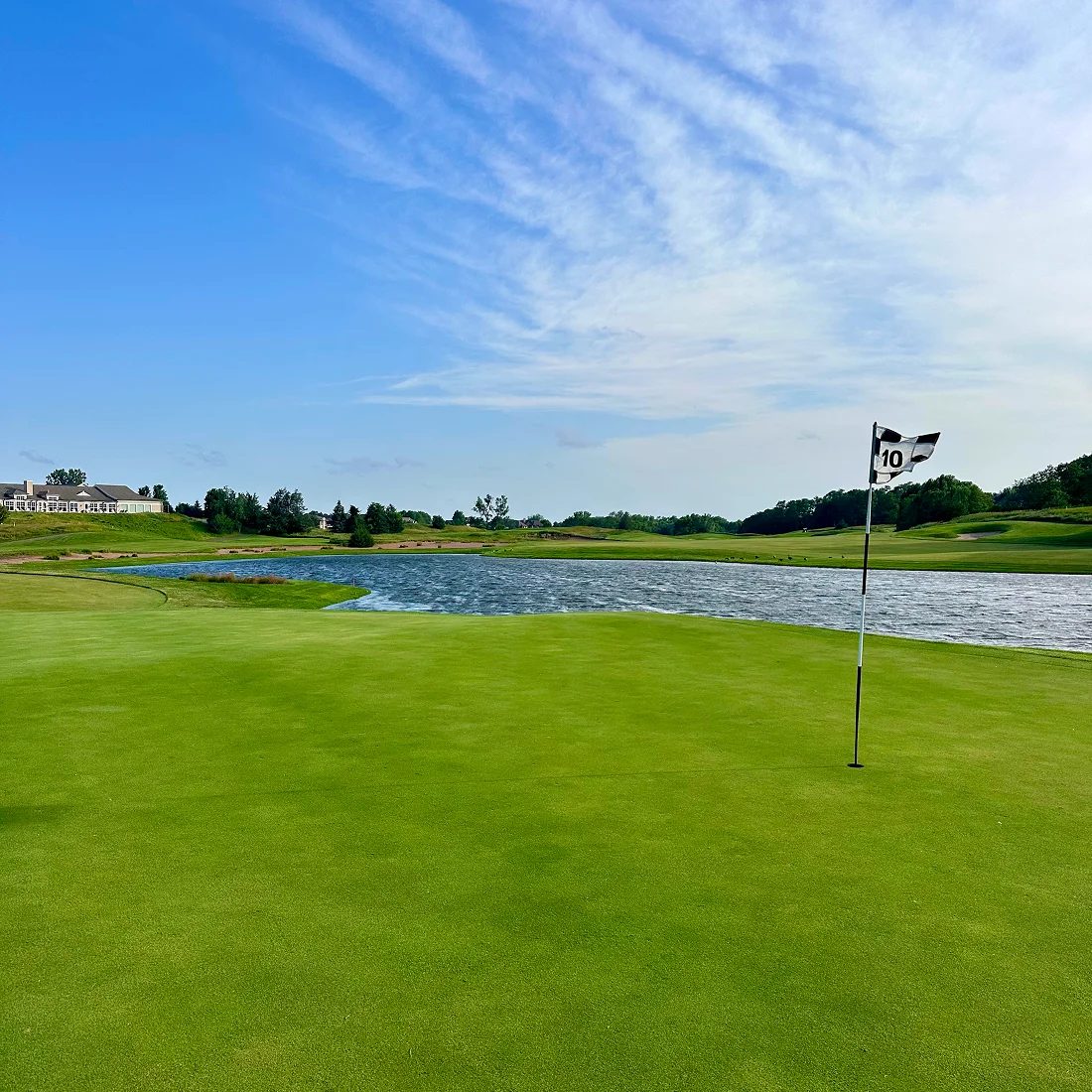
Thirty minutes east of the Twin Cities, in the rolling hills above the St. Croix River, sits the best public course in western Wisconsin. Troy Burne opened in June 1999 as a collaboration between Tom Lehman, the 1996 Open champion, and the design firm of Michael Hurdzan and Dana Fry. The name does double duty. Troy is the township the course stands in, and Burne is the Scots word for a creek, a nod to the water that winds through the property and comes into play on eight holes.
What they built is a stadium links of a kind the Upper Midwest rarely attempts. More than 120 bunkers were hewn from the native sand beneath the site, the bent grass fairways run generous, the stadium greens are big and strongly sloped, and amber prairie grasses wave across the hillsides. Golf Digest kept Troy Burne on its list of America's 100 Greatest Public Courses from 2017 through 2020 and nominated it for Best New Public Course when it opened. It stands at No. 15 on this site's Wisconsin ranking, and for Twin Cities golfers it pulls off a rare double. The test is genuinely championship grade, yet booking it is a simple daily fee transaction.
The Scorecard
The card below is the Lehman tee card, the championship setup. Published totals for these tees vary slightly by source and season, running from 6,978 to 7,034 yards. The card shown here is the club's tee sheet card as carried by its booking platform, and it sums exactly. Four more tee sets scale the same examination down to every level of golfer, ending at the 4,932 yard front tees.
By the Numbers
From the scorecard below: Lehman tees.
A slope of 136 from the Lehman tees, rating 74.3 puts it ahead of about 34% of the 182 courses in our database with a published slope.
| Front nine | Par | Yards |
|---|---|---|
| Hole 1 | 5 | 590 |
| Hole 2 | 4 | 444 |
| Hole 3 | 3 | 173 |
| Hole 4 | 4 | 342 |
| Hole 5 | 5 | 582 |
| Hole 6 | 4 | 364 |
| Hole 7 | 4 | 391 |
| Hole 8 | 3 | 222 |
| Hole 9 | 4 | 488 |
| Total | 36 | 3,596 |
| Back nine | Par | Yards |
|---|---|---|
| Hole 10 | 4 | 413 |
| Hole 11 | 3 | 176 |
| Hole 12 | 5 | 491 |
| Hole 13 | 3 | 195 |
| Hole 14 | 4 | 458 |
| Hole 15 | 3 | 140 |
| Hole 16 | 5 | 608 |
| Hole 17 | 4 | 434 |
| Hole 18 | 4 | 467 |
| Total | 35 | 3,382 |
Par 71 with five par 3s is the first clue that Troy Burne ignores the standard template. The distribution is the second. The front nine carries two big par 5s, while the back nine hides its length in the 608 yard 16th and a pair of par 4s beyond 450 yards. The short par 4 4th, at 342 yards, is the one place the course offers a genuine gamble off the tee.
Green Fees
- 18 holes, every day, walking$115
- 18 holes, every day, riding$140
- Senior rate, Monday to Thursday, cart included$105
- Twilight after 3 p.m., riding$110
- 9 holes, walking$65
- 9 holes, riding$77
- LocationHudson, Wisconsin
- Par / Yardage71 / 6,978 yards (Lehman tees)
These rates come from the club's published rate sheet, as carried on its golf trail listing, and GolfLink and Golf Digest both back up the headline figure by listing the riding round at $140. Every green fee includes complimentary range balls. The club also sells season passes, the Lehman Pass and a Player's Card, but the daily fee above is the number a visitor should plan around.
The Story
The course began with developer Glenn Rehbein, who first saw the rural Town of Troy site in western Wisconsin in 1996 and pictured the premier upscale daily fee club in the Upper Midwest. Lehman was a Minnesota native fresh off his Open Championship win at Royal Lytham and St Annes, and he was retained alongside Hurdzan and Fry, the era's leading environmental design firm. His brief asked for a course that stayed fair while still challenging, one that tested players of all levels and rewarded good shot making. Hurdzan and Fry then shaped that brief to the native topography of the St. Croix Valley.
Troy Burne opened for play in June 1999, sculpted from rolling valley hills. The front nine runs over big open ridges covered in native grasses, while the back nine drops into a quiet hollow ringed by oak, maple, birch and pine. Nearly half of the 120 plus bunkers guard the greens, and the meandering burn crosses or skirts eight holes. A championship resume arrived quickly. The course hosted USGA qualifying and a short-lived Nationwide Tour stop, and Golf Digest's Best New nomination put it on the national map in its first seasons.
The club has stayed a daily fee facility with limited season passes, anchored by a 10,110 square foot clubhouse in traditional Shaker style and the Aisling event center, added on the property in 2023. It was listed for sale in late 2021 at $7.5 million, the highest asking price its broker had seen for a Wisconsin course. That number said something about what a top tier public course thirty minutes from a major metro had become worth. Through every change in the business around it, the golf has remained the point, a Lehman era championship layout open to anyone with a tee time.
Signature Holes
Hole 5 - Par 5 - 582 yards
The hardest hole on the course by the card, and the front nine makes its statement here. At 582 yards from the Lehman tees this par 5 is a true three shot hole for almost everyone, played through the open, grass covered ridge country of the front nine, with the burn waiting to punish a loose approach. The Troy Burne bargain shows itself early. There is generous room off the tee, then the precision demanded keeps rising the closer you get to the green.
Hole 15 - Par 3 - 140 yards
The shortest hole at Troy Burne and the easiest on the card by handicap, a brief exhale late in the round. Short does not mean free. Like every green here it is a stadium green, ringed by sand and shaped with enough slope that a careless first putt can wander a long way from the hole. Little par 3s like this one decide matches precisely because everyone standing on the tee expects to win it.
Hole 16 - Par 5 - 608 yards
The longest hole on the course, a 608 yard par 5 beginning the run home through the wooded hollow of the back nine. Two full shots still leave a real approach, and with water in play on the back nine's low ground, the second shot is a decision rather than a formality. Birdie here is earned the Lehman way, with three good shots in a row, and it can flip a round just as the finish tightens.
Practical Info
Troy Burne is at 295 Lindsay Road in Hudson, Wisconsin. The address says Hudson, the setting is the Town of Troy, and the drive runs roughly 30 minutes from St. Paul and under an hour from Minneapolis, traffic permitting. The everyday rate is $115 walking or $140 riding, with complimentary range balls either way. Seniors play for $105 with cart from Monday to Thursday, and twilight begins at 3 p.m. Tee times can be booked up to three weeks ahead for groups of up to twelve. With few trees on the open front nine, wind is a real factor here, and a morning tee time is the calmest and best conditioned slot of the day.
Budget your attention for the greens. They are large, strongly sloped stadium greens, and with nearly half the bunkering sitting greenside, an approach played to the correct section is worth more than one played merely close. The practice facility is a proper one, with a driving range and a short game area, and the instruction program under the club's PGA staff is well regarded for junior golfers. Staying for dinner at the clubhouse grill is an easy call. This club hosts the Minnesota Wild's preferred outing every September, and it runs a full day here, not just a round.
Questions, Answered
How much does it cost to play Troy Burne?
Eighteen holes costs $115 walking or $140 riding on the published everyday rate, and complimentary range balls are included. Seniors play from Monday to Thursday for $105 with cart included. Twilight after 3 p.m. runs $90 walking or $110 riding, and 9 holes are $65 walking or $77 riding when available.
Who designed Troy Burne, and what does the name mean?
Tom Lehman designed it with Michael Hurdzan and Dana Fry, and it opened in June 1999. The name joins Troy, the township the course stands in south of Hudson, with Burne, the Scots word for a creek, for the water that crosses the property and comes into play on eight holes.
Is Troy Burne walkable, and how far is it from the Twin Cities?
Yes, walking is welcomed and priced into the rate structure, though the rolling St. Croix Valley terrain and the distance between some tees make it a purposeful walk. The course is about 30 minutes east of St. Paul, just across the St. Croix River in Hudson, Wisconsin, which makes it one of the closest championship courses to the Twin Cities metro.
Keep Exploring Wisconsin
Read our Wisconsin Golf Guide for more top courses, green fees, and trip planning across the state.
Troy Burne Golf Club features in our ranking of the 15 Best Golf Courses in Wisconsin.
More Wisconsin course guides: Sand Valley, Mammoth Dunes, Sedge Valley at Sand Valley, Erin Hills, Geneva National Resort & Club (Palmer Course), Tuscumbia Country Club, Mascoutin Golf Club, Old Hickory Golf Club, The Golf Courses of Lawsonia (Links Course), Blackwolf Run (River Course), Blackwolf Run (Meadow Valleys Course), Whistling Straits (Irish Course), SentryWorld, University Ridge Golf Course, The Bull at Pinehurst Farms, Washington County Golf Course and Whistling Straits - Straits Course.