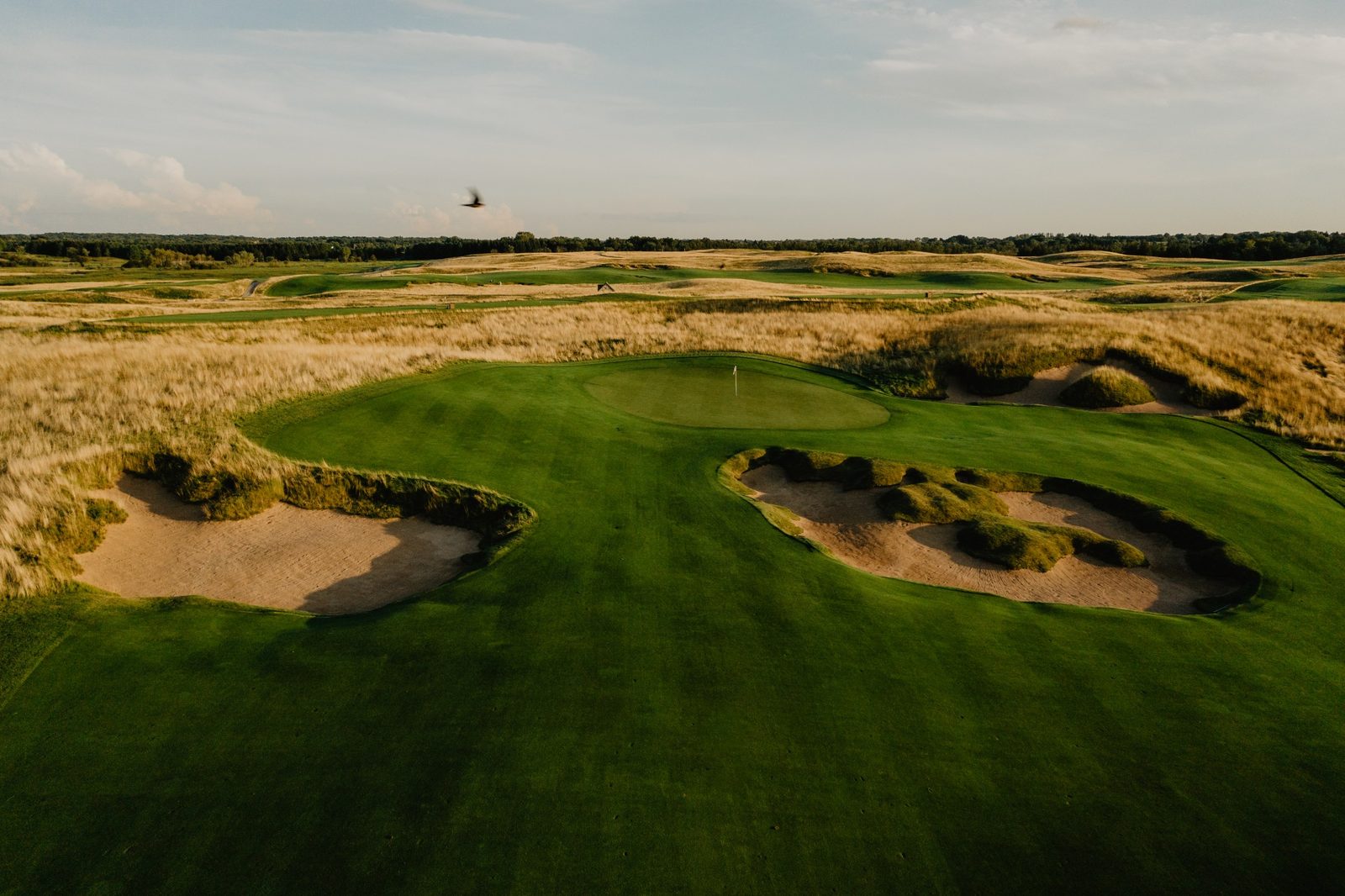
A U.S. Open course that anyone can book. That sentence alone earns Erin Hills its place in American golf. In the rolling Kettle Moraine country of Erin, Wisconsin, about 35 miles northwest of Milwaukee, glaciers left a landscape of kettle holes, ridges and tumbling fescue ground so naturally suited to golf that restraint became the architects' great achievement. The course opened in 2006 and has since hosted the 2017 U.S. Open, the 2011 U.S. Amateur and the 2025 U.S. Women's Open, and every one of those championships was played on ground anyone can reserve with a phone call. Its Wisconsin standing is No. 4, and Golf Digest ranks it the 10th best public course in America.
Everything about the presentation is championship pure. The course is walking only, with no cart paths and not a house in sight, just fine fescue fairways running over the glacial contours, rugged bunkering and greens set into the land as if they grew there. From the Black tees it stretches to 7,772 yards at a 78.1 rating, one of the sternest cards in public golf, yet forward tee sets bring the same architecture within everyone's reach. When the wind moves across the moraine, and it usually does, Erin Hills becomes the complete examination of power, patience and nerve on a walk through some of the prettiest inland ground in the game.
The Scorecard
The card below comes from the Black tees, transcribed from the club's own published scorecard at par 72 and 7,772 yards, split 3,795 out and 3,977 in, rated 78.1 with a 146 slope. It is among the longest and sternest scorecards in American public golf, and the back nine, with par 5s of 613 and 663 yards, is where the championship reputation is earned.
By the Numbers
From the scorecard below: Black tees.
From the Black tees it plays to a slope of 146, rating 78.1, steeper than about 83% of the 182 courses in our database with a published slope.
| Front nine | Par | Yards |
|---|---|---|
| Hole 1 | 5 | 552 |
| Hole 2 | 4 | 361 |
| Hole 3 | 4 | 476 |
| Hole 4 | 4 | 445 |
| Hole 5 | 4 | 462 |
| Hole 6 | 3 | 237 |
| Hole 7 | 5 | 607 |
| Hole 8 | 4 | 492 |
| Hole 9 | 3 | 163 |
| Total | 36 | 3,795 |
| Back nine | Par | Yards |
|---|---|---|
| Hole 10 | 4 | 504 |
| Hole 11 | 4 | 423 |
| Hole 12 | 4 | 464 |
| Hole 13 | 3 | 212 |
| Hole 14 | 5 | 613 |
| Hole 15 | 4 | 370 |
| Hole 16 | 3 | 247 |
| Hole 17 | 4 | 481 |
| Hole 18 | 5 | 663 |
| Total | 36 | 3,977 |
Study the card and the Kettle Moraine shows through it. The yardage breathes with the land, from the 163-yard 9th to the twin monsters at the 14th and 18th, and no two consecutive holes ask the same question twice. Almost nobody should play the Black tees, and the club's forward sets, down past 6,200 and 5,600 yards, preserve the architecture at a human scale. Choose the tee that allows a swing at the par 5s rather than mere survival, and Erin Hills gives the rarest thing in golf, a major championship walk at the pace of a visitor's own game.
Green Fees
- Peak season, May 28 - Sep 26, 2027$555
- Spring and fall, May 3 - 16 and Sep 27 - Oct 16, 2027$435
- Second round for overnight guests, spring and fall$220
- Juniors, pre-high school graduation$225
- LocationErin, Wisconsin
- Par / Yardage72 / 7,772 yards (Black tees)
Erin Hills publishes its rates directly, and the club's own rates page currently posts the 2027 rates at $555 at peak and $435 in the spring and fall bands, with active or retired 20-year military at $335 and a $220 second-round rate for overnight guests in the shoulder bands. The seasonal structure is corroborated by the two prior cycles, with Golf Monthly reporting $375 to $455 for 2025 and a GolfCourseGuide sampling in September 2026 putting the course at $395 to $495. Play is walking only, with no push or pull carts. A caddie costs a $65 service fee per player plus a suggested gratuity of $75 or more, and a forecaddie is $65 per group plus a suggested $35 per player.
The Story
Erin Hills is the life's work of Wisconsin developer Bob Lang, who bought the farmland in the Town of Erin and funded the course largely with his own money, determined to build a course worthy of a U.S. Open on land the glaciers had already designed. He hired Dr. Michael Hurdzan and Dana Fry, who brought in Golf Digest architecture editor Ron Whitten as a collaborator, and the team adopted a minimalist creed. Move almost no earth, let the kettle moraine contours route the holes, and keep the green sites as nature left them. The USGA's faith arrived astonishingly early, with the course awarded the 2008 U.S. Women's Amateur Public Links before it was ever seeded.
The course opened in 2006 and the championships followed in procession. The 2011 U.S. Amateur was won by Kelly Kraft, and then came the prize Lang had built for, the 2017 U.S. Open, the first ever played in Wisconsin and won by Brooks Koepka by four shots. The road was not smooth. Lang's changes to the layout in pursuit of the Open strained his finances and he sold the course in 2009 to Andrew Ziegler, whose stewardship brought a conditioning upgrade and, from 2010, a firm walking-only policy befitting a course with no paved cart paths. Early quirks were refined along the way, including the blind Dell hole, removed after 2008, whose place in the routing was taken by the beloved par-3 9th.
The USGA has since made Erin Hills a fixture of its championship calendar. Matthew McClean won the 2022 U.S. Mid-Amateur here, and in 2025 the U.S. Women's Open returned major championship golf to the moraine, with Sweden's Maja Stark winning at 7 under par. The club's own scorecard already prints the future, the U.S. Women's Amateur in 2033, the U.S. Amateur in 2035 and the U.S. Junior Amateur in 2039. For a public course barely two decades old, it is a staggering record, and the happiest part of it remains the simplest. The same 18 holes stay open to anyone who books a tee time.
Signature Holes
Hole 1 - Par 5 - 552 yards
Championship golf announces itself immediately. The opening hole is a par 5 of 552 yards from the Black tees, with a wetland guarding the left side and the final act played out in the last 60 yards, where the fairway flows into a green that juts toward the wetland. Golf Club Atlas's hole-by-hole study lingers on the set of bunkers sitting some 50 yards short of the green, which shape the second shot and the lay-up more than any hazards near the flag. Aim away from the visible green, trust the ground to feed the ball home, and the course's whole philosophy is taught on a single hole. A birdie chance and a bogey warning in one gorgeous opener.
Hole 9 - Par 3 - 163 yards
The shortest hole on the course carries its happiest history. The 9th is a downhill par 3 of 163 yards to a domed green surrounded by bunkers and natural amphitheater dunes, and it began life as the course's bye hole, a spare par 3 built to settle matches. When the blind Dell hole was removed after the 2008 season, the bye hole took its place as the 9th in 2009, and golfers, in architect Ron Whitten's telling, fell in love with it, a tee shot watched all the way down to the green. It is the front nine's postcard and its pressure point in equal measure, because a domed target at this length forgives nothing struck casually.
Hole 18 - Par 5 - 663 yards
The finisher is a giant at 663 yards from the Black tees, the longest hole on the card and one of the great closing par 5s in championship golf. This is the ground over which the 2017 U.S. Open was decided, and the hole keeps its championship character for the public golfer. It is a genuine three-shotter for nearly everyone, where the second shot's position decides whether the approach is a glory attempt or a scramble, and where visiting writers reach for words like fiendish and score-wrecking with genuine affection. Walk off the 18th green at Erin Hills and the full measure of a major venue has been played, on the same turf, at the full championship length. There is no finer public finish in the Midwest.
Practical Info
Erin Hills is walking only in the fullest sense. There are no push or pull carts, so the choice is carrying a bag or taking a caddie, and the caddie is the right call for a first visit, at a $65 service fee per player plus a suggested gratuity of $75 or more. The club's own published card for 2027 runs $555 at peak, May 28 to September 26, and $435 in the spring and fall bands, with overnight guests in the shoulder season earning a $220 second round. The season runs from early May to mid-October, and tee times for peak dates should be booked as early as the club allows. This is a serious walk over serious hills, so train the legs, break in the shoes, and arrive ready to enjoy the climb.
Stay on property if possible. The Lodge, built in the style of an Irish country inn, and the cottages put guests steps from the first tee and inside the championship bubble for the whole visit, and the clubhouse pub does the rest. Milwaukee is roughly 35 miles southeast for flights and a city night on either end, and the shrine at Holy Hill rises on the horizon east of the course, the view that orients a round all day. Pair Erin Hills with Whistling Straits and the Sand Valley courses, each within a few hours' drive, and the result is the finest public golf road trip in the Midwest, with this course as its championship anchor.
Questions, Answered
How much does it cost to play Erin Hills?
The club's published 2027 green fee is $555 in peak season, May 28 to September 26, and $435 in the spring and fall bands, with juniors at $225 and active or retired 20-year military at $335. Recent seasons ran lower, $375 to $455 in 2025 and a sampled $395 to $495 range in 2026, so check the rates page for the season in question before booking. Caddies are extra.
Can anyone play Erin Hills, the U.S. Open course?
Yes. Erin Hills is a public course and anyone can book a tee time, walk the same holes that hosted the 2017 U.S. Open, the 2011 U.S. Amateur and the 2025 U.S. Women's Open, and play from tee sets ranging from the 7,772-yard Black tees down to forward sets under 5,700 yards.
Is Erin Hills walking only?
Yes, completely. There are no golf carts in normal play and no push or pull carts are allowed, so golfers either carry their own bag or take a caddie or forecaddie. The policy has been in place since 2010, the course has no paved cart paths, and the walk over the Kettle Moraine hills is part of the championship experience.
Keep Exploring Wisconsin
Read our Wisconsin Golf Guide for more top courses, green fees, and trip planning across the state.
Erin Hills features in our ranking of the 15 Best Golf Courses in Wisconsin.
More Wisconsin course guides: Sand Valley, Mammoth Dunes, Sedge Valley at Sand Valley, Geneva National Resort & Club (Palmer Course), Troy Burne Golf Club, Tuscumbia Country Club, Mascoutin Golf Club, Old Hickory Golf Club, The Golf Courses of Lawsonia (Links Course), Blackwolf Run (River Course), Blackwolf Run (Meadow Valleys Course), Whistling Straits (Irish Course), SentryWorld, University Ridge Golf Course, The Bull at Pinehurst Farms, Washington County Golf Course and Whistling Straits - Straits Course.