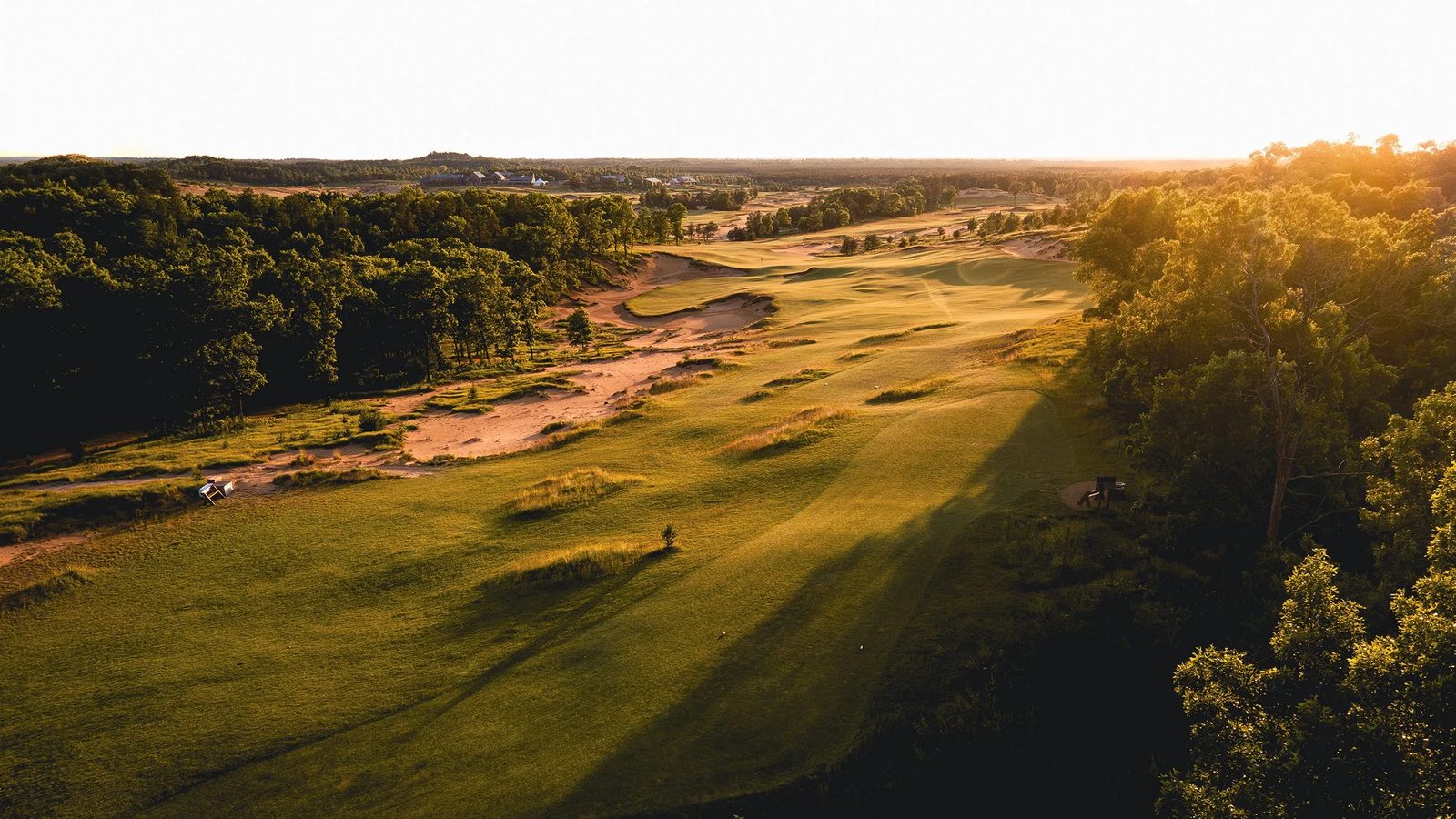
Some courses whisper. Mammoth Dunes grins at full volume. A year after Coore and Crenshaw opened Sand Valley, David McLay Kidd took the adjoining ground and made the biggest statement in Wisconsin golf. His par 73 circles a massive V-shaped sand ridge, spreads fairways that can stretch 150 yards wide and builds greens so large that a 60-foot putt counts as an ordinary outcome. The dunes dominate everything, and the course simply named itself after them. It ranks No. 3 in Wisconsin, and as the second round of a Sand Valley trip it is the one groups talk about all the way home.
The scale is the strategy. Kidd built his early reputation on demanding courses, then designed this one as an outright celebration of fun. Swing hard. Find the ball. Save the hard questions for the greens, where enormous contoured surfaces sort golfers by imagination rather than by power. Drivable par 4s turn up through the round. So do a boomerang-shaped green and a tiny par 3 wedged across a sand chasm, and everywhere there is room to attempt the heroic shot. This is championship golf engineered to make every handicap smile, and it succeeds completely.
The Scorecard
The card below is the Black tees. It reads par 73 and 7,063 yards, split 36 out and 37 in. Five par 5s would be the headline on most cards. Here the front nine at 3,592 yards and the back nine run of short, drivable par 4s tell the real story of a course that gives strokes back as happily as it takes them.
By the Numbers
From the scorecard below: Black tees.
A slope of 141 from the Black tees, rating 74.1 puts it ahead of about 59% of the 182 courses in our database with a published slope.
| Front nine | Par | Yards |
|---|---|---|
| Hole 1 | 4 | 419 |
| Hole 2 | 4 | 395 |
| Hole 3 | 5 | 536 |
| Hole 4 | 3 | 205 |
| Hole 5 | 4 | 457 |
| Hole 6 | 4 | 354 |
| Hole 7 | 5 | 549 |
| Hole 8 | 3 | 228 |
| Hole 9 | 4 | 449 |
| Total | 36 | 3,592 |
| Back nine | Par | Yards |
|---|---|---|
| Hole 10 | 4 | 341 |
| Hole 11 | 5 | 539 |
| Hole 12 | 4 | 400 |
| Hole 13 | 3 | 146 |
| Hole 14 | 4 | 323 |
| Hole 15 | 5 | 545 |
| Hole 16 | 3 | 183 |
| Hole 17 | 4 | 436 |
| Hole 18 | 5 | 558 |
| Total | 37 | 3,471 |
Read the card as Kidd's manifesto. Par 73 is built from five par 5s, the shortest par 3 in the resort's championship family sits at the 13th, and temptation waits at the drivable 10th and 14th. The Black tees rate 74.1 with a 141 slope, sterner numbers than the wide fairways promise, because the enormous greens defend par with distance on the putter rather than trouble off the tee. Play one set forward and Mammoth Dunes becomes what it was built to be, the happiest low round of the trip.
Green Fees
- Peak season, May 21 - Oct 4, 2026$325
- Shoulder season, Apr 24 - May 20 and Oct 5 - 18, 2026$235
- Replay round, peak season$165
- Replay round, shoulder season$115
- LocationNekoosa, Wisconsin
- Par / Yardage73 / 7,063 yards (Black tees)
Mammoth Dunes follows the resort-wide Sand Valley rate structure, with one price for lodging guests and day guests alike. Peak play costs $325 in 2026 and the shoulder bands cost $235, while replay rounds run $165 at peak and $115 in the shoulder. The prior cycle peaked at $295 in 2025. Tax is extra and play is walking only. A standard caddie costs $100 per bag plus gratuity.
The Story
Mammoth Dunes opened on May 31, 2018, as the second 18-hole course at Sand Valley, built while the Coore and Crenshaw original was still settling in next door. The commission reunited Kidd with the Keiser family nearly two decades after the young Scot launched the whole modern links movement with Bandon Dunes in 1999. This time the brief ran the other way. Where his intervening work had sometimes punished golfers, Mammoth Dunes was to embrace them, and the property set the terms, its towering V-shaped ridge of exposed sand fixing the scale for everything that followed.
The golf world noticed the change of heart. GOLF Magazine named Mammoth Dunes the Best New Course of 2018, the course has held a place in the national top 25 public courses on Golf Digest's list, and Golfweek ranks it among the finest resort courses in America. Its most famous hole carries a famous story too. The drivable 14th was designed by Brian Silvernail, winner of Golf Digest's Armchair Architect contest, and Kidd's team built, refined and grassed his sketch with the amateur architect working alongside them in the dirt. A resort guest's drawing became one of the most loved holes in the Midwest. That is Mammoth Dunes in miniature, big and generous and quietly radical.
Signature Holes
Hole 6 - Par 4 - 354 yards
The Boomerang Green is the most photographed putting surface at Sand Valley and the soul of this course. This drivable par 4 plays to a horseshoe-shaped green bracketed by two dunes, its two wings divided by a swale that changes every putt depending on which side of the boomerang the flag occupies. Kidd drew the idea from Alister MacKenzie's boomerang green at Crystal Downs in Michigan, and his team tested the contours by rolling a basketball across the surface to prove a putt could travel from wing to wing. Play boldly from the tee, then putt with imagination fully switched on.
Hole 14 - Par 4 - 323 yards
The Armchair Architect hole is also a masterpiece of democratic design. Brian Silvernail's winning sketch gave the 14th a Redan-style green on a drivable par 4, a combination Kidd embraced wholeheartedly. The fairway cants significantly from right to left and a speed slot sits just past the middle fairway bunker, so a drive carried a little over 200 yards on the right line can chase for 15 to 20 seconds and finish on the green. Kidd's stated premise was that as many golfers as possible should feel able to go for it, with only a minor penalty for missing. The result is the most purely fun tee shot at the resort.
Hole 13 - Par 3 - 146 yards
The smallest hole on the course makes the biggest impression. From the Black tees the 13th plays just 146 yards across a deep sand chasm to a shallow ridgeline green sandwiched between a wasteland and a massive dune. Course writers single it out as the par 3 that feels more intimidating than any other here, precisely because the target looks so slight against so much sand. There is no bail-out and no trick to it. Hit a short iron with a steady nerve, and use the ridge rather than fighting it. Miss, and the recovery from sand or dune grass becomes the story of the round.
Big Greens, Bigger Choices
Scale is the strategy at Mammoth Dunes, and the card proves it before a ball is struck. Par 73 at 7,063 yards from the Black tees, built from five par 5s, nine par 4s and four par 3s, with the front nine at 3,592 yards and the back at 3,471. Fairways can stretch 150 yards wide and greens grow so large that a 60 foot putt counts as an ordinary outcome. Yet the Black tees still rate 74.1 with a slope of 141, sterner than the width promises, because the enormous greens defend par with distance on the putter rather than trouble off the tee.
That trade shapes who thrives here. Power gets a friendly hearing, since the routing circles a massive V shaped sand ridge and gives a hard swing room to work. Imagination gets the final say. The 354 yard 6th plays to the Boomerang Green, a horseshoe shaped surface bracketed by two dunes and divided by a swale, so the flag position changes every putt depending on which wing holds it. Landing on the correct wing is half the battle, and a caddie earns the fee reading surfaces this huge. A golfer can find every green in regulation and still have a long day if the ball keeps finishing on the wrong side of a contour.
The back nine leans into temptation. Drivable par 4s appear at the 341 yard 10th and the 323 yard 14th, where a fairway that cants from right to left holds a speed slot just past the middle fairway bunker, and a drive carried a little over 200 yards on the right line can chase onto the Redan style green. Between them sits the counterweight, the 146 yard 13th, the shortest hole on the card, played across a deep sand chasm to a shallow ridgeline green with no bail out. Mammoth Dunes rewards the golfer who swings freely off the tee and thinks carefully once the ball reaches the green. It punishes careless positioning more than crooked driving, which is a generous and unusual way to run a championship test.
Practical Info
Mammoth Dunes plays on the resort-wide Sand Valley rate card, at $325 at peak in 2026 and $235 in the shoulder bands, with replays at $165 and $115, one rate for lodging and day guests, and walking only. The season runs April 24 to October 18. If a group plays one replay on the property, this is the place to spend it. The width, the drivable holes and the giant greens send tired golfers back out happiest, and a late-day round across the V-shaped ridge in low light is the resort's great golden hour. A caddie earns the fee reading greens this huge, where landing on the correct wing of a surface is half the battle.
Pair it with the original Sand Valley course for the classic one-two of the resort. Take Coore and Crenshaw's angles in the morning and Kidd's scale after lunch, then finish with the Sandbox short course at dusk and dinner at the lodge. Sedge Valley and The Lido complete the stable for longer stays. Everything at Sand Valley books as one trip, lodging and golf together, and peak dates go early, so build the itinerary around a tee time here and let the rest of the resort arrange itself around it. Juniors 16 and under play free after 2 p.m. with a full-paying adult, which makes the forgiving width a family favorite for a first round too.
Questions, Answered
How much does it cost to play Mammoth Dunes?
Mammoth Dunes uses the Sand Valley Resort rate card. Peak season in 2026 runs May 21 to October 4 at $325, the shoulder bands cost $235, and replay rounds run $165 at peak and $115 in the shoulder, the same for lodging and day guests. Tax is extra, play is walking only, and a standard caddie is available at $100 per bag plus gratuity.
Why is Mammoth Dunes a par 73?
David McLay Kidd built five par 5s into the routing around the property's V-shaped sand ridge, so the card reads 36 on the front nine and 37 on the back for par 73 at 7,063 yards from the Black tees. That run of par 5s is part of the fun-first design, with more eagle putts, more swings and more smiles.
What is the Boomerang Green at Mammoth Dunes?
It is the horseshoe-shaped green of the drivable par-4 6th hole, inspired by Alister MacKenzie's boomerang green at Crystal Downs. A swale divides its two wings, so the flag position changes the hole completely, and Kidd's team famously tested the contours by rolling a basketball across the surface before grassing it.
Keep Exploring Wisconsin
Read our Wisconsin Golf Guide for more top courses, green fees, and trip planning across the state.
Mammoth Dunes features in our ranking of the 15 Best Golf Courses in Wisconsin.
More Wisconsin course guides: Sand Valley, Sedge Valley at Sand Valley, Erin Hills, Geneva National Resort & Club (Palmer Course), Troy Burne Golf Club, Tuscumbia Country Club, Mascoutin Golf Club, Old Hickory Golf Club, The Golf Courses of Lawsonia (Links Course), Blackwolf Run (River Course), Blackwolf Run (Meadow Valleys Course), Whistling Straits (Irish Course), SentryWorld, University Ridge Golf Course, The Bull at Pinehurst Farms, Washington County Golf Course and Whistling Straits - Straits Course.