Palmetto Dunes - Robert Trent Jones Course
Hilton Head's grand oceanfront original sweeps from Jones bunkering and lagoons to a finish at the Atlantic itself.
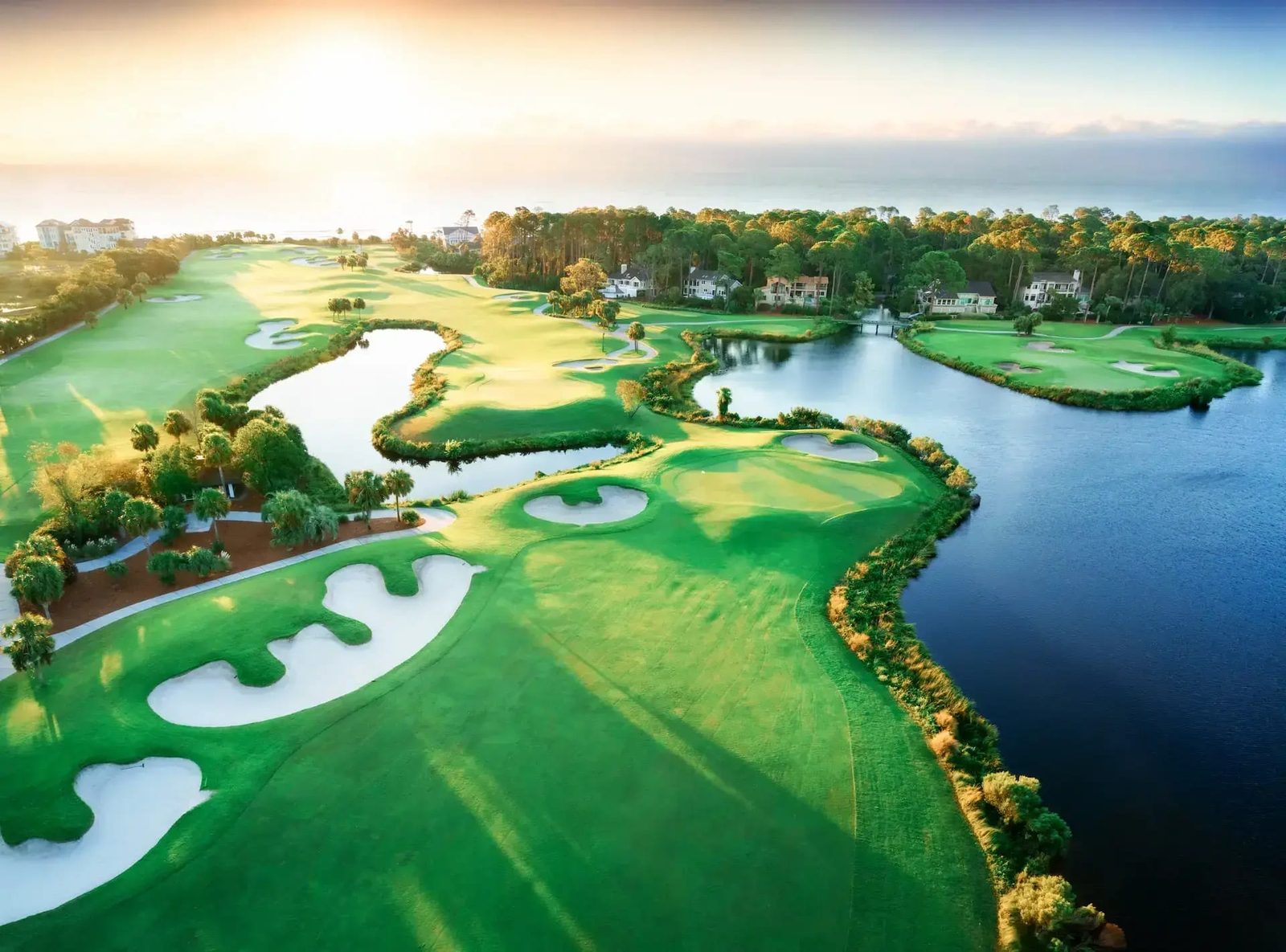
The Robert Trent Jones Oceanfront Course is where Hilton Head Island golf grew up. Opened in 1969 as the centerpiece of the new Palmetto Dunes resort, in the same year Harbour Town debuted across the island, it gave the island its grand, sweeping resort test. Wide fairways run under live oaks. Enormous bunkers stand guard in the Jones style. Water threads through an 11-mile lagoon system. And one hole finishes at the Atlantic Ocean itself, one of the rarest sights in Hilton Head golf.
Jones built the course in his prime vocabulary of target golf. Every fairway asks for a chosen side, every green sits elevated behind its guarding sand, and the lagoons punish the shot that drifts from the plan. His protege Roger Rulewich renovated the course in 2002, refreshing the master's work for the modern game. The layout that resulted is both a history lesson and a thoroughly current championship test, 7,005 yards from the Gold tees with a slope that keeps strong players honest.
Golfweek keeps it on its Best Courses You Can Play in South Carolina list, and for a Hilton Head trip it fills the essential role opposite Harbour Town. Where Sea Pines is precision in the shade, Palmetto Dunes is power and panorama in the open, the island's big-shouldered resort round with the ocean saved for the turn. The elevated green of the par-5 10th, with the Atlantic spread behind it, is one of the great halfway-house views in American golf.
The Scorecard
The card below is the Gold tees card from the resort's own official hole-by-hole course maps. It plays 36 on each nine, and its yardages sum to 7,005 yards, matching the Gold total published for the course by the island's visitor authority and Where2Golf. Published rating and slope figures for the Gold set conflict across the club at 74.8 and 141, the visitor authority at 74.3 and 138 and GolfersDesk at 74.7 and 137, so neither figure is shown on this page. Five men's sets and a junior set step the course down from the Gold tees.
By the Numbers
From the scorecard below: Gold Tees.
| Front nine | Par | Yards |
|---|---|---|
| Hole 1 | 4 | 389 |
| Hole 2 | 4 | 387 |
| Hole 3 | 4 | 370 |
| Hole 4 | 5 | 582 |
| Hole 5 | 3 | 204 |
| Hole 6 | 4 | 422 |
| Hole 7 | 4 | 410 |
| Hole 8 | 3 | 227 |
| Hole 9 | 5 | 522 |
| Total | 36 | 3,513 |
| Back nine | Par | Yards |
|---|---|---|
| Hole 10 | 5 | 550 |
| Hole 11 | 4 | 405 |
| Hole 12 | 3 | 168 |
| Hole 13 | 4 | 398 |
| Hole 14 | 4 | 443 |
| Hole 15 | 5 | 531 |
| Hole 16 | 4 | 386 |
| Hole 17 | 3 | 204 |
| Hole 18 | 4 | 407 |
| Total | 36 | 3,492 |
The Gold card is a Jones symphony in two movements. A front nine builds through its two par 5s at 582 and 522 yards to the turn, and a back nine opens with the ocean at the 10th and then works the lagoons home. Four par 5s, four par 3s and a set of par 4s that never drops below 370 yards give the card its grand, even pressure. There is no breather hole on the Jones Course, only changes of scenery between examinations.
Green Fees
- LocationHilton Head Island, South Carolina
- Par / Yardage72 / 7,005 yards (Gold Tees)
Palmetto Dunes prices the Jones Course dynamically by season, day and hour, and publishes no static rate card. GolfLink's published estimate of $300 sits at the top of the range the resort's tee sheet produces in peak season. Resort guests and multi-round Palmetto Dunes packages price best, and the Jones course traditionally commands the premium of the resort's three courses.
The Story
Palmetto Dunes was Hilton Head's second great golf resort, developed as the island's resort era began, and Robert Trent Jones Sr., the defining architect of postwar American golf, was hired to build its showcase course. The Jones Course opened in 1969, with GolfLink's directory printing 1968 as the construction year. It was the first of the resort's three courses and for years its crown jewel, a championship layout of lagoons, oaks and ocean frontage on the island's Atlantic shore.
The course's defining feature is its relationship with the resort's lagoon system, the network of waterways that winds through Palmetto Dunes and comes into play across the back nine especially, where holes 10 through 14 and the 17th all negotiate water. And then there is the ocean. The par-5 10th plays straight toward the Atlantic to an elevated green on the dunes, and the 11th tee stands on the ocean itself, one of only two truly oceanfront moments on all of Hilton Head Island.
In 2002 Roger Rulewich, Jones's longtime lead designer, renovated his mentor's course, rebuilding and modernizing while keeping the sweeping scale intact. The resort has kept investing since, most visibly at the Jones clubhouse range, now powered by Toptracer technology with covered bays and ball-tracing screens. More than five decades after it opened, the Jones Course remains Palmetto Dunes' flagship and one of the island's essential rounds, the grand original against which Hilton Head's many younger courses are measured.
Signature Holes
Hole 10 - Par 5 - 550 yards
The signature hole of Palmetto Dunes is one of the great oceanfront experiences in the South. A straightaway par 5, usually into the prevailing wind, it takes three solid shots to reach an elevated green sitting on the horizon with the Atlantic spread behind it. The resort calls the view breathtaking, and for once the brochure undersells it.
Hole 4 - Par 5 - 582 yards
The longest hole on the Gold card is a sweeping par 5 where a good drive and a solid second shot still leave a short iron to a deep green. It is the front nine's scoring examination and the hole where the Jones scale shows itself most fully, all big fairways, big bunkers and big targets.
Hole 12 - Par 3 - 168 yards
The back nine's water test in miniature is a well-bunkered one-shotter played over water to a green much longer than it appears. It sits deep in the lagoon stretch of the course where the 10th through the 14th all negotiate the resort's waterways. Club selection, not courage, is the skill here.
Practical Info
The Jones Course is at Palmetto Dunes Oceanfront Resort, Hilton Head Island, SC 29928, with its clubhouse off Trent Jones Lane inside the resort. Book through the resort's own site or a resort stay, and the golf team is at 843-686-9137.
Warm up at the Jones range, now a Toptracer facility with covered bays, high-speed cameras and television monitors. It is the most high-tech practice ground on the island and a genuine pre-round attraction.
The free Palmetto Dunes app carries GPS yardages and hole-by-hole information for all three resort courses and is worth downloading before the round. Carts carry GPS as well.
Play the Jones Course as the centerpiece of a Palmetto Dunes triple with the George Fazio and Arthur Hills courses, or pair it with Harbour Town across the island for the definitive 1969 Hilton Head double, the year both courses opened.
The golf exhibition at 4 p.m. each Monday and the Audubon-certified sanctuary setting are reminders that Palmetto Dunes runs the Jones Course as a full resort experience, not merely a tee sheet.
Questions, Answered
Which hole at the Jones Course is on the ocean?
The par-5 10th is the one. Its elevated green sits on the dunes with panoramic Atlantic views, and the 11th tee stands on the ocean. It is one of only two oceanfront holes on Hilton Head Island, and the resort's signature moment.
Who designed the Robert Trent Jones Course at Palmetto Dunes?
Robert Trent Jones Sr. designed it, opening in 1969 as the first and flagship course of Palmetto Dunes Oceanfront Resort. Roger Rulewich, Jones's longtime lead designer, renovated the course in 2002.
How long is the Jones Course?
From the Gold tees it plays 7,005 yards at par 72, split 3,513 out and 3,492 in. The Blue tees play about 6,570 yards and further sets step down through the White and Green tees.
Keep Exploring South Carolina
Read our South Carolina Golf Guide for more top courses, green fees, and trip planning across the state.
Palmetto Dunes - Robert Trent Jones Course features in our ranking of the 20 Best Golf Courses in South Carolina.
More South Carolina course guides: Caledonia Golf & Fish Club, The Dunes Golf & Beach Club, True Blue Golf Club, Atlantic Dunes by Davis Love III, Heron Point by Pete Dye, Osprey Point Golf Course, TPC Myrtle Beach, Tidewater Golf Club, Grande Dunes Resort Club, Legends Resort - Moorland Course, Cougar Point Golf Course, Barefoot Resort - Dye Course, Prestwick Country Club, Legends Resort - Heathland Course, Turtle Point Golf Course, King's North at Myrtle Beach National, Kiawah Island - Ocean Course and Harbour Town Golf Links.