Caledonia Golf & Fish Club
Mike Strantz's first solo design, a sculpted masterpiece laid through the live oaks and old rice fields of Pawleys Island.
Some courses announce themselves from the road. Caledonia's entrance may be the most famous arrival in South Carolina golf, a long drive tunneling beneath a canopy of ancient live oaks draped in Spanish moss, across the ground of a former rice plantation, to a clubhouse built in the manner of an antebellum plantation house. What waits at the end of that drive justifies the theater. This is Mike Strantz's first solo design, the course that introduced one of golf's most original artistic voices to the world in 1994.
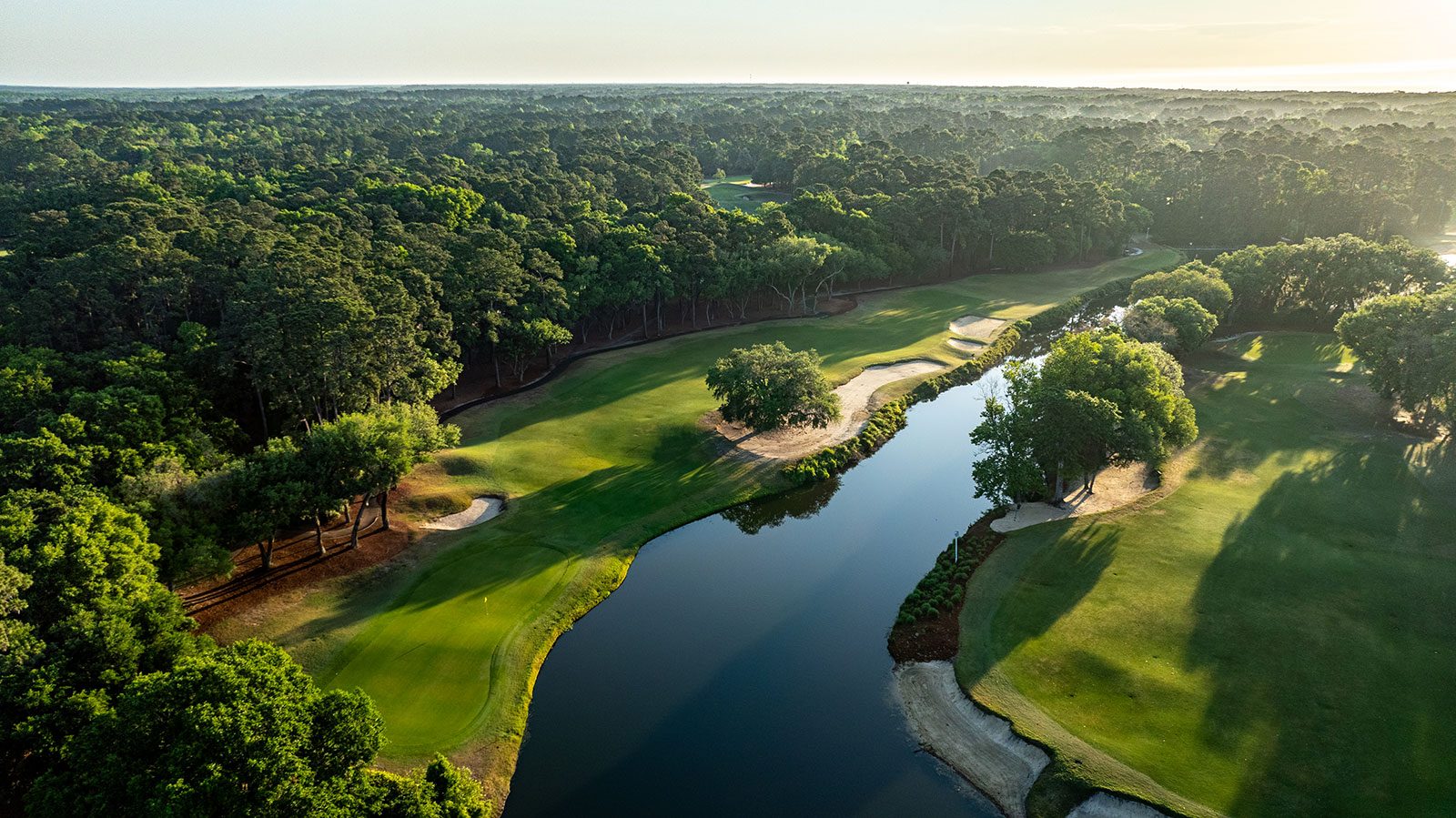
The golf is as considered as the setting. Strantz routed eighteen holes through the oaks and along an inlet of the Waccamaw River, shaping organically curved fairways, vast irregular bunkers and large, cleverly angled greens. The result is a par 70 of just 6,526 yards from the back tees that never feels short. Nearly every hole offers a genuine choice between a safe line and a braver one. Take the braver one, provided it comes off, and the hole usually rewards you for it.
The Scorecard
The card below is the Pintail set, Caledonia's back tees, published hole by hole in GolfBlogger's course account. It goes out in 3,151 and home in 3,375, for 6,526 yards at par 70, and the hole figures sum exactly to the printed Pintail total carried by the club's published scorecard data. The rating of 71.8 and slope of 138 are printed for the Pintail set, a pair that published scorecard data and the account's tee notes agree on. The shape is all Strantz, five par 3s against only three par 5s, the 571-yard 2nd, the 528-yard 8th and the 553-yard 10th.
By the Numbers
From the scorecard below: Pintail.
From the Pintail it plays to a slope of 138, rating 71.8, steeper than about 42% of the 182 courses in our database with a published slope.
| Front nine | Par | Yards |
|---|---|---|
| Hole 1 | 4 | 376 |
| Hole 2 | 5 | 571 |
| Hole 3 | 3 | 187 |
| Hole 4 | 4 | 396 |
| Hole 5 | 4 | 419 |
| Hole 6 | 3 | 157 |
| Hole 7 | 4 | 399 |
| Hole 8 | 5 | 528 |
| Hole 9 | 3 | 118 |
| Total | 35 | 3,151 |
| Back nine | Par | Yards |
|---|---|---|
| Hole 10 | 5 | 553 |
| Hole 11 | 3 | 167 |
| Hole 12 | 4 | 405 |
| Hole 13 | 4 | 398 |
| Hole 14 | 4 | 415 |
| Hole 15 | 4 | 462 |
| Hole 16 | 4 | 417 |
| Hole 17 | 3 | 175 |
| Hole 18 | 4 | 383 |
| Total | 35 | 3,375 |
The inward nine is the longer half by 224 yards, and it builds steadily. The 553-yard 10th announces it, the 462-yard 15th is the longest par 4 on the card, and the 417-yard 16th keeps the pressure on before the 175-yard 17th offers a breath. The outward nine holds the exclamation points instead, the little 118-yard 9th at the turn and the 187-yard 3rd, the longest of the five one-shotters. Nothing on either side is long for its par. Everything is angled, bunkered and thought through.
Green Fees
- LocationPawleys Island, South Carolina
- Par / Yardage70 / 6,526 yards (Pintail)
Caledonia publishes no static rate card, so there is no single figure to quote honestly. The club prices tee times dynamically, by season, day and hour, through its own booking channels and the Myrtle Beach package market. Spring is the peak, when the club sits on nearly every buddies trip itinerary on the south Strand. Summer and winter dates run well below the spring level. For a real number on a real date, the club's own tee sheet is the only source that counts.
The Story
Rice came first. At its mid-1800s peak, the Caledonia plantation's fields produced some 700,000 pounds of rice a year, worked through the tidal inlet that still slices through the middle of the modern layout, and the property continued as a farm until 1940. The oaks along the entrance drive were already old when the rice era ended. They are a large part of why arriving here feels like arriving somewhere that has been beautiful for a very long time.
Strantz arrived as a former Tom Fazio associate striking out on his own, and Caledonia became the first of just nine courses he designed as a solo artist before his untimely death in 2005. It has been a fixture of the national Top 100 public lists ever since. Even the tee markers carry the property's sporting heritage. Each set of tees is named for a duck species and marked with a matching decoy, Pintail at the back, then Mallard, Wood Duck and Redhead.
Signature Holes
Hole 18 - Par 4, 383 yards
One of the great finishing walks in American public golf, and it earns the gallery. The hole plays along the edge of the old rice fields to a green set beneath the clubhouse porch, and the approach must carry the inlet water guarding the front of the green while that porch watches. At 383 yards it asks for precision rather than power. Good round or bad one, you finish in front of an audience.
Hole 2 - Par 5, 571 yards
The longest hole on the card is also the fullest expression of Strantz's shaping hand. The 571-yard 2nd sweeps through the oaks with fairway bunkers scattered like punctuation, and the further the tee shot travels, the more the hole narrows its questions. For almost everyone it is a true three-shot hole. The green angles away behind sand, and it rewards the golfer who has planned the whole hole backwards from the flag.
Hole 9 - Par 3, 118 yards
The shortest hole at Caledonia, and the most debated, needs no length to lodge in the memory. Strantz fitted this 118-yard par 3 into the ground beside the turn house, fronting a dumbbell-shaped green with a vast waste area. The shot is only a wedge, and somehow nothing about it feels simple. Hit the green or face an awkward recovery from the sand below it.
Angles Through the Oaks
Nothing at Caledonia is long for its par, and nothing is straightforward either. Mike Strantz fitted five par 3s against only three par 5s through live oaks and along an inlet of the Waccamaw River, producing a par 70 of 6,526 yards from the Pintail tees that never feels short. The rating of 71.8 and slope of 138 explain the feeling. Organically curved fairways, vast irregular bunkers and large and cleverly angled greens keep shifting the preferred side, so nearly every hole offers a genuine choice between a safe line and a braver one, with the braver line usually rewarded when it comes off.
The homeward half does the heavier lifting. It runs 3,375 yards against 3,151 out, announced by the 553-yard 10th and built steadily through the 462-yard 15th, the longest par 4 on the card, and the 417-yard 16th before the 175-yard 17th offers a breath. Outward holds the exclamation points instead. The 571-yard 2nd sweeps through the oaks as a true three-shot hole whose green angles away behind sand, rewarding the golfer who plans the whole hole backwards from the flag. Then, right at the turn, the card goes quiet and gets tricky.
That trick is the 118-yard 9th, the shortest hole at Caledonia and the most debated. A dumbbell-shaped green is fronted by a vast waste area, so the shot is only a wedge and somehow nothing about it feels simple, with an awkward recovery waiting in the sand below for a miss. The round closes with the opposite kind of pressure at the 383-yard 18th, played along the old rice fields to a green set beneath the clubhouse porch, the approach carrying inlet water that guards the front while the porch watches. Caledonia rewards planning and precision over power from start to finish. It punishes the unconsidered shot, especially the short one played as if length were the only test.
Practical Info
Caledonia sits at the southern end of the Grand Strand in Pawleys Island, a short drive south of Myrtle Beach. Its sister course, True Blue, stands directly across the road, which makes the two Strantz designs the natural 36-hole day on any south Strand trip. Tee times run through the club directly and through most Myrtle Beach package providers. In the spring peak the sheet fills well ahead, so this is a course that rewards early booking.
Build the turn into the plan. The chowder served at the turn house is a Caledonia tradition golfers talk about years later, and skipping it would be a genuine mistake. After the round, the clubhouse porch above the 18th green is the spot, drink in hand, watching approach shots come in over the water. The oak canopy keeps much of the course shaded, a genuine mercy in the Carolina summer.
Questions, Answered
Who designed Caledonia Golf & Fish Club?
Mike Strantz designed Caledonia as his first solo work after leaving Tom Fazio's firm, and it opened in 1994. It remains the most celebrated of the nine courses he completed as a solo artist before his death in 2005, and it is routinely ranked among America's finest public courses.
Why does Caledonia play to par 70?
Strantz fitted five par 3s and only three par 5s into the routing through the oak hammock, so the card reads par 70, with 35 on each nine. At 6,526 yards from the Pintail tees and a rating of 71.8, it tests accuracy and imagination well beyond what the yardage alone suggests.
What are the duck names on Caledonia's tees?
Each tee set is named for a duck species and marked by a decoy, honoring the property's waterfowling heritage. Pintail runs 6,526 yards, Mallard 6,121, Wood Duck 5,710 and Redhead 4,957. Most visiting golfers choose the Mallard set.
Keep Exploring South Carolina
Read our South Carolina Golf Guide for more top courses, green fees, and trip planning across the state.
Caledonia Golf & Fish Club features in our ranking of the 20 Best Golf Courses in South Carolina.
More South Carolina course guides: The Dunes Golf & Beach Club, True Blue Golf Club, Atlantic Dunes by Davis Love III, Heron Point by Pete Dye, Osprey Point Golf Course, TPC Myrtle Beach, Tidewater Golf Club, Grande Dunes Resort Club, Legends Resort - Moorland Course, Cougar Point Golf Course, Barefoot Resort - Dye Course, Prestwick Country Club, Legends Resort - Heathland Course, Turtle Point Golf Course, Palmetto Dunes - Robert Trent Jones Course, King's North at Myrtle Beach National, Kiawah Island - Ocean Course and Harbour Town Golf Links.