Golden Horseshoe Golf Club (Gold Course)
Robert Trent Jones Sr.'s self-declared finest design, wrapped in a Colonial Williamsburg arboretum.
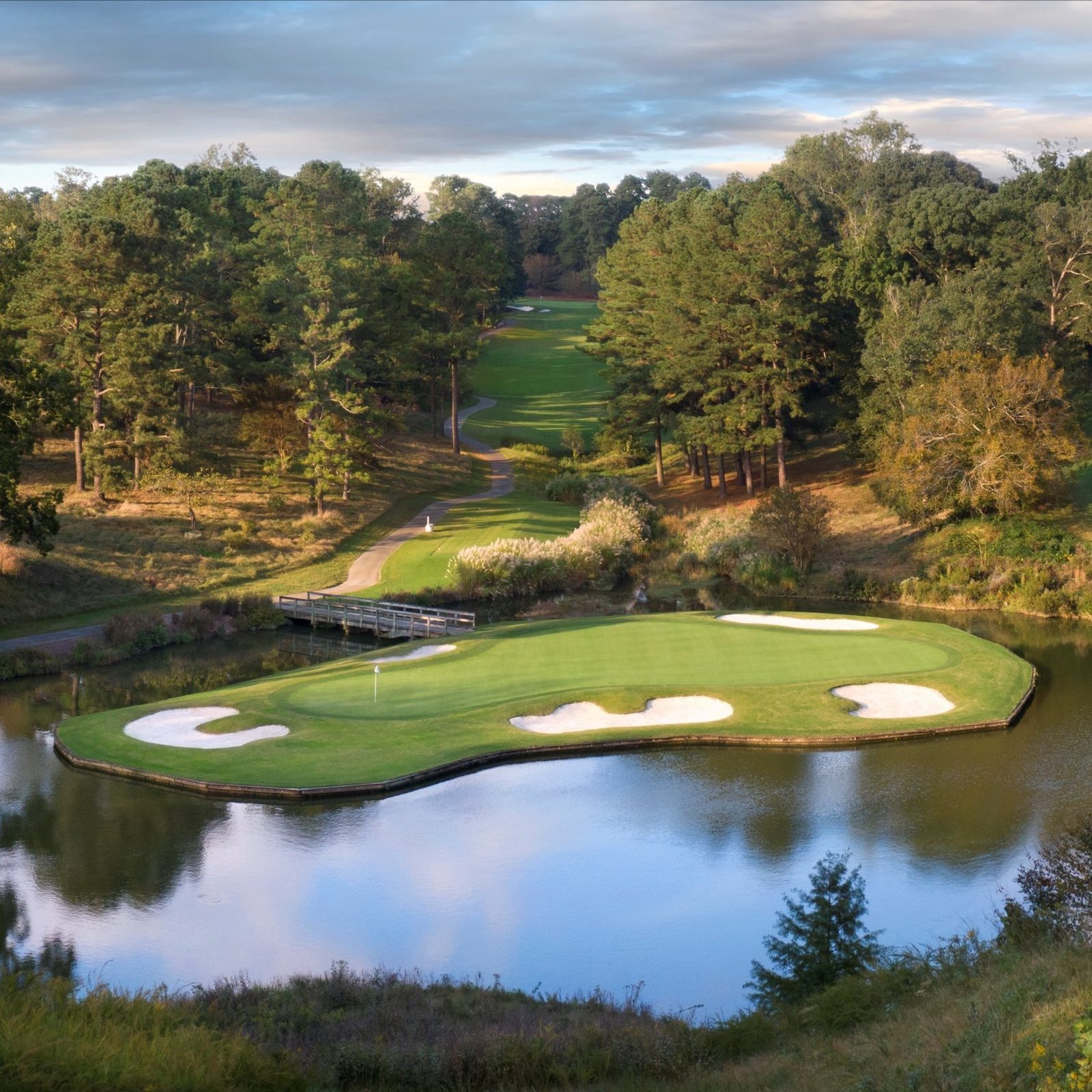
A short stroll from Duke of Gloucester Street, in the middle of one of America's great living-history museums, sits the course Robert Trent Jones Sr. called his finest design. The Gold Course at Golden Horseshoe Golf Club opened in 1963 as the golfing crown of Colonial Williamsburg, routed through a natural arboretum of hardwood forest where no house, road or development ever intrudes. Jones did not hand out superlatives casually. That he saved his highest praise for a 6,817-yard par 71 in the Virginia Tidewater tells visitors exactly what awaits.
The Gold is a shotmaker's course in the classic Jones mold. Elevated tees look down on doglegs that ask for shaped drives, and water weaves through a little valley at the center of the property. The four par 3s are the soul of the round, and three of them cross the same stretch of water, capped by the island-green 16th that has been photographed for sixty years. Golf Digest places the Gold in America's 100 Greatest Public Courses, and GOLF Magazine includes it in the Top 100 Courses You Can Play.
The Scorecard
The card below is the Gold tees, the championship set at 6,817 yards and par 71. The Gold tees rate 73.4 with a slope of 140. The Blue tees step down to 6,522 yards at 72.1 and 136 for a friendlier day.
By the Numbers
From the scorecard below: Gold tees.
Slope 140 from the Gold tees, rating 73.4 - harder than about 55% of the 182 courses in our database with a published slope.
| Front nine | Par | Yards |
|---|---|---|
| Hole 1 | 4 | 402 |
| Hole 2 | 5 | 498 |
| Hole 3 | 3 | 201 |
| Hole 4 | 4 | 421 |
| Hole 5 | 4 | 348 |
| Hole 6 | 5 | 485 |
| Hole 7 | 3 | 206 |
| Hole 8 | 4 | 337 |
| Hole 9 | 4 | 372 |
| Total | 36 | 3,270 |
| Back nine | Par | Yards |
|---|---|---|
| Hole 10 | 4 | 466 |
| Hole 11 | 4 | 403 |
| Hole 12 | 3 | 188 |
| Hole 13 | 4 | 363 |
| Hole 14 | 4 | 445 |
| Hole 15 | 5 | 634 |
| Hole 16 | 3 | 169 |
| Hole 17 | 4 | 435 |
| Hole 18 | 4 | 444 |
| Total | 35 | 3,547 |
Par is oddly and wonderfully distributed. The three par 5s fall at the 2nd, 6th and 15th, and the four par 3s bunch around the valley, with the 7th, 12th and 16th all crossing water. Older listings still show the Gold tees at 73.8 and 144. The figures in current use after the 2017 renovation are 73.4 and 140.
Green Fees
- LocationWilliamsburg, Virginia
- Par / Yardage71 / 6,817 yards (Gold tees)
Golden Horseshoe prices the Gold Course dynamically through the Colonial Williamsburg tee sheet, and published figures do not agree on a single rate. Listings put the round at $99 to $169 with cart and as high as $199, and the club's Player's Pass bundles the Gold at $119 in season for pass holders only. With figures that far apart, no single standard visitor rate exists to quote. Check the live tee sheet for the date in mind.
The Story
The club's name reaches back to 1716, when Colonial Governor Alexander Spotswood led his Knights of the Golden Horseshoe across the Blue Ridge Mountains and presented each survivor with a small golden horseshoe. Golf arrived nearly 250 years later. Colonial Williamsburg commissioned Jones, then at the height of his powers, to build a championship course beside the restored colonial capital, and the Gold Course opened in 1963. Its island-green 16th was among the first island greens built anywhere in golf.
The course announced itself immediately. Four years after opening, Jack Nicklaus set the professional course record of 67 in an exhibition match. The Gold later hosted the 1999 USGA Men's State Team Championship and the 2007 NCAA Division I Men's Championship, where Michael Schachner shot 60 and matched the 60 Daniel Summerhays had shot on the same course at the fall 2006 PING/Golfweek Preview. In 2016 and 2017 the club closed the course for a full renovation directed by the architect's son, Rees Jones, who rebuilt every green and bunker while keeping his father's routing intact. The Gold reopened on July 1, 2017, refreshed for its next half-century.
Signature Holes
Hole 16 - Par 3 - 169 yards
The postcard hole. Jones built one of golf's first island greens here in 1963, well before island greens became fashionable, and the hole has been counted among the finest in the world ever since. The green sits alone in the pond in the valley at the heart of the course, and 169 yards of carry over water, with no bailout worth the name, has decided more matches than any hole in Virginia.
Hole 12 - Par 3 - 188 yards
The 12th shares the same pond as the 16th but plays to a peninsula green rather than an island, so the miss is wet on fewer sides and the mind games are subtler. At 188 yards from the Gold tees it still demands a full long iron, and the diagonal green rewards the player who can hold that shot against the slope.
Hole 15 - Par 5 - 634 yards
The 15th is the heavyweight of the Gold. At 634 yards it runs a full 136 yards longer than any other hole on the course, and it is a true three-shot hole for all but the longest hitters. Its length arrives just as the round turns for home, making it the last full-throated test before the watery theater of the 16th and the strong par-4 finish.
The Water Holes Decide the Day
Three of the four par 3s at the Gold cross the same stretch of water in a little valley at the center of the property, and that repetition is the strategy rather than a quirk. The 7th, the 12th and the 16th all ask for a carried shot over the pond in Williamsburg, each at a different yardage and to a different kind of target, so a strength gets tested until it either holds or cracks. From the Gold tees the course plays 6,817 yards at par 71, rated 73.4 with a slope of 140, numbers that already hint at trouble concentrated in a few memorable places rather than spread evenly across the hardwood arboretum.
The distinction between the two back-nine water holes deserves close attention. The 188-yard 12th plays to a peninsula green, wet on fewer sides, where the diagonal surface rewards a long iron held against the slope and the miss still has somewhere dry to finish. The 169-yard 16th removes that comfort entirely. Robert Trent Jones Sr. built one of the first island greens in golf there in 1963, a green sitting alone in the pond with 169 yards of carry and no bailout worth the name. Nineteen fewer yards, infinitely more consequence. Golfers remember the pair together because the 12th teaches the shot and the 16th grades it without mercy or, on a good day, without a splash.
Around those holes Jones built a shotmaker round of elevated tees and doglegs that ask for shaped drives, in a setting where no house, road or development ever intrudes. The back nine runs 3,547 yards against 3,270 on the front, and most of that extra length sits in one place. The 634-yard 15th runs a full 136 yards longer than any other hole on the course, a true three-shotter arriving just before the island green and a strong par 4 finish at the 17th and 18th. Patience on the heavyweight, nerve on the island. That pairing, more than any single yardage, explains why Jones called this his finest design.
Practical Info
Golden Horseshoe stands on South England Street in Colonial Williamsburg, Williamsburg, VA 23185, directly across from the restored area. A player can leave the 18th green and be walking Duke of Gloucester Street in minutes. Play is open to resort guests and visitors, and the club also runs the Rees Jones-designed Green Course and the nine-hole Spotswood Course on the same grounds, so a 45-hole golf day is entirely possible without moving the car.
Williamsburg is a year-round destination, but the Gold is at its best in spring and fall, when the hardwood arboretum shows either blossom or color and the Tidewater humidity relents. Summer rounds call for early tee times. Because green fees are priced dynamically, shoulder-season and weekday rounds can cost meaningfully less than the peak figures quoted in travel guides, and pairing golf with a Colonial Williamsburg hotel stay often unlocks the best packaged rates.
Questions, Answered
What makes the 16th hole so famous?
It is one of the first island greens ever built, created by Robert Trent Jones Sr. in 1963, and it has been a fixture of best-holes lists ever since, including a place in Golf Magazine's Top 500 Holes in the World. From the Gold tees it plays 169 yards, all carry over the pond.
Who renovated the Gold Course, and when?
Rees Jones, the original architect's son, directed a full renovation that rebuilt every green complex and bunker while preserving his father's routing. The course reopened on July 1, 2017.
How much does it cost to play the Gold Course?
Rates are dynamic and move with season and demand. Published guides have listed the round anywhere from $99 to $199 with cart, so check the Colonial Williamsburg tee sheet for the date in mind rather than trusting any single quoted figure.
Keep Exploring Virginia
Read our Virginia Golf Guide for more top courses, green fees, and trip planning across the state.
Golden Horseshoe Golf Club (Gold Course) features in our ranking of the 15 Best Golf Courses in Virginia.
More Virginia course guides: The Highland Course at Primland, The Cascades Course at Omni Homestead Resort, Full Cry at Keswick Hall, Independence Golf Club, Pete Dye River Course of Virginia Tech, Kingsmill Resort (River Course), Poplar Grove Golf Club, The Old Course at Omni Homestead Resort, Royal New Kent Golf Club, The Club at Viniterra, Mattaponi Springs Golf Club, Potomac Shores Golf Club, Stonewall Golf Club and Stonehouse Golf Club.