The Cascades Course at Omni Homestead Resort
William Flynn's 1923 mountain masterpiece and Sam Snead's home course, hidden in an Allegheny valley.
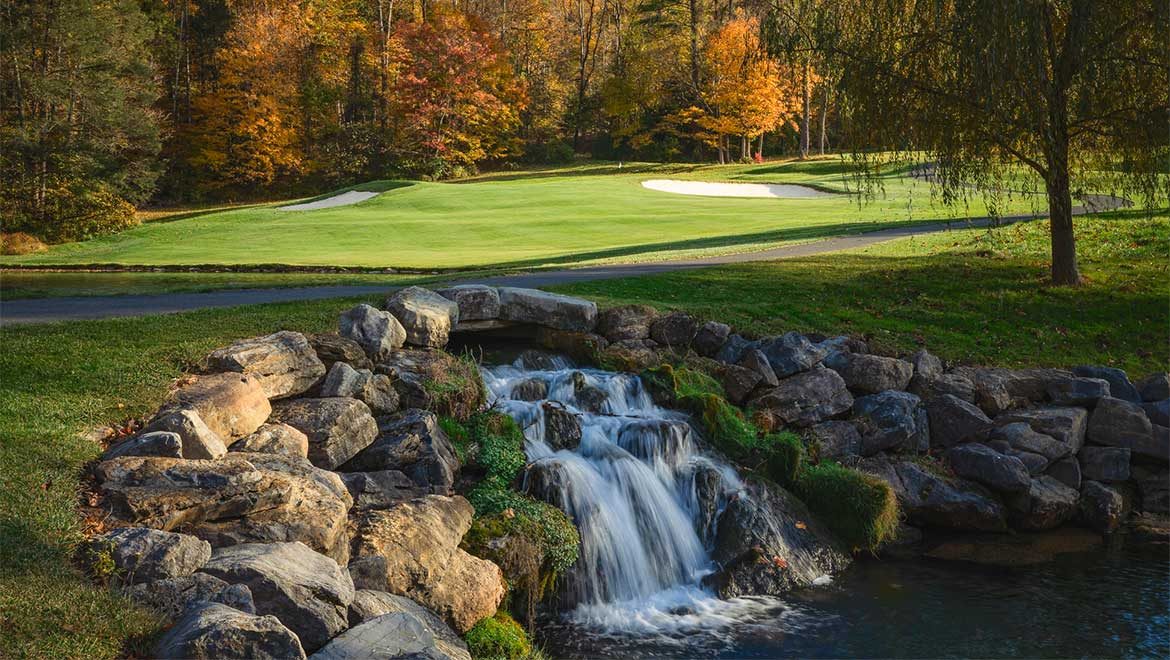
Start with the setting, because the golf keeps pointing back to it. High in Virginia's Allegheny Mountains, in a valley cut by a mountain stream outside the village of Hot Springs, sits the course Sam Snead called home. William Flynn built the Cascades in 1923 for the Omni Homestead Resort, and his routing climbs into the wooded slopes for the first eleven holes before dropping back through the Cascades valley for a closing stretch as handsome as any in American resort golf. Golfweek ranks it No. 2 among Virginia's public courses. A century after it opened, it remains the standard by which mountain golf in the East is judged.
On paper it looks gettable. Par 70. Just 6,679 yards. Then the ground starts tilting. Fairways lean with the hillsides, the stream keeps wandering into play, and Flynn's greens demand approaches struck from the correct side of every slope, so the course plays far longer than the number suggests. Snead grew up in this valley and served as the Cascades' first golf professional. He shot 61 here. He also liked to say a round at his home course meant cleaning all 14 clubs afterward, because every club in the bag gets used, and used honestly.
The Scorecard
The card below is the classic published back-tee card for the Cascades, 6,679 yards at par 70, rated 73.0 with a slope of 137. GolfLink and the course's published hole-by-hole listings carry the same figures. Ten par 4s do the heavy lifting, and the mountain holes concentrate on the front nine, which runs 3,289 yards.
By the Numbers
From the scorecard below: Back tees.
Slope 137 from the Back tees, rating 73.0 - a sterner test than about 39% of the 182 courses in our database with a published slope.
| Front nine | Par | Yards |
|---|---|---|
| Hole 1 | 4 | 398 |
| Hole 2 | 4 | 432 |
| Hole 3 | 4 | 289 |
| Hole 4 | 3 | 210 |
| Hole 5 | 5 | 575 |
| Hole 6 | 4 | 367 |
| Hole 7 | 4 | 417 |
| Hole 8 | 3 | 153 |
| Hole 9 | 4 | 448 |
| Total | 35 | 3,289 |
| Back nine | Par | Yards |
|---|---|---|
| Hole 10 | 4 | 381 |
| Hole 11 | 3 | 192 |
| Hole 12 | 4 | 476 |
| Hole 13 | 4 | 440 |
| Hole 14 | 4 | 429 |
| Hole 15 | 3 | 229 |
| Hole 16 | 5 | 527 |
| Hole 17 | 5 | 513 |
| Hole 18 | 3 | 203 |
| Total | 35 | 3,390 |
Everything about this finish is gloriously upside down. The last four holes run par 3, par 5, par 5 and par 3, so the round ends on a 203-yard one-shotter after back-to-back three-shotters of 527 and 513 yards. One caution for trip planners. The resort's current web table lists par 71 and 6,729 yards for its longest day-to-day setup, a modern re-measurement. The card reproduced here is the published par 70, 6,679-yard version, the one that matches the championship record and our Virginia ranking.
Green Fees
- 18 holes, resort guest$342
- 18 holes, non-registered guest$362
- 9 holes, resort guest$182
- 9 holes, non-registered guest$192
- Twilight, after 2 p.m., resort guest$182
- Junior (ages 12 to 18), 18 holes$112
- Junior (ages 12 to 18), 9 holes$79
- LocationHot Springs, Virginia
- Par / Yardage70 / 6,679 yards (Back tees)
The figures come from Omni Hotels' official Homestead golf rates page, the resort's published Cascades rate card. Golf Trip Index's Homestead guide carries the same headline numbers, $342 for a resort guest and $362 for a non-registered guest over 18 holes. The course is open Wednesday to Monday. Twilight comes with free rentals, and 9-hole, junior and twilight times are booked by phone at 800-838-1766. Callaway rental clubs run $105 and arrive with six balls.
The Story
Golf at the Homestead predates all of this. The resort's Old Course began with six holes in 1892 and keeps what is billed as the oldest first tee in continuous use in America. By the early 1920s the resort wanted a true championship test, so it turned to William Flynn, the Philadelphia architect behind Shinnecock Hills and Cherry Hills. Flynn found his ground in the Cascades valley, a few miles from the hotel, and legend and record agree on what happened next. He blasted his holes through the limestone ridges with dynamite. The Cascades opened in 1923.
The championships arrived quickly and never really left. The course hosted the 1928 U.S. Women's Amateur, the 1966 Curtis Cup and the 1967 U.S. Women's Open, then the 1988 U.S. Amateur, the 2000 U.S. Mid-Amateur and the 2004 NCAA Division I Men's Championship, among many other national events. Robert Trent Jones Sr. carried out renovation work in 1961, and a restoration in 2005 brought the course back closer to Flynn's intent. Watching over the whole story was the valley's most famous son. Sam Snead was born in nearby Ashwood, learned the game here, and remained the Homestead's professional for decades.
Signature Holes
Hole 4 - Par 3 - 210 yards
The postcard one-shotter of the mountain side. From the tee the shot falls steeply downhill, a long iron or hybrid sent through a chute of mature trees to a green set into the hillside. The drop makes the yardage lie. Standing in that chute, you cannot feel the wind either, which is rather the point. It is the most photographed hole on this side of the routing.
Hole 5 - Par 5 - 575 yards
Length with manners. At 575 yards this is the longest hole on the course and its No. 1 handicap hole, a genuine three-shot par 5 that keeps climbing and bending through the trees. Power alone does not solve it. The fairway tilts, the final approach asks for position, and those two demands matter more than another ten yards off the tee. Walk off with a par and it feels like gaining a shot on the field. Around here, it is.
Hole 12 - Par 4 - 476 yards
The longest par 4 at the Cascades anchors the valley stretch of the back nine, and it asks for the day's fullest drive followed by a long, true approach at 476 yards. The homeward run refuses to let up from here. When the finish finally does relent, it relents strangely. The round ends 3-5-5-3, two par 5s and two par 3s across the last four holes, a closing sequence nobody would dare draw up today.
A Finish That Refuses to Behave
Forget everything learned about how a round is supposed to end. The Cascades closes par 3, par 5, par 5, par 3 across the final four holes in Hot Springs, a sequence the review rightly calls gloriously upside down. That means the last short hole plays 203 yards at the 18th, after back-to-back three-shotters of 527 yards at the 16th and 513 yards at the 17th have already taken their toll. There is no stock finishing par 4 to lean on, no familiar drive and mid-iron to close a match. William Flynn built the routing in 1923 through an Allegheny valley, and the finish still feels like a designer enjoying the freedom to ignore a template that had not hardened yet.
The rest of the par 70 card prepares a golfer for that strangeness by refusing to play as short as it looks. At 6,679 yards from the back tees, rated 73.0 with a slope of 137, the Cascades carries five par 3s and ten par 4s against only three par 5s, with the mountain holes concentrated across the first eleven before the routing drops into the valley. Fairways lean with the hillsides, the stream keeps wandering into play, and approaches demand the correct side of every slope. Sam Snead, the first golf professional here who shot 61 on his home course, liked to say a round meant cleaning all 14 clubs afterward because every club gets used honestly. The card backs him up completely.
Two holes show the range of that honesty. The 210-yard 4th falls steeply downhill through a chute of mature trees to a green set into the hillside, where the drop makes the yardage lie and the chute hides the wind. The 476-yard 12th, the longest par 4 on the course, anchors the valley stretch and asks for the fullest drive of the day followed by a long and true approach. Between a one-shotter that plays shorter than its number and a two-shotter that plays longer, the Cascades keeps recalibrating trust. Golfers who play the yardage book get fooled. Golfers who play the ground in front of them get the real course.
Practical Info
Do not go looking for the first tee beside the hotel. The Cascades sits at Healing Springs, about 3.5 miles from the main resort at 7696 Sam Snead Highway, Hot Springs, VA 24445, and resort shuttles run golfers out to the valley. Play is a resort privilege, so a round is normally booked as part of an Omni Homestead stay. For the second round, the Old Course starts right at the hotel and makes an ideal warm-up or follow-up.
Mountain weather is the main planning variable. The season runs roughly April to October at this elevation, and cool mornings are common even in midsummer, so pack layers. The course rewards walking fitness and patience in equal measure, because sidehill lies are the house specialty. Leave time around the round for the resort itself. Its warm springs pools and grand hotel have drawn travelers to this valley since long before Flynn arrived with his dynamite.
Questions, Answered
Who designed the Cascades Course?
William Flynn designed the Cascades in 1923, blasting the routing through limestone in the valley outside Hot Springs. Robert Trent Jones Sr. renovated the course in 1961, and restoration work in 2005 returned much of Flynn's original character.
Why is the Cascades a par 70?
Flynn's routing has ten par 4s, five par 3s and only three par 5s, and two of those par 5s come back to back at the 16th and 17th. The finish runs 3-5-5-3, one of the most distinctive closing sequences in American golf.
What is Sam Snead's connection to the Cascades?
Snead grew up in the Hot Springs valley, became the first golf professional at the Cascades, and shot 61 on his home course. He stayed on as the Homestead's professional for decades and remains the course's defining figure.
Keep Exploring Virginia
Read our Virginia Golf Guide for more top courses, green fees, and trip planning across the state.
The Cascades Course at Omni Homestead Resort features in our ranking of the 15 Best Golf Courses in Virginia.
More Virginia course guides: The Highland Course at Primland, Golden Horseshoe Golf Club (Gold Course), Full Cry at Keswick Hall, Independence Golf Club, Pete Dye River Course of Virginia Tech, Kingsmill Resort (River Course), Poplar Grove Golf Club, The Old Course at Omni Homestead Resort, Royal New Kent Golf Club, The Club at Viniterra, Mattaponi Springs Golf Club, Potomac Shores Golf Club, Stonewall Golf Club and Stonehouse Golf Club.