Every course you can play - from the People's Country Club at Bethpage to a Donald Ross classic above Lake George, by way of three championship courses at one Verona resort. Public and resort only: if a course will not sell you a tee time, it is not on this list.
15Courses you can play
830Golf courses statewide
3Courses at Turning Stone
2U.S. Opens at No. 1
New York is the strangest golf state in America: the deepest private bench in the country, and a public game that answers it with a state park. Bethpage Black - a municipal course that has hosted two U.S. Opens, a PGA Championship and a Ryder Cup - is the most famous public course on earth, and it anchors a bookable collection that runs from Long Island to Lake George to the Finger Lakes: Golden Age classics by Tillinghast, Ross and Emmet, a Nicklaus links in the Bronx, Pete Dye's only New York design, and three championship courses at a single Oneida Nation resort in Verona. The National Golf Foundation counts some 830 courses across the state; these are the fifteen worth planning a trip around.
How we chose them
Our fifteen follows Golfweek's 2026 New York public-access panel in order - Bethpage Black first, Leatherstocking second, Atunyote third - cross-checked against Golf Digest, whose public-course survey agrees that Bethpage Black stands alone in the state (it is the only New York course on Golf Digest's 100 Greatest Public list) and whose Best in State public names line up with the panel's throughout. Access calls, stated plainly: Bethpage Black and Red, Ferry Point, Montauk Downs, Union Vale, Greystone, Pound Ridge, Saratoga National, Ravenwood and Mansion Ridge sell daily-fee tee times to anyone; Leatherstocking, the Sagamore and the three Turning Stone courses book through their resorts. No green fees are published on this page, because New York's top end prices dynamically by season and day. One flag for the next national re-cut: Bethpage Black holds a claim on our national top 25 as strong as any course not already on it, and this page makes that claim plainly rather than quietly re-ranking anything here.
Access key: Public anyone can book · Resort bookable with a stay or as a resort guest · Semi-private members plus public tee times
Bethpage Black
Public
Farmingdale - A.W. Tillinghast (1936)
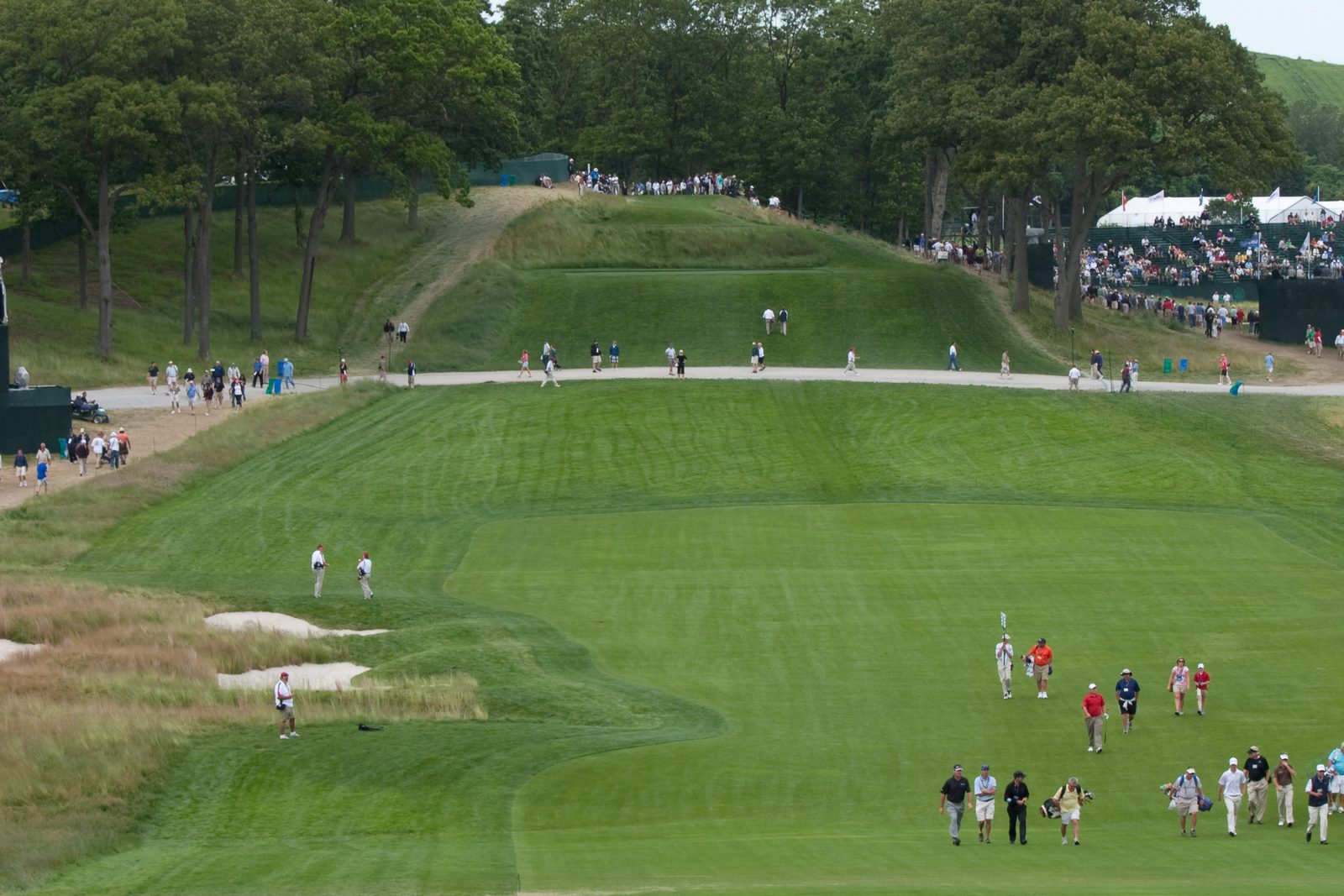
The People's Country Club, and the most famous public course in America. A.W. Tillinghast's Black Course opened at Bethpage State Park in 1936, all 7,468 yards of par-71 muscle behind a first-tee warning sign that has become a pilgrimage site of its own: an extremely difficult course, recommended only for highly skilled golfers. The championships keep ratifying the legend - the 2002 and 2009 U.S. Opens, the 2019 PGA Championship and the 2025 Ryder Cup all came to a municipal course where anyone can book a tee time, and Golf Digest counts it as the only New York course on its 100 Greatest Public list. It is walking only, it is gloriously hard, and it belongs to everyone. Read our course guide.
Cooperstown's other hall of fame. Leatherstocking opened in 1909 on the shore of Otsego Lake - the Glimmerglass of James Fenimore Cooper's novels - and Devereux Emmet's design, expanded to 18 holes a decade later, still plays exactly as a Golden Age resort course should: 6,401 yards of par-72 charm, sharp greens and gentle hills in front of the Otesaga Resort Hotel. The finish is the postcard: a par 3 of up to 195 yards over the water, then a par 5 that starts from an island tee and runs along the lake. GolfPass's everyday golfers ranked it the No. 1 public course in New York in 2025, and USA Today's 10Best readers voted it the No. 2 public course in America. Read our course guide.
Tom Fazio's parkland showpiece for the Oneida Indian Nation, opened in 2004 a few miles from the Turning Stone resort it serves. Atunyote - the Oneida word for eagle - stretches 7,315 yards across rolling Mohawk Valley hills, with wide fairways, big undulating greens, streams, lakes and waterfalls arranged with Fazio's usual polish. The PGA Tour thought so highly of it that the Turning Stone Resort Championship called it home from 2007 to 2010, and its gated, private-club presentation still startles first-time visitors: this serene, immaculate test is a resort course anyone can reserve. Read our course guide.
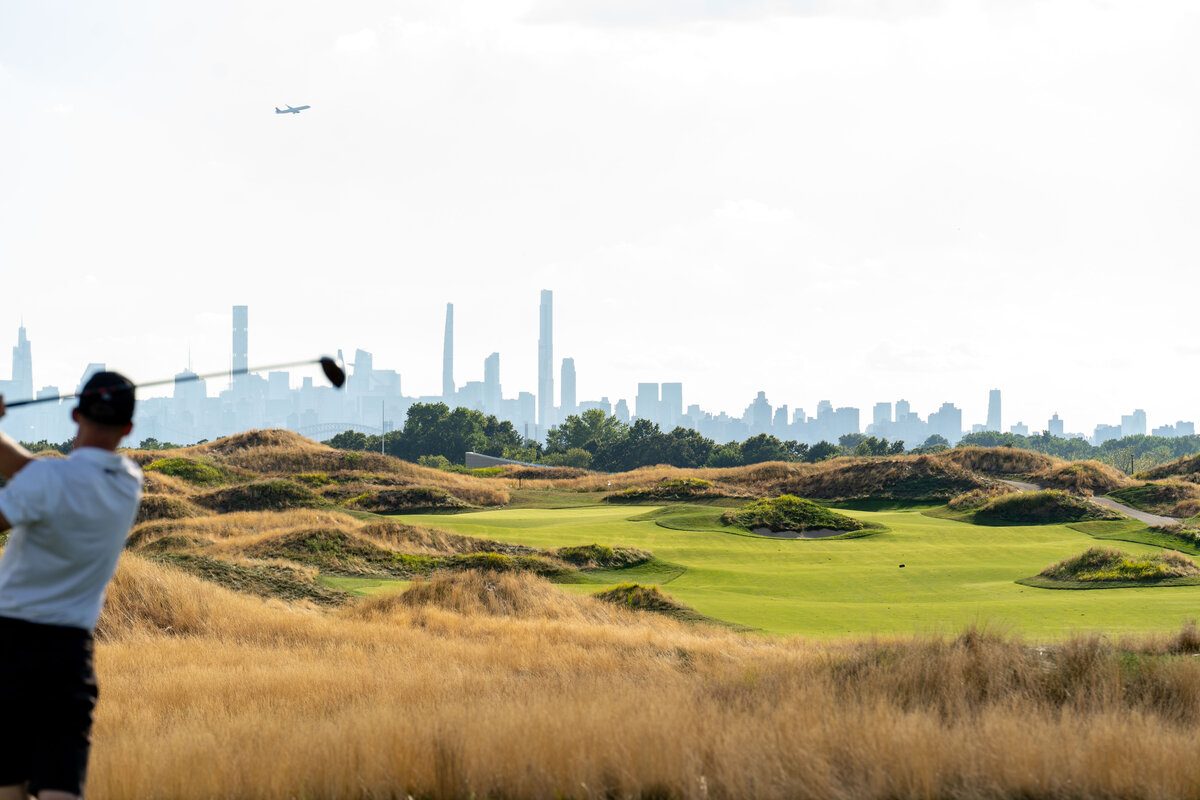
A links in the Bronx. Jack Nicklaus built Ferry Point on a former landfill at the foot of the Whitestone Bridge, and it opened in 2015 as New York City's championship course: a nearly treeless, dune-lined layout of flowing fescue and bold bunkering, 7,400 yards from the back tees, with the East River, both great bridges and the Manhattan skyline taking turns as the backdrop. Nicklaus designed it strong enough to hold a major if the city ever asks, and playable enough to serve the municipal golfers it was built for. No other city course in America looks or plays anything like it. Read our course guide.
The Sagamore Golf Course
Resort
Bolton Landing - Donald Ross (1928)
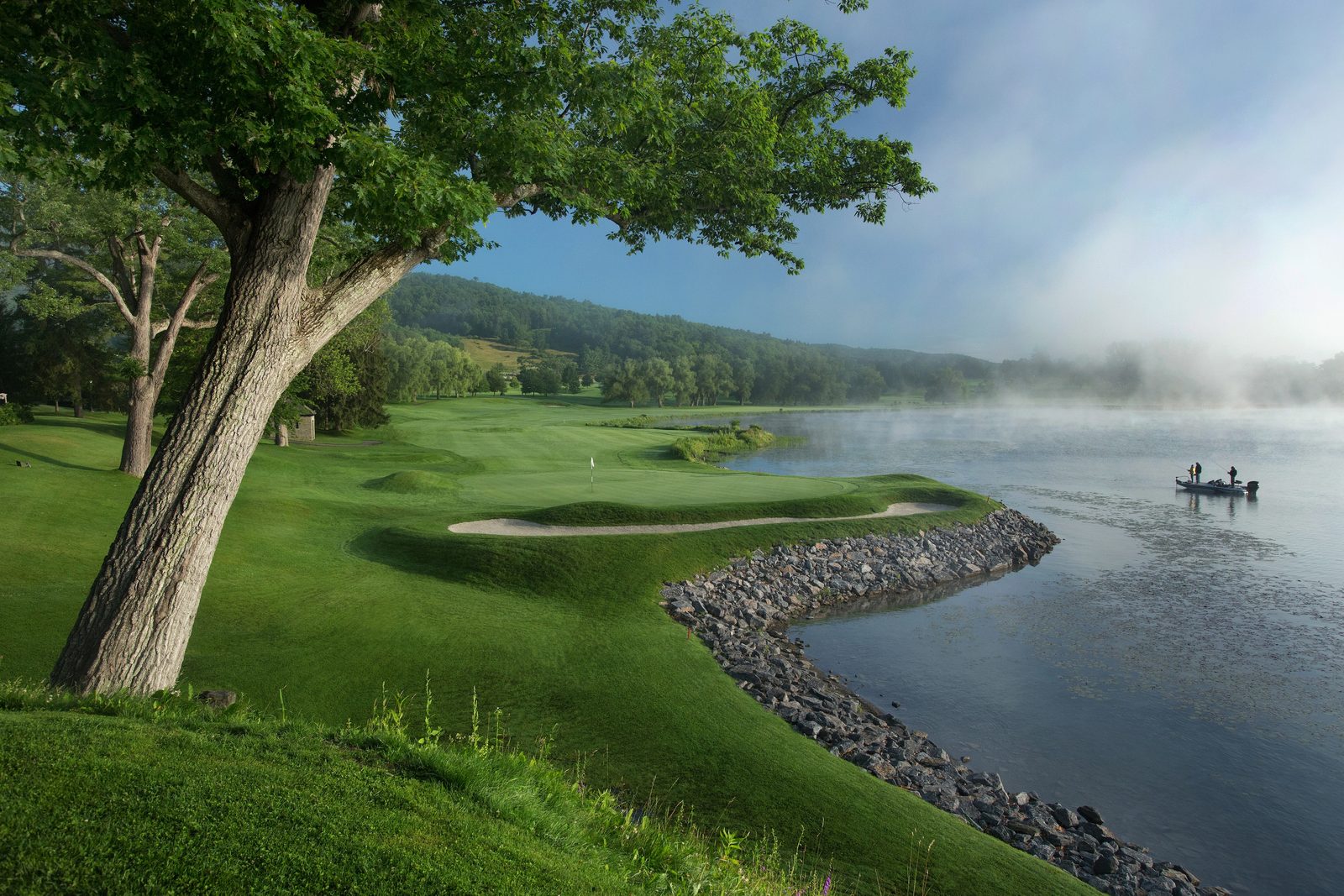
Donald Ross above Lake George. Ross built the Sagamore course in 1928 under his own supervision for the grand resort on Green Island, routing a par-70 championship test through upland meadow and Adirondack hardwoods on the mainland shore. The first tee is the famous view - Ross broke his own rule against opening into the morning sun because the panorama of the lake and the peaks was too good to waste - and the round that follows is pure Ross: narrow fairways, deep bunkers and undulating plateau greens. A 1985 restoration returned the course to Ross's original blueprints, and it remains the Adirondacks' essential round.
Montauk Downs State Park
Public
Montauk - Captain H.C. Tippett (1927), Robert Trent Jones Sr. redesign (1968)
State-park golf at the end of Long Island. Montauk Downs began in 1927 with a Captain H.C. Tippett layout, took its modern championship shape from Robert Trent Jones Sr.'s 1968 redesign, and has been polished since by Rees Jones. It is the only 18-hole publicly owned course in East Hampton Town, which makes it the East End's great democratic answer to the private giants nearby: small, elevated, well-bunkered greens, Atlantic wind that can remake the course from one day to the next, and a state-park green fee within reach of anyone who makes the drive to The End. Read our course guide.
An Irish links built by Irish golfers in Dutchess County. Frustrated by the hunt for New York City tee times, a group of Irish golf societies bought 200 acres of former cattle farmland and hired Stephen Kay and Doug Smith to build the homeland course of their imagination. What opened in 2000 is a delight: a 6,854-yard par-72 links of forced carries, penal fescue, quirky blind shots and views to the Catskills, an hour and a half from the city and a world away from it. Read our course guide.
The other Tillinghast at Bethpage, and a masterpiece in its own right. The Red Course opened in 1935, a year before the Black, and starts with a long uphill par 4 that is widely called one of the finest opening holes on Long Island. From there it trades its sibling's outright punishment for strategy: tree-lined early holes, then a vast fescue-and-bunker plain from the 8th that carries the same rugged Tillinghast muscle with a little more room to breathe. At 7,092 yards it is no soft option - it is simply the most enjoyable championship round most golfers will ever book at a state park. Read our course guide.
Scotland, transplanted to the Rochester suburbs. Craig Schreiner opened Greystone in 1996 as a full-throated links: rolling hills, grass mounding, tall native grasses, pot bunkers and large undulating greens across 7,215 yards. The course takes its name from the gray stone that bulkheads the water on its two most dramatic holes - the par-3 6th and the par-4 18th, where a miss can ricochet straight into the pond. Western New York golfers have treated it as the region's public benchmark for three decades, and Golfweek's panel agrees, keeping it firmly inside the state's top ten. Read our course guide.
Turning Stone Resort Casino (Shenendoah)
Resort
Verona - Rick Smith (2000)
The original championship course at Turning Stone, and still a Tour-caliber examination. Rick Smith opened Shenendoah in 2000 at more than 7,000 yards, routing it through woods and wetlands with the conditioning standards of a private club, then returned in 2016 to redesign his own work. The pros have validated it twice over: the PGA Professional Championship - the national championship of club professionals - was played here in both 2006 and 2016. Paired with Atunyote and Kaluhyat, it gives one Verona resort three of the fifteen best bookable courses in New York. Read our course guide.
The Next Five
Ranks 11-15 complete the picture: Pete Dye in Westchester, a Rulewich test beside the Saratoga races, the Finger Lakes' championship daily fee, Nicklaus in the Hudson Valley, and Turning Stone's third entry. On a long New York trip, this is the bench that fills the second half of the itinerary.
Pound Ridge Golf Club
Public
Pound Ridge - Pete Dye (2008)
Pete Dye's only design in New York, opened in 2008 in the Westchester woods less than an hour from Manhattan: 7,165 yards of cliffs, streams and rock walls, with a giant boulder - Pete's Rock - sitting in the middle of the par-5 13th fairway and the par-3 15th, dubbed Headstone, flanked by a rock outcropping that reaches into the green. Read our course guide.
The upscale daily-fee answer to a day at the races, opened June 2, 2001 on a former horse farm a mile from Saratoga Race Course. Roger Rulewich, a longtime Robert Trent Jones Sr. disciple, built a test of forced carries - sixteen holes ask for one - wetlands, stone walls and the island-green par-3 15th on Lake Lonely.
Ravenwood Golf Club
Public
Victor - Robin Nelson (2002)
The Finger Lakes' championship daily fee, opened in 2002 just east of Rochester. Robin Nelson's big, flowing design was named among Golf Digest's best new upscale daily-fee courses, has hosted the New York State Men's Amateur, and finishes with a par 5 whose green is guarded by seven bunkers and backed by a natural amphitheater hill. Read our course guide.
The only public 18-hole Jack Nicklaus Signature course in New York, opened for daily-fee play on May 11, 1999 on a historic 220-acre Hudson Valley estate. Extreme elevation change, rock formations and stone walls predating the Revolution frame 6,889 yards an hour northwest of New York City. Read our course guide.
The sternest of the Turning Stone trio, opened in 2003. Robert Trent Jones Jr. named it for the Oneida word meaning the other side of the sky and threaded it through woods, wetlands and six lakes - the thinking golfer's counterpoint to Atunyote's open parkland, and the third Turning Stone course on this list. Read our course guide.
Honorable Mentions
Seneca Hickory Stick in Lewiston - a Robert Trent Jones Jr. design that Golfweek ranks among America's top 50 casino courses - leads the next wave, alongside En-Joie in Endicott, the longtime PGA Tour B.C. Open host; the Monster at Resorts World Catskills; Bethpage's own Blue and Green courses; Eisenhower Park's Red Course, another Devereux Emmet design; and Van Cortlandt Park in the Bronx, America's oldest public course. Absent on purpose: Shinnecock Hills, the National Golf Links of America, Fishers Island, Winged Foot, Oak Hill, Friar's Head, Sebonack and Maidstone give New York more great private golf than any state in America - Golf Digest counts three New York courses in its national top ten - but none of them will sell you a tee time, and Mulliganist only ranks courses you can actually play.