Bethpage Black
The People's Country Club, a walking-only championship test that has hosted the U.S. Open, the PGA Championship and the Ryder Cup.
The most famous sign in American golf hangs at the first tee of Bethpage Black in Farmingdale, New York. The warning is printed in plain language. The Black Course is an extremely difficult course and is recommended only for highly skilled golfers. It might be the most honest sign in the game, and it might also be the most beloved, because the course behind it belongs to everyone. Bethpage Black is a municipal golf course in a state park, bookable by any golfer with a license and a phone, and it has hosted the U.S. Open twice, the PGA Championship and the 2025 Ryder Cup. There is nothing else quite like it, a genuine major championship arena that a schoolteacher from Queens can play for seventy dollars.
A.W. Tillinghast built the Black in 1936 as the crown of the Bethpage State Park golf complex, and his design brief seems to have been simple. No mercy, but no tricks either. The course runs 7,468 yards from the Blue tees at par 71, routed over rolling and sandy Long Island terrain, with elevated greens guarded by sprawling bunkers and rough that swallows errant shots whole. Long par 4s arrive in bunches. The par 5s ask for position before power. The walk itself is part of the examination, because the Black is walking only and the hills between the 15th green and the finish are famous in their own right. Golfers who post a score here have earned every number on the card.
What keeps the Black joyful rather than grim is the company it keeps. The tee sheet mixes the footprints of major champions with foursomes of friends who have been making the pilgrimage for decades, sleeping in the parking lot in the old days and refreshing the reservation system at 7 p.m. in the new ones. The conditioning matches the championship pedigree. The bunkers are raked and deep and honest. And the closing stretch in front of the clubhouse terrace has decided a U.S. Open and a Ryder Cup. This is the people's country club, and a round here is a story golfers tell for the rest of their lives.
The Scorecard
The card below is the Blue tee set, the championship tees of Bethpage Black, taken from the course's published scorecard table and corroborated hole for hole by the pro shop scorecard transcription published by LiveAbout. The Blue tees play 7,468 yards at par 71, with a USGA course rating of 78.1 and a slope of 152 - figures on which LiveAbout and Tiger Golf Traveler's published card data agree.
By the Numbers
From the scorecard below: Blue Tees.
A slope of 152 from the Blue Tees, rating 78.1 puts it ahead of about 96% of the 182 courses in our database with a published slope.
| Front nine | Par | Yards |
|---|---|---|
| Hole 1 | 4 | 430 |
| Hole 2 | 4 | 389 |
| Hole 3 | 3 | 230 |
| Hole 4 | 5 | 517 |
| Hole 5 | 4 | 478 |
| Hole 6 | 4 | 408 |
| Hole 7 | 5 | 553 |
| Hole 8 | 3 | 210 |
| Hole 9 | 4 | 460 |
| Total | 36 | 3,675 |
| Back nine | Par | Yards |
|---|---|---|
| Hole 10 | 4 | 502 |
| Hole 11 | 4 | 435 |
| Hole 12 | 4 | 501 |
| Hole 13 | 5 | 608 |
| Hole 14 | 3 | 161 |
| Hole 15 | 4 | 478 |
| Hole 16 | 4 | 490 |
| Hole 17 | 3 | 207 |
| Hole 18 | 4 | 411 |
| Total | 35 | 3,793 |
The front nine runs 3,675 yards at par 36 and the back nine 3,793 yards at par 35, for 7,468 yards and par 71 in total. The shape of the card tells the Black's story well enough on its own. Four par 4s stretch over 475 yards, a 608-yard par 5 at the 13th plays as a three-shot hole even for professionals, and the closing par 4 of just 411 yards runs uphill to a green beneath the clubhouse, where a tired swing at the end of the long walk gets punished one final time. Every published set of tees at Bethpage is a serious test. The Blue set is simply the one the majors made famous.
Green Fees
- NYS Resident - 18 Holes, Weekday$70
- NYS Resident - 18 Holes, Weekend$80
- NYS Resident - Twilight, Weekday$44
- NYS Resident - Twilight, Weekend$50
- Non-Resident - 18 Holes, Weekday$140
- Non-Resident - 18 Holes, Weekend$160
- Non-Resident - Twilight, Weekday$88
- Non-Resident - Twilight, Weekend$100
- LocationFarmingdale, New York
- Par / Yardage71 / 7,468 yards (Blue Tees)
Green fees are New York State Parks' own published Bethpage rates, taken from the price list dated April 22, 2026, with the resident and non-resident tiers shown separately exactly as Parks publishes them. New York State residents who have turned or will turn 62 in the current year, and residents under 18, pay less, at $47 for 18 holes and $30 at twilight. A valid New York State driving license is the only acceptable proof of residency, and a $5 per-player reservation fee applies. The Black is walking only, with no riding carts, and every golfer carries or pulls their own bag up one of the great walks in American golf.
The Story
Bethpage State Park took shape in the 1930s on the former estate lands of Farmingdale, developed as a public works project with golf at its heart. The Red and Blue courses opened first in 1935, and Tillinghast's Black followed in 1936 as the most ambitious of the set, a championship course built for the public from the very first spade of earth. Tillinghast routed it across the property's most dramatic ground, pushing tees onto ridges and greens onto plateaus, and gave it the scale and severity he usually reserved for wealthy private clubs. For most of the twentieth century the Black was a beloved regional secret, famous among New York golfers and unknown almost everywhere else.
That changed forever in 2002, when the U.S. Open came to Bethpage and Tiger Woods won wire to wire as the only player to finish under par. The galleries were enormous, loud and proudly New York, and the championship announced the Black to the world as both a brutal test and a populist triumph. The Open returned in 2009, when Lucas Glover won a rain-soaked marathon that finished on Monday. The PGA Championship followed in 2019, won by Brooks Koepka after a Sunday wobble that nearly let the field back in. The Barclays playoff events in 2012 and 2016 added two more chapters, and in September 2025 the Black hosted the Ryder Cup, the first municipal course ever to hold it. A state park course now sits on the shortest of lists in championship golf, and it still costs less than a Broadway ticket.
Signature Holes
Hole 4 - Par 5, 517 yards
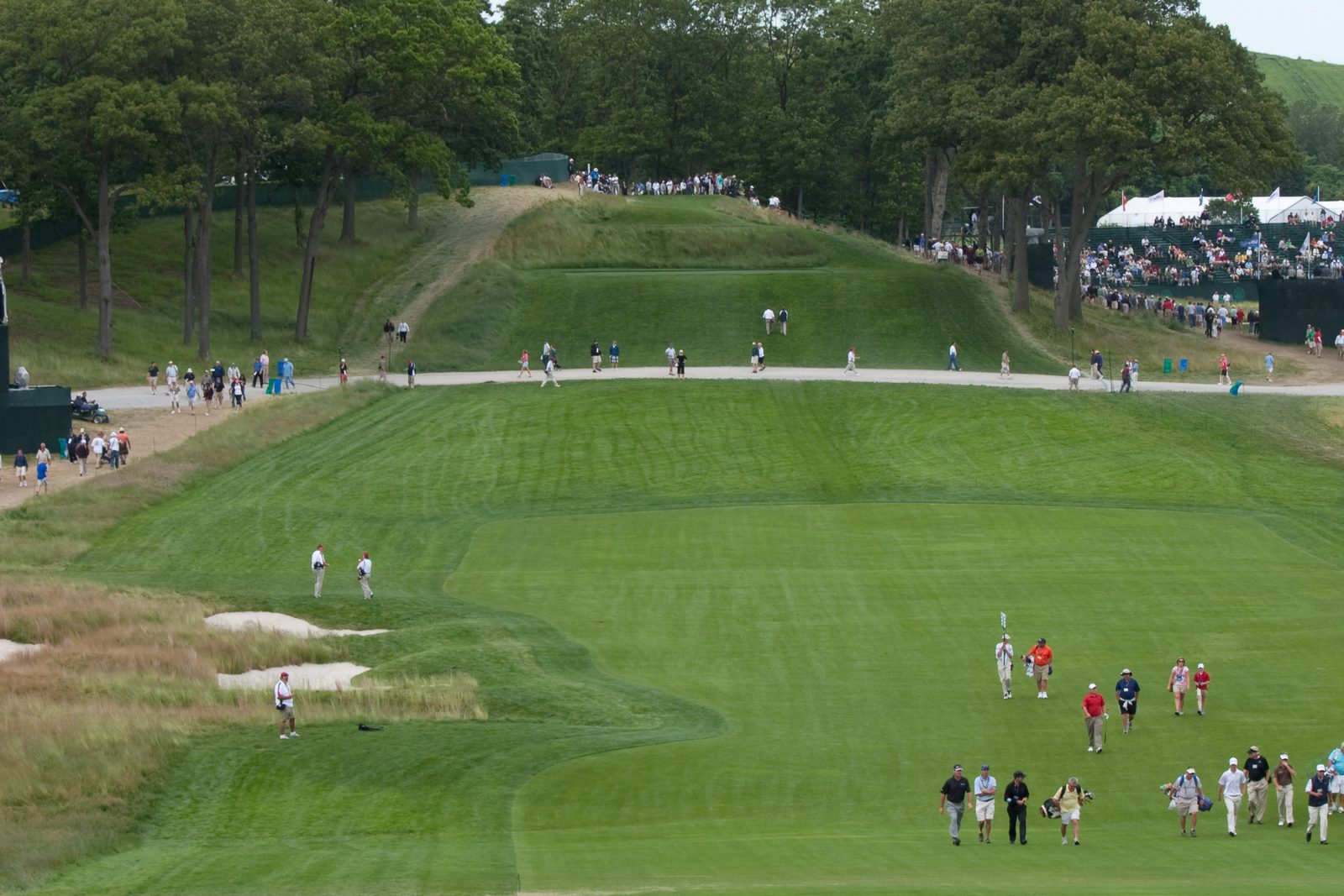
The first par 5 is the Black's great strategic set piece, a double dogleg that bends right off the tee and then left toward a green perched on a plateau. The tee shot must find the correct side of the fairway to open up the second shot, which threads between bunkers toward a layup shelf. The approach then climbs to a green guarded front and sides by sand. From the fairway the whole hole unfolds like a diagram of Tillinghast's thinking. Every shot asks a question, and the questions get harder the bolder the answers.
Hole 15 - Par 4, 478 yards
The 15th is widely considered the hardest hole on the course, a long par 4 that doglegs left and then climbs steeply to one of the most elevated greens in championship golf. The drive must carry the corner bunkers and hold a narrowing fairway, and the approach is played blind or semi-blind uphill to a green that sits like a tabletop above a deep front bunker. Golfers who walk off with a par here have hit two of the finest shots of their round back to back, and the view back down the hill from the green is the reward.
Hole 17 - Par 3, 207 yards
The penultimate hole is a long iron or hybrid over a sea of sand to a wide, shallow green angled away from the tee. Five bunkers ring the putting surface, the wind off the Atlantic side of Long Island is rarely still, and the green's diagonal shape means the pin position changes the shot completely from one day to the next. In the 2002 U.S. Open this hole helped separate Tiger Woods from the field, and in casual play it separates a good round from a great one with the same quiet efficiency.
Where Length Stops Being Polite
Forget the warning sign for a moment and look at the card alone. At 7,468 yards for par 71, with a rating of 78.1 and a slope of 152, the Black asks for length on almost every hole and then asks for it again on the walk between them. Eleven par 4s carry the round, four of them stretch past 475 yards, and the back nine at 3,793 yards plays longer than the front nine at 3,675. That imbalance matters late, when legs are heavy from a walking only round and the hills toward the finish start to collect their tax.
Tillinghast built the pressure in layers rather than in single hazards. Elevated greens sit behind sprawling bunkers, rough swallows anything loose, and the par 5s reward position before power instead of handing out free swings. The 4th shows the method best, a 517-yard double dogleg that bends right and then left to a plateau green, where the correct side of the fairway decides whether the second shot even has a sensible line. Played boldly without that position, the hole closes down fast, and the questions only get harder the bolder the answers become.
The closing argument comes at the 15th and the 17th, the two holes the review singles out for good reason. The 15th, at 478 yards and widely considered the hardest hole on the course, doglegs left and climbs steeply to a tabletop green above a deep front bunker, demanding two fine shots back to back. Two holes later the 207-yard 17th spreads five bunkers around a wide and shallow green angled away from the tee, so the pin position alone changes the shot completely. Long and straight ball strikers who can also control trajectory into elevated greens get rewarded here. Anyone leaking drives into the rough, or floating hopeful approaches toward guarded plateaus, pays on almost every hole.
Practical Info
Bethpage State Park sits in Farmingdale on Long Island, roughly an hour east of Manhattan by car or Long Island Rail Road. Tee times are the hard part. New York State residents can book seven days in advance through the state's online reservation system and non-residents five days, and Black tee times vanish within moments of release, especially on weekends. Registered golfers should log in before the booking window opens. The Black is walking only, so arrive ready for a hilly four-to-five-hour walk. Pull carts are available and caddies can be arranged, and the park's other four courses, the Red, Blue, Green and Yellow, make a fine second round or a warm-up the day before.
The fees are the famous bargain. New York State residents pay $70 on weekdays and $80 on weekends for 18 holes, and non-residents pay $140 and $160, with twilight and senior and junior rates below those figures in the fee table's full published schedule. A valid New York State driving license is the only acceptable residency proof. Play the tees that suit your game, because the White tees at 6,684 yards are still a championship examination for most golfers. And take a moment at the first tee to read the warning sign, the most photographed plaque in public golf. It is not wrong. It is absolutely worth it.
Questions, Answered
How hard is it to get a Bethpage Black tee time?
Very competitive but genuinely open to everyone. New York State residents book seven days ahead and non-residents five days ahead through the state reservation system after a one-time registration, and prime Black times are claimed within moments of release. Flexibility on day and hour is the visitor's best friend, and the park's four other courses, led by the Red, are excellent same-trip alternatives.
Can anyone play Bethpage Black, or is it members and residents only?
Anyone can play. Bethpage Black is a public course in a New York State Park; non-residents simply pay the published non-resident rate, $140 on weekdays and $160 on weekends for 18 holes, against $70 and $80 for residents. The only gate is the tee sheet itself.
Is Bethpage Black really walking only?
Yes. No riding carts are permitted on the Black Course, a rule that has held through its U.S. Opens, its PGA Championship and the 2025 Ryder Cup. Pull carts are available and caddies can be arranged; golfers should expect a hilly walk of about five miles and wear proper golf shoes for the climbs, especially the rise to the 15th green.
Keep Exploring New York
Read our New York Golf Guide for more top courses, green fees, and trip planning across the state.
Bethpage Black features in our ranking of the 15 Best Golf Courses in New York.
More New York course guides: Leatherstocking Golf Course, Turning Stone Resort Casino (Atunyote), Bally's Golf Links at Ferry Point, Montauk Downs State Park, Bethpage Red, The Links at Greystone, Turning Stone Resort Casino (Shenendoah), Pound Ridge Golf Club, Ravenwood Golf Club, The Golf Club at Mansion Ridge, Turning Stone Resort Casino (Kaluhyat) and The Links at Union Vale.
Photos: Dov Harrington (CC BY 2.0, via Wikimedia Commons)
