Every course you can play - from three Big Cedar Lodge courses in the Ozark hills to a Tillinghast municipal reborn in Kansas City, by way of Lake of the Ozarks resort golf and Gary Player and Arthur Hills in St. Louis. Public, resort and semi-private only: if a course will not sell you a tee time, it is not on this list.
15Courses You Can Play
337Golf Courses Statewide
54Championship Holes At Big Cedar Lodge
1934Oldest Course On The List
Missouri golf has a new center of gravity and three old ones. The new one is Branson, where Johnny Morris's Big Cedar Lodge has stacked three nationally ranked 18-hole courses - by Coore and Crenshaw, Tom Fazio and Tiger Woods - into the ridges above Table Rock Lake, with two more of the state's top seven a short drive away. The old ones need no apology: Lake of the Ozarks, where resort golf has run since the dam went in; Kansas City, whose parks department holds two of the state's top ten, including a Tillinghast design restored to national attention in 2026; and St. Louis, where the famous names are private but the public bench - Fazio in the river bluffs, Gary Player and Arthur Hills in the Meramec hills - is deeper than its reputation. These are the fifteen bookable courses worth planning a trip around.
How we chose them
Our fifteen starts with Golfweek's 2026 Best Courses You Can Play panel for Missouri, whose top ten we keep in order - Ozarks National first, Buffalo Ridge Springs second, Payne's Valley third, Branson Hills fourth, Creekmoor fifth, Old Kinderhook sixth, LedgeStone seventh, Swope Memorial eighth, Stone Canyon ninth and Shoal Creek tenth - cross-checked against LINKS Magazine's 2026 Missouri top ten, which names the identical ten courses with the restored Swope Memorial higher, Golf Digest, which keeps all three Big Cedar courses on its America's 100 Greatest Public Courses list and in the state's overall top ten, and GolfPass's Golfers' Choice polling, which lifts Mozingo Lake, Tapawingo and Pevely Farms into our Next Five alongside Missouri Bluffs and Osage National. Access calls, stated plainly: the Big Cedar Lodge trio, Old Kinderhook and Osage National are resort rounds that sell tee times to anyone, no stay required; Creekmoor and LedgeStone are semi-private in their own descriptions - members and residents book first, and public tee times follow; Stone Canyon calls itself a public golf club in its own words; and The Club at Porto Cima and Dalhousie, two celebrated Lake and Cape Girardeau names, are private on current evidence and are not ranked. Every other course sells daily-fee tee times to anyone. No green fees are published on this page, because Missouri's top end prices dynamically by season, day and package. No Missouri course is in our national top 25 yet: Ozarks National, the state's consensus top course and a fixture on national public lists, holds the strongest claim, and it is the leading candidate for a future national list.
Access key: Public anyone can book · Resort bookable with a stay or as a resort guest · Semi-private members plus public tee times
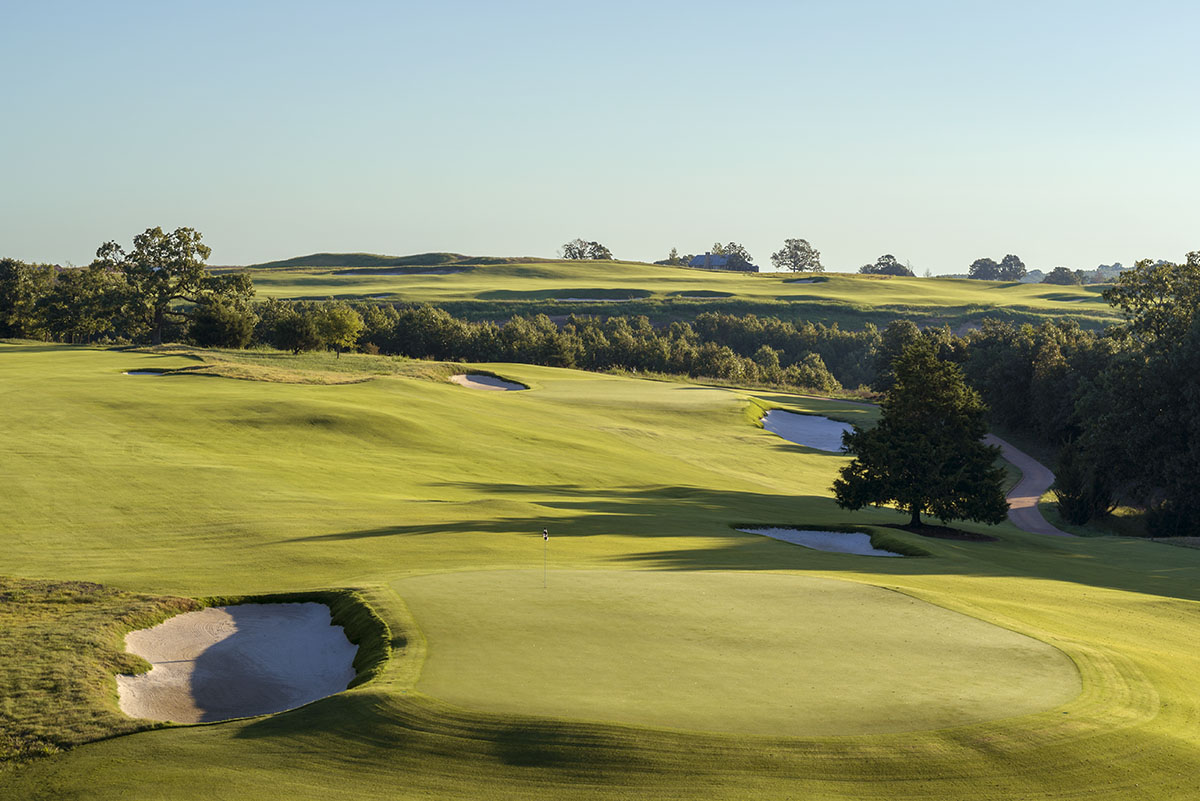
Coore and Crenshaw on a maze of Ozark ridgelines, and the summit of Missouri golf. Bill Coore worried at first that the tumbling ground above Table Rock Lake would force a routing of nothing but Cape holes; instead he and Ben Crenshaw found a par 71 of 7,036 yards that flows along the ridges through cedar glades and native grasses, all reveal and no filler, after a preview season in the fall of 2018 and a formal opening in 2019. The championship test arrived quickly: in August 2020 the PGA Tour Champions came for Phil Mickelson's senior debut, and he won with rounds of 61, 64 and 66, driving the green at the 352-yard par-4 5th, its green backed by a century-old stone house, and holing the eagle putt. Golfweek's panel puts Ozarks National first among Missouri courses you can play, and Golf Digest keeps it among America's 100 Greatest Public Courses. It is the design-lover's round at Johnny Morris's Big Cedar Lodge, and the anchor of the Branson destination. Read our course guide.
Big Cedar Lodge (Buffalo Ridge Springs)
Resort
Hollister - Tom Fazio & Johnny Morris (1999)
The original Big Cedar championship course, reborn. Tom Fazio built the course in 1999 as Branson Creek, and it was a fixture on national top-100 public lists before Johnny Morris acquired it in 2013 and rebuilt it with Fazio's hand on the work: bunkers rebuilt, exposed rock formations brought into play, water features added and expanded, and a new name, Buffalo Ridge Springs, borrowed from the free-roaming bison herd of the adjacent 10,000-acre Dogwood Canyon Nature Park that grazes in view of several holes. The golf is 7,036 yards of par 71 across the same dramatic ridgelines as its younger siblings. With Top of the Rock it co-hosted the PGA Tour Champions' Bass Pro Shops Legends of Golf from 2014 to 2019. Golfweek's panel puts it second among Missouri courses you can play - the scenic elder statesman of the Big Cedar trio. Read our course guide.
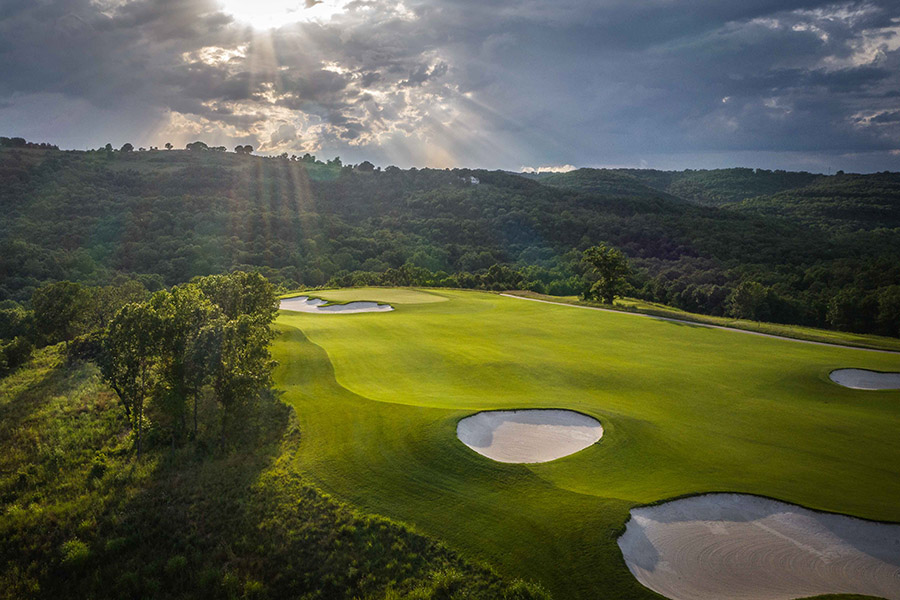
Tiger Woods's first public course, built as a love letter to Missouri golf. Payne's Valley is the first public layout from TGR Design in the United States, named for Payne Stewart, the Springfield native and three-time major champion, and it opened in September 2020 with a televised exhibition matching Woods against Rory McIlroy, Justin Thomas and Justin Rose. The design brief was joy: sprawling fairways, low rough and green surrounds that invite invention across 7,370 yards of par 72, with the Ozarks supplying the drama - tree-cloaked ridges, exposed rock at every turn, a peninsula green at the 5th and a plunging par 3 at the 10th. Then comes the encore, the bonus 19th hole called The Rock: a 136-yard island-green par 3 framed by waterfalls pouring down massive rock walls, and a cart ride back up through the formations to finish. Golfweek's panel puts it third among Missouri courses you can play. Read our course guide.
Branson Hills Golf Club
Public
Branson - Chuck Smith & Bobby Clampett (2009)
A tribute course that plays like a thrill ride. Chuck Smith, with former U.S. Amateur champion Bobby Clampett consulting, opened the course in June 2009 as the Payne Stewart Golf Club, and every hole still carries a plaque telling a story from Stewart's career, while the clubhouse keeps a museum of his Ryder Cup bags and his 1999 U.S. Open replica trophy. The golf honors him properly: 7,324 yards of par 72 that starts with a 464-yard par 4 plunging 130 feet from tee to green and never lets up - elevation changes, creeks, waterfalls, stonework and brilliant white-sand bunkers through the wooded Ozark hills. The club records that Golfweek ranked it first in Missouri from 2012 to 2018, before the Big Cedar courses arrived, and the honors continue: GolfPass's Golfers' Choice for 2026 placed it among America's Top 50 public courses and first in Missouri. Golfweek's current panel puts it fourth in the state.
The Golf Club at Creekmoor
Semi-private
Raymore - Tom Clark (2007)
Kansas City's premier semi-private course, in the words of its own community association. Tom Clark designed Creekmoor in 2007 on the highest point in Cass County, twenty minutes south of downtown Kansas City: 7,406 yards of par 72 with 65 bunkers, none of them small, Zoysia fairways that sit the ball up like a tee and firm, fast bentgrass greens. It is the centerpiece of a residential community, yet the houses stay visible without ever intruding, and the wetlands and woodlands do the framing. Members book ten days out, residents seven and guests five, which is the semi-private model working exactly as it should. The championship credentials are current: Creekmoor hosted the 2026 Kansas City Amateur Championship. Golfweek's panel puts it fifth among Missouri courses you can play, and first among the Kansas City metro's bookable courses.
Old Kinderhook
Resort
Camdenton - Tom Weiskopf (1999)
Lake of the Ozarks golf at its most graceful. Tom Weiskopf opened Old Kinderhook in 1999 in a tranquil, tree-lined valley in the Ozark hills above the lake at Camdenton: 6,726 yards of par 71 with water in play on twelve holes, Zoysia fairways, large and subtly undulating bentgrass greens, and rock waterfalls and streams threading the round. The signature moment is the 416-yard par-4 8th, which falls a full 100 feet from tee to a green guarded by hardwoods and wetlands. The course anchors a full resort community - lodge, marina country all around, and the lake's boating life minutes away - which makes it the natural golf base for a Lake of the Ozarks trip. Golfweek's panel puts it sixth among Missouri courses you can play, and the lake region's first choice.
LedgeStone Country Club
Semi-private
Branson - Tom Clark (1994)
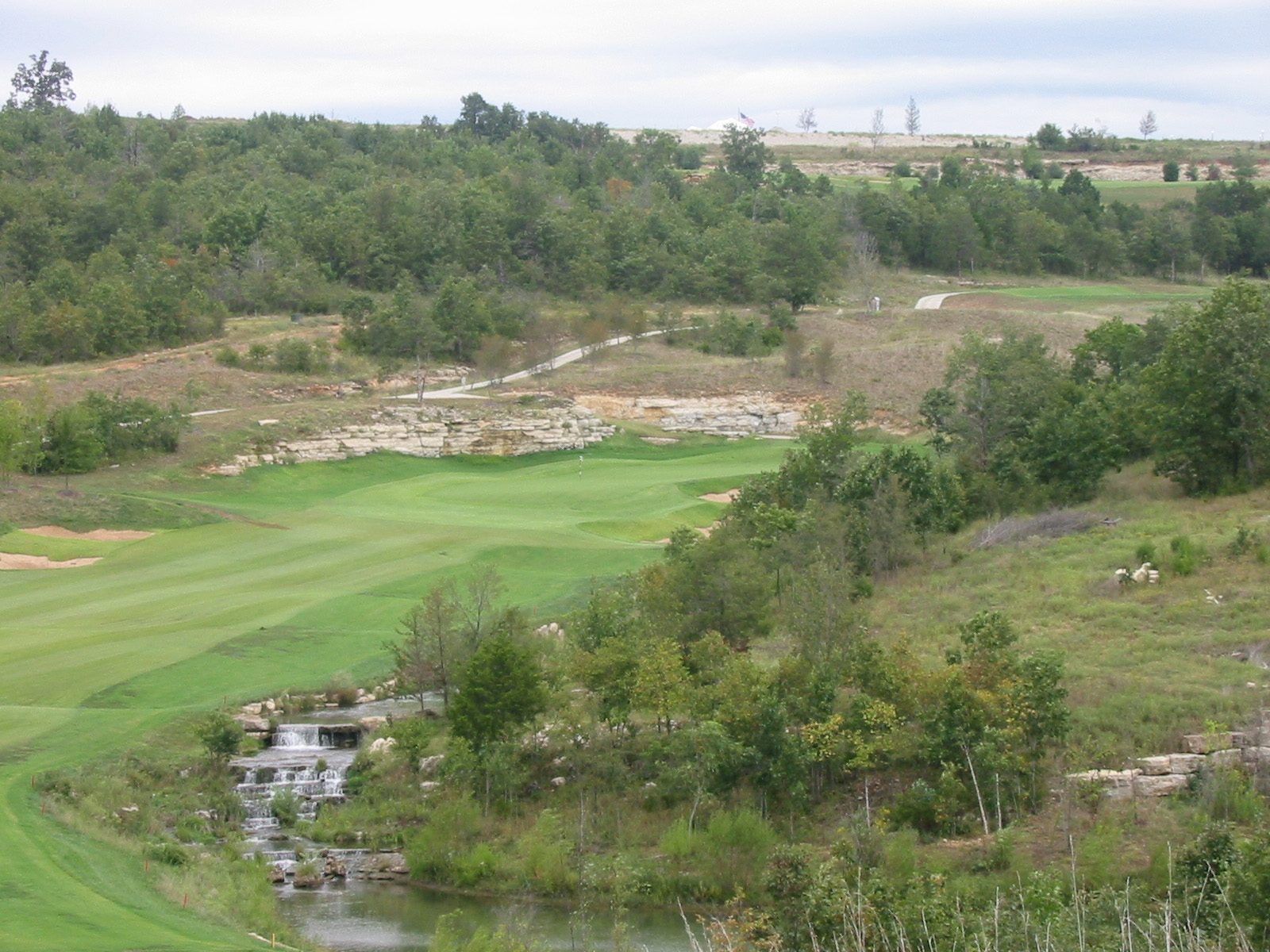
The Ozarks in their rawest form, ten minutes from the Branson Strip. Tom Clark - his second course on this list, after Creekmoor - built LedgeStone in 1994 inside what is now StoneBridge Village in Branson West: 6,881 yards of par 71 that zig and zag through stone walls and quarries, steep climbs and drops, in a wooded setting that feels a world away from the neon. The holes carry names for their features - Sidewinder, The Shelf, The Plunge - and the showstopper is the par-3 15th, The Quarry, which drops some ten stories to a green sandwiched between a water-filled quarry in front and a high stone wall behind. The club is owned by the village's property owners, sells annual memberships, and has transitioned to semi-private by opening its tee sheet to the public. Golfweek's panel puts it seventh among Missouri courses you can play.
Swope Memorial Golf Course
Public
Kansas City - A.W. Tillinghast (1934)
A Tillinghast municipal, restored to glory in 2026 - the feel-good story of Missouri golf. Swope Memorial was Kansas City's first public course, built in 1915 in Swope Park, and A.W. Tillinghast completely redesigned it, reopening in 1934 with his dolomites, bold greens and artistic bunkering. It hosted the PGA Tour's Kansas City Open in 1949 - the only public course in the area to host the event - the 1953 United Golf Association National Championship, won by Charlie Sifford and Ann Gregory, and the 2005 USGA Women's Amateur Public Links. After an 18-month restoration by CE Golf Design's Todd Clark and Brent Hugo, with architecture historian Ron Whitten advising, the course reopened to public play on August 1, 2026 with Tillinghast's greens, bunkers and mounding back in place and the Kansas City skyline back in view - by the restoration team's account, the only public Tillinghast course in America that keeps all of its original holes and routing. Golfweek's panel puts it eighth among Missouri courses you can play, and its classic tag honors the 1934 design.
Stone Canyon Golf Club
Public
Blue Springs - Greg Norman (2009)
Greg Norman in the Kansas City hills, and proudly public about it. In the club's own words, Stone Canyon is a public golf club and home to the only Greg Norman Signature design in the Midwest. Norman opened it in 2009 in Blue Springs, east of Kansas City: 7,059 yards of par 72 with bentgrass from tee to green, his trademark tattered-edge bunkers and shaved green surrounds, and a routing draped over rock walls and stone outcroppings. The postcard is the 381-yard par-4 3rd, which finishes at a green set inside an amphitheater of rocks. New ownership in 2015 invested in the course and its conditioning, and the current record shows a slope of 144 from the back tees - this is a full championship examination hiding in a city suburb. Golfweek's panel puts it ninth among Missouri courses you can play.
Shoal Creek Golf Course
Public
Kansas City - Steve Wolfard (2001)
Kansas City's other municipal treasure. Shoal Creek is a Kansas City Parks and Recreation course in the city's Northland, designed in 2001 by Steve Wolfard - who learned the trade working with Jack Nicklaus and Jack Nicklaus II - as his first solo creation. It stretches 6,952 yards of par 71, with a slope of 140 from the Gold back tees, and although it weaves through a residential development, nature is the dominant motif: dense woods, wetlands slashed across fairways, and rock walls in the Ozark-edge style of the region. The finish is formidable, a 455-yard par 4 that slithers through the trees to a wide, shallow green guarded by a large bunker. Together with Swope Memorial it gives one city parks department two of the state's top ten courses you can play - a municipal double few American cities can match. Golfweek's panel puts it tenth, newly returned to the ranking.
The Next Five
Ranks 11-15 complete the picture: St. Louis's Fazio flagship in the river bluffs, Arnold Palmer's 27 holes at Lake of the Ozarks, the Maryville municipal that Golf Digest once named the best new public course in America, Gary Player's 27-hole St. Louis staple, and Arthur Hills in Eureka. On a long Missouri trip, this is the bench that fills the second half of the itinerary.
Missouri Bluffs Golf Club
Public
St. Charles - Tom Fazio (1995)
St. Louis's championship public, and the only Tom Fazio design in the area, in the club's own description. Fazio opened Missouri Bluffs in 1995 above the Missouri River bluffs in St. Charles: 7,047 yards of par 71 through rolling hills lined with hundred-year-old trees, Zoysia fairways and bentgrass greens. The Missouri Division of Tourism calls it widely considered one of the best championship public golf courses in Missouri, and for three decades it has been the first name St. Louis golfers give a visiting player. On a St. Louis trip it is the essential round, thirty minutes from downtown.
Osage National Golf Resort
Resort
Lake Ozark - Arnold Palmer (1992)
Arnold Palmer on the Osage River, at resort scale. Palmer's original 18 - the River and Mountain nines - opened in 1992 near Lake of the Ozarks, and a third nine, the Links, followed in 1998, giving the resort 27 holes that combine up to 7,167 yards of par 72 with big elevation changes and river-valley scenery. Golf Digest's course record credits a 2025 renovation by the CE Golf Design team, the same architects behind Swope Memorial's restoration. Onsite condos and stay-and-play packages are available, but no stay is required for a tee time - it is the Lake of the Ozarks' second essential round, after Old Kinderhook.
Mozingo Lake Golf Course
Public
Maryville - Donald Sechrest (1995)
The little city course that beat America. Maryville, a northwest Missouri college town, opened Donald Sechrest's design on the banks of Mozingo Lake in 1995, and Golf Digest named it the Best New Public Golf Course in America for 1996. The love has lasted: GolfPass reviewers voted it the top course in Missouri in 2023 and second in 2026, and the AJGA brought its Maryville Junior to the course in August 2026. It plays 7,137 yards of par 72 across rolling, open ground, and Tom Watson's Watson 9 junior course, opened in 2016, sits beside it - a municipal facility that keeps punching at championship weight.
Tapawingo National Golf Club
Public
Sunset Hills - Gary Player (1994)
Gary Player's 27 holes in the Meramec River valley, and a St. Louis institution. In the club's own words it is a centrally located public course, where rivers, lakes and hardwood forests frame three Player-designed nines - the Woodlands, the Prairie and the Meramec - that opened from 1994 and combine up to 7,151 yards of par 72. The Woodlands' par-3 3rd, played over a lake, is the postcard. GolfPass included Tapawingo in its Editors' Choice selections for Missouri in 2026, and for a generation of St. Louis golfers it has been the metro's premium public round.
Pevely Farms Golf Club
Public
Eureka - Arthur Hills (1998)
Arthur Hills on a former farm above the Meramec valley. Hills opened Pevely Farms in 1998 in Eureka, southwest of St. Louis, stretching some 7,100 yards of par 72 across tree-lined, rolling ground with Zoysia fairways and bentgrass greens - a strategic layout of doglegs and forced layups that GolfPass reviewers reward with some of the highest layout and conditioning marks in the state. It sits on GolfPass's 2026 Golfers' Choice list for Missouri, and with Tapawingo and Missouri Bluffs it completes the St. Louis area's three-course public trip.
Honorable Mentions
Thousand Hills Golf Course in Branson (Robert E. Cupp, 1995) leads the next wave - a Golf Digest four-star course and repeat Best of the Ozarks readers' winner in the heart of the Strip, held here only because its 5,111-yard, par-64 card is an executive-length test on a list of regulation courses - alongside The Quarry at Crystal Springs in Maryland Heights, the Norman K. Probstein course at Forest Park in St. Louis (27 municipal holes in one of America's great urban parks), the Lodge of Four Seasons' two public courses in Lake Ozark (The Cove, Robert Trent Jones Sr., and The Ridge, Ken Kavanaugh), Bear Creek Valley Golf Club in Osage Beach, Eagle Knoll Golf Club in Hartsburg (Gary Kern, 1996, on the Missouri River bluffs), Holiday Hills and Pointe Royal in Branson, and Tiffany Greens Golf Club in Kansas City (Robert Trent Jones Jr.). Big Cedar Lodge's three short courses - Top of the Rock (Jack Nicklaus), Mountain Top (Gary Player) and Cliffhangers, all rated among the nation's best short courses by LINKS Magazine - are destination golf of the first order, but as par-3 layouts they are amenities of the resort's three ranked courses rather than entries here. Two geography notes: Gateway National Golf Links, the Keith Foster course St. Louis golfers treat as a home track, sits across the river in Madison, Illinois, and Kansas City's Kansas-side publics belong to a Kansas list. Absent on purpose: Bellerive Country Club in St. Louis - host of the 1965 U.S. Open, the 1992 and 2018 PGA Championships and the 2026 BMW Championship - plus St. Louis Country Club (C.B. Macdonald, 1914), Old Warson Country Club, Boone Valley Golf Club in Augusta, Dalhousie Golf Club in Cape Girardeau (Gary Nicklaus, 2002 - a private national club in its own words), The Club at Porto Cima at Lake of the Ozarks (Jack Nicklaus, members and their guests), the Country Club of St. Albans, and Kansas City's Oakwood, Kansas City Country Club and Blue Hills make Missouri a genuinely deep private-golf state - but none of them will sell you a tee time, and Mulliganist only ranks courses you can actually play.