Payne's Valley
Tiger Woods's first public course, 7,370 yards of wide-open Ozarks joy ending at the island-green 19th hole beneath The Rock.
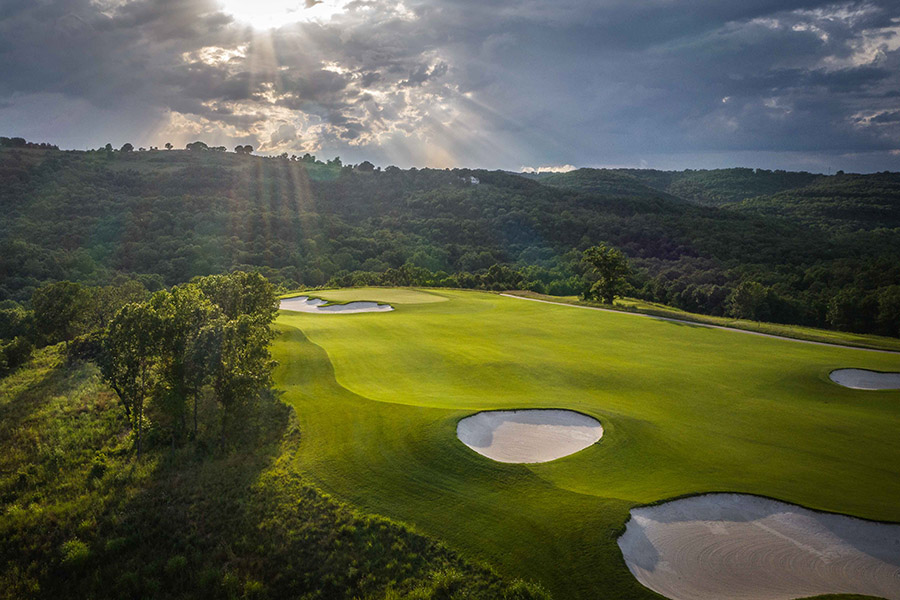
This is the most joyful hard course in America. Payne's Valley, Tiger Woods's first public-access design, spreads across the limestone canyon country above Table Rock Lake at Big Cedar Lodge with fairways so wide they reframe what a championship course can feel like. The design brief, as Woods's team at TGR Design described it from the start, was fun at full scale. Eighty-five acres of fairway, enormous greens, low rough and surrounds that invite invention, stretched across 7,370 yards of par 72. We rank it third among Missouri courses you can play, and the readers of USA TODAY just voted it the best public course in America for 2026, an honor the resort now leads with.
The scale is the first surprise and the strategy is the second. The fairways forgive the tee ball, but the greens defend themselves with size and contour, and a ball on the wrong tier is a three-putt waiting to happen. The par 3s carry the postcards, the peninsula green at the 5th and the plunging 10th with its heart-shaped green and waterfalls behind. Then the round refuses to end at 18. A bonus 19th hole, the island-green par 3 called The Rock, waits beneath a towering limestone wall, and the cart ride back climbs through the rock itself.
The name does quiet work, too. The course honors Payne Stewart, the Springfield native and three-time major champion whose style and spirit Missouri golf still claims as its own. Woods, a Stanford man with no Missouri roots, built him a tribute that plays like a celebration rather than a memorial. For the resort golfer this is Big Cedar's showpiece round, the one with the widest grin, and the natural pairing with the architectural seminar happening next door at Ozarks National.
The Scorecard
The card below shows the Tiger tees, the back set, taken from the club's own printed scorecard. It plays 7,370 yards at par 72, rated 75.6 with a slope of 132, and it foots exactly, 3,624 yards out and 3,746 back. The card carries a nineteenth line for the bonus hole, 134 yards of par 3 that stands outside the 72, and the club's Pace guidance asks five hours for the full 19, which tells you something about both the scale and the sightseeing.
By the Numbers
From the scorecard below: Tiger tees.
Slope 132 from the Tiger tees, rating 75.6 - a sterner test than about 15% of the 182 courses in our database with a published slope.
| Front nine | Par | Yards |
|---|---|---|
| Hole 1 | 4 | 483 |
| Hole 2 | 3 | 267 |
| Hole 3 | 4 | 334 |
| Hole 4 | 5 | 544 |
| Hole 5 | 3 | 188 |
| Hole 6 | 4 | 444 |
| Hole 7 | 4 | 368 |
| Hole 8 | 5 | 567 |
| Hole 9 | 4 | 429 |
| Total | 36 | 3,624 |
| Back nine | Par | Yards |
|---|---|---|
| Hole 10 | 3 | 183 |
| Hole 11 | 4 | 429 |
| Hole 12 | 4 | 341 |
| Hole 13 | 5 | 653 |
| Hole 14 | 4 | 421 |
| Hole 15 | 4 | 456 |
| Hole 16 | 3 | 224 |
| Hole 17 | 4 | 487 |
| Hole 18 | 5 | 552 |
| Total | 36 | 3,746 |
The card's personality is generosity with a long memory. Five sets of tees run from the Tiger set at 7,370 down to 4,957 at the forward markers, and the par 3s tell the story of the design, four of them, none alike, from the 267-yard 2nd that plays shorter downhill to the heart-shaped 10th at 183. The par 5s build in length as the round goes on, 544, 567, then the 653-yard 13th, before the 552-yard finisher brings you home toward the lake and the bonus hole waiting beyond it.
Green Fees
- Peak season, public (from)$525
- Peak season, resort guest (from)$425
- Shoulder season, public (from)$275
- Off season, public (from)$215
- LocationHollister, Missouri
- Par / Yardage72 / 7,370 yards (Tiger tees)
Big Cedar's published 2026 rates, summarized independently by two sources that agree on every figure, put Payne's Valley at the top of the resort's price ladder, with peak season running from mid April to late October. Resort guests pay the lower figure and book the longer windows, and shoulder and off-season starting rates step down to $275 and $250 public and guest, then $215 and $200. The figures are starting points on a seasonal sheet rather than a flat card. Forecaddies work the course in season, and a non-playing rider costs $45 plus tax. GolfLink's $250 estimate belongs to a combined facility entry and matches nothing on the published sheet, so it is not used here.
The Story
Payne's Valley was announced as the first public course from TGR Design, Tiger Woods's design firm, with Big Cedar founder Johnny Morris developing it as the resort's third championship layout. Morris himself designed the bonus 19th hole, an island green set into a lake at the base of a massive limestone outcrop he calls The Rock, with waterfalls pouring down its face. The course opened on September 22, 2020 with the Payne's Valley Cup, a televised exhibition matching Woods and Justin Thomas against Rory McIlroy and Justin Rose for the Payne Stewart Family Foundation.
The exhibition finished tied, so the day came down to closest to the pin on the 19th, where Thomas hit his tee shot to eight feet seven inches to win it. The course has drawn honors at the same pace as crowds. Golfweek's panel places it third among Missouri public courses and inside its 2026 top 200 resort courses, Golf Digest put it 81st on the 2025 list of America's 100 greatest public courses, and USA TODAY's 10Best readers voted it the best public course in America in 2026, a billing the resort's own awards page now carries. For a course that opened as a tribute, the competitive record arrived early and keeps growing.
Signature Holes
Hole 19 - Par 3 - 134 yards (bonus hole)
The most famous extra hole in golf. Johnny Morris designed this island-green par 3 himself, set in a lake at the base of The Rock, a limestone wall some 200 feet tall with waterfalls cascading down its face. It does not count toward the score, which is exactly the point. The round ends with a closest-to-the-pin game beneath a cliff, and the Payne's Valley Cup itself was decided here in 2020, when Justin Thomas stuck his tee shot inside nine feet to settle the match. The cart ride back to the clubhouse then winds up through the rock formations, a finish no other American course attempts.
Hole 5 - Par 3 - 188 yards
The peninsula hole. The 5th plays across a lake to a green that juts into the water, the first of the course's great water par 3s and the one that introduces the canyon-and-lake landscape the routing keeps returning to. At 188 yards from the Tiger tees it asks for a full carry and a committed swing, with the wide fairways of the holes around it offering no hint of the precision suddenly required.
Hole 13 - Par 5 - 653 yards
The brute of the card. At 653 yards the 13th is the longest hole at Big Cedar and a genuine three-shot examination for every golfer alive, the hole preview coverage singled out before the course even opened as the round's true test. The fairway is wide in the Payne's Valley manner, but the yardage is relentless, and the hole anchors a back-nine stretch where the course's friendly reputation quietly hardens.
Width, Then the Greens Decide
Eighty-five acres of fairway sounds like a promise that nothing can go wrong, and for about one hole that promise holds. Payne's Valley gives the tee ball extraordinary room, with low rough and surrounds that invite invention, then moves the entire argument onto the greens. The surfaces are enormous and heavily contoured, and a ball parked on the wrong tier turns a safe approach into a three-putt waiting to happen. Width here is not forgiveness. It is a sorting mechanism, separating golfers who use the space to find the right angle from golfers who simply enjoy the view from the middle and then pay for it on the putting surface.
The par 5s explain how the pressure builds. They grow as the round goes on, from 544 yards at the 4th and 567 at the 8th to the 653-yard 13th, the longest hole at Big Cedar and a genuine three-shot examination for every golfer alive, before the 552-yard finisher brings the round home toward the lake. Set against that climb, the par 3s supply the sudden precision tests. The 188-yard 5th plays across a lake to a peninsula green and demands a full carry with no warning from the generous holes around it. The 183-yard 10th plunges to a heart-shaped green with waterfalls behind. Neither hole is long by the card's standards. Both punish a casual swing out of all proportion to their yardage.
From the Tiger tees the full measure is 7,370 yards at par 72, rated 75.6 with a slope of 132, though five sets of tees step the course down to 4,957 yards for a friendlier version of the same ideas. Then, wonderfully, the round refuses to end on schedule. The bonus 19th hole, a 134-yard island-green par 3 called The Rock beneath a towering limestone wall with waterfalls down its face, plays as a closest-to-the-pin finish that does not count toward the score. It is the perfect summary of the design. Make the serious test generous enough to enjoy, then end with pure theatre.
Practical Info
Payne's Valley shares the Big Cedar golf complex in Hollister with Ozarks National and Buffalo Ridge, using the Ozarks National practice facility and a pro shop reached at the resort's golf number, (800) 225-6343. Public tee times are sold without a lodge stay, with resort guests booking earlier windows at lower rates. The club expects a five-hour pace for the 19 holes, carts have GPS, forecaddies are on hand in season by request, and complimentary snacks appear at the turn. Collared shirts are required for men, soft spikes only, and riders pay $45 plus tax.
Sequence the Big Cedar days by appetite. Payne's Valley is the celebratory round, best played when the light is good and nobody is in a hurry, because the 19th hole and the rock-tunnel cart return are experiences to linger over. Pair it with Ozarks National for the architecture and Buffalo Ridge for the classic ridge golf, and note the seasonal shape of the pricing, with the same course costing barely two-fifths as much on an off-season weekday as on a peak Saturday. Branson's shows and Table Rock Lake fill the non-golf hours without effort.
Questions, Answered
How much does it cost to play Payne's Valley?
Big Cedar's published 2026 rates start at $525 for public golfers and $425 for resort guests in peak season, mid April to late October. Shoulder-season starting rates are $275 public and $250 guest, and off-season rounds start at $215 and $200. The figures come from the resort's published rate structure as summarized by two independent sources that agree, and they are starting points, so prime times can price higher.
What is the 19th hole at Payne's Valley?
A bonus par 3 of 134 yards from the Tiger tees, designed by Big Cedar founder Johnny Morris and called The Rock. The green is an island set in a lake beneath a roughly 200-foot limestone wall with waterfalls, and it plays as a closest-to-the-pin finish after the 18th rather than as part of the score. The Payne's Valley Cup in September 2020 was decided on this hole, Justin Thomas winning it with a tee shot to eight feet seven inches.
Can you play Payne's Valley without staying at Big Cedar Lodge?
Yes. Big Cedar sells public tee times at Payne's Valley with no stay required. Resort guests book earlier windows and pay the lower guest rate, and the public window widens in season, but the course is genuinely open to day golfers at the public rate.
Who designed Payne's Valley and who is it named for?
Tiger Woods and his firm TGR Design built it, their first public-access course, with Johnny Morris designing the bonus 19th hole. It opened on September 22, 2020. The name honors Payne Stewart, the Springfield, Missouri native and three-time major champion, and the opening exhibition, the Payne's Valley Cup, raised money for the Payne Stewart Family Foundation.
Keep Exploring Missouri
Read our Missouri Golf Guide for more top courses, green fees, and trip planning across the state.
Payne's Valley features in our ranking of the 15 Best Golf Courses in Missouri.
More Missouri course guides: Buffalo Ridge Springs and Ozarks National.
More course guides: Pinehurst No. 2.