Every course you can play - from two French Lick resort masterpieces a century apart to three university championship courses, a Pete Dye course with four holes inside the Indianapolis Motor Speedway and the longest par 72 east of the Mississippi. Public, resort and semi-private only: if a course will not sell you a tee time, it is not on this list.
15Courses You Can Play
422Golf Courses Statewide
36Championship Holes At French Lick Resort
1917Oldest Course On The List
Indiana is Pete Dye's home state, and its bookable golf reads like his family album - his volcanic French Lick mountaintop, his Purdue collaboration, his Brickyard Crossing inside the Speedway, his state-park course at The Fort - set among older and younger masters: a Donald Ross original from 1917 at the same resort, a Langford nine in Attica, Coore and Crenshaw at Notre Dame, Steve Smyers and Fuzzy Zoeller at Indiana University, Hale Irwin and Robert Trent Jones Jr. in the Indianapolis suburbs, and Tim Liddy twice, in a Peru quarry and on a Jasper horse farm. The famous private names, Crooked Stick and Victoria National above all, stay behind their gates. These are the fifteen bookable courses worth planning a trip around.
How we chose them
Our fifteen starts with Golfweek's 2026 Best Courses You Can Play panel for Indiana, whose order we keep - the Pete Dye Course at French Lick first, the Donald Ross Course second, the Pfau Course at Indiana University third, the Warren Course at Notre Dame fourth, Purdue's Kampen-Cosler fifth, Coyote Crossing sixth, Purdue's Ackerman-Allen seventh, Rock Hollow eighth and Chariot Run ninth, with Harrison Hills and Brickyard Crossing deadlocked at tenth: Harrison Hills takes the No. 10 slot on its Golden Age bones and Brickyard Crossing heads the Next Five, and both entries say so. Ranks 12-15 blend Golf Digest's best-in-state standing, which placed Prairie View seventh among all Indiana courses including the private clubs and also honored The Fort and Purgatory, with Sultan's Run, which French Lick Resort sells inside its own Southern Indiana Golf Tour package alongside the state's top two. Access calls, stated plainly: French Lick's two courses give overnight resort guests priority booking, with non-guest rounds available by phone, and are tagged Resort on that basis, the same stay-and-play logic on which Firestone ranks in Ohio; Coyote Crossing is semi-private in its own words, open to the public with daily fee rates; Harrison Hills and Sultan's Run describe themselves as public and sell tee times to anyone; every other course on the list is a straightforward public tee time. Otter Creek in Columbus, a former U.S. Amateur Public Links host, is not ranked because it is closed for a full rebuild until 2027 - it is named, with its story, in the honorable mentions. No green fees are published on this page, because Indiana's top end prices by package, season and affiliation. No Indiana course is in our national top 25 yet: the Pete Dye Course at French Lick, the state's consensus top course and a fixture on national public-course lists, holds the strongest claim, and it is the leading candidate for a future national list.
Access key: Public anyone can book · Resort bookable with a stay or as a resort guest · Semi-private members plus public tee times
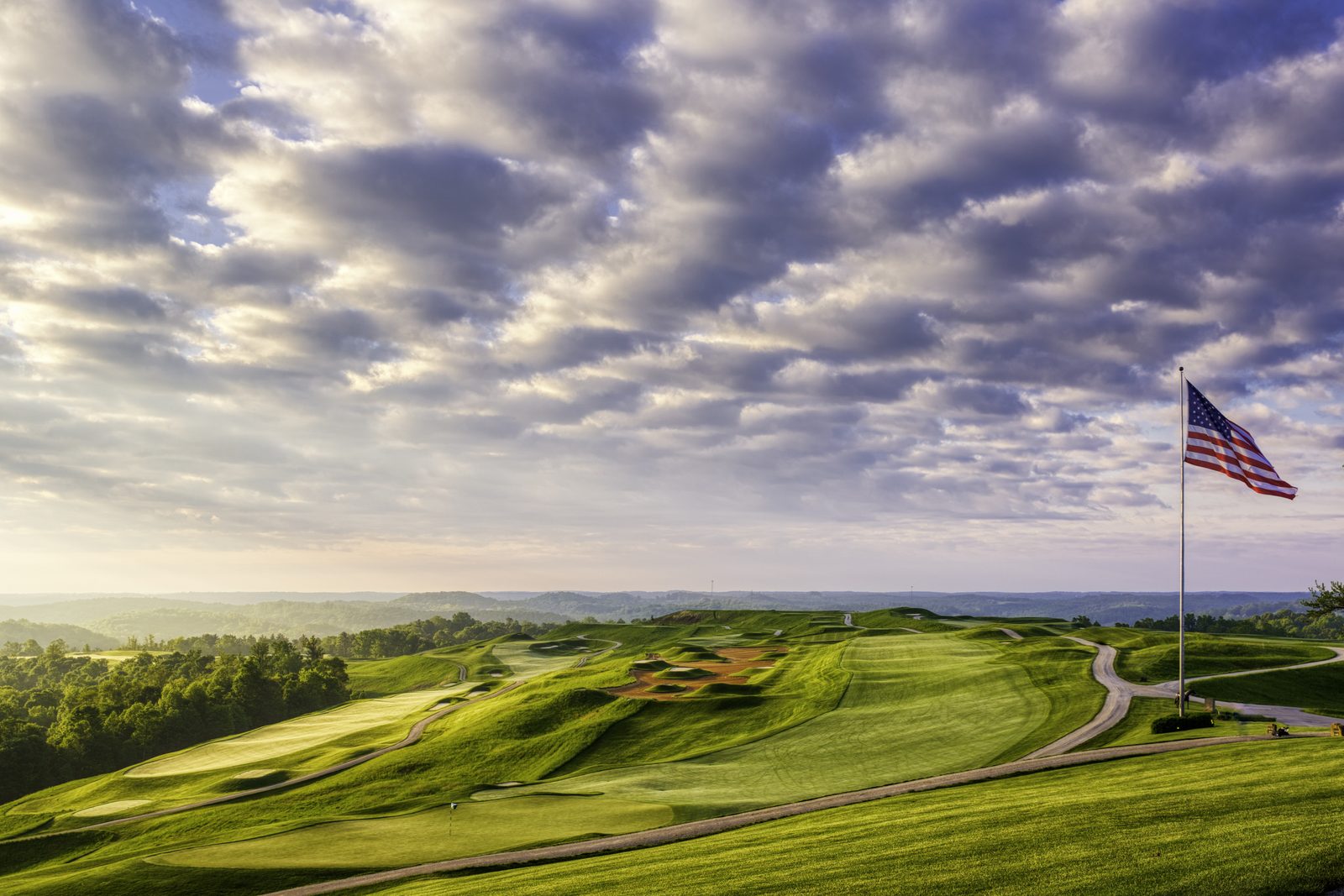
Pete Dye at full volume, on a ridgetop above the Hoosier National Forest. Dye opened his French Lick course in the spring of 2009 on some of the highest ground in southern Indiana: 8,102 yards of par 72 with a slope of 148 from the back tees, volcano bunkers erupting from the fairways, and views the resort measures at 40 miles. The clubhouse is the restored mansion of former Indianapolis mayor Thomas Taggart, and the championship calendar arrived immediately - Golf Digest named it the Best New Public Course of 2009, the PGA Professional Championship followed in 2010, Colin Montgomerie won the 2015 Senior PGA Championship here, and the Senior LPGA Championship played its first four editions on this course. Overnight resort guests hold priority booking, with non-guest rounds available by phone. Golfweek's panel puts it first among Indiana courses you can play. Read our course guide.
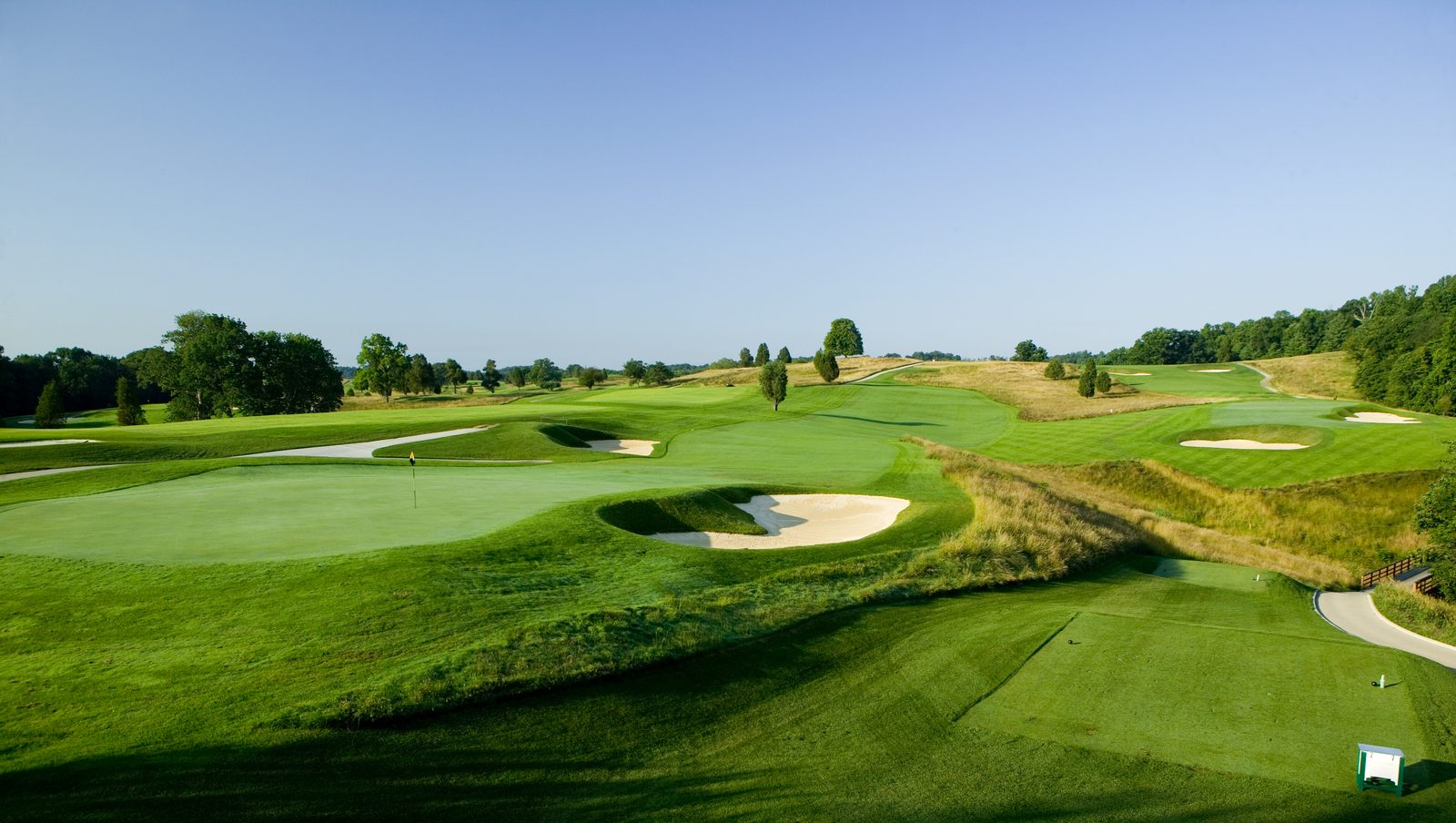
A Donald Ross original from golf's Golden Age, still hosting the conversation a century later. Ross laid out the Hill Course at French Lick in 1917: 7,030 yards of par 70 across rolling Orange County hills, all elevated greens, deep bunkering and short grass running to the edges. Walter Hagen won the 1924 PGA Championship here, and the LPGA Championship came in 1959 and 1960. A $4.6 million restoration completed in 2006 under Lee Schmidt returned the course to Ross's intent, and the panels keep it at the front of the state: Golfweek's panel puts it second among Indiana courses you can play, and GOLF Magazine's raters placed it third among all Indiana courses, private clubs included, one spot ahead of its younger sibling up the hill. It shares the resort's guest-priority booking with the Pete Dye Course. Read our course guide.
The Pfau Course at Indiana University
Public
Bloomington - Steve Smyers & Fuzzy Zoeller (2020)
The modern university championship course, built at full scale in the Bloomington woods. Steve Smyers and Fuzzy Zoeller, the Bloomington-raised Masters champion, opened the Pfau Course in June 2020 on the 265-acre site of the old IU Championship Course: 7,908 yards of par 71 with 147 bunkers, rugged fescue edges, big elevation change and greens full of movement. It is the home of Indiana University golf and a public course in the fullest sense, a championship examination anyone can book in a college town. Golfweek's panel puts it third among Indiana courses you can play - the newest course in the state's top ten - and it is the natural anchor of a Bloomington golf weekend.
Warren Golf Course at Notre Dame
Public
Notre Dame - Bill Coore & Ben Crenshaw (2000)
Coore and Crenshaw's traditionalist walk in the woods north of the Golden Dome. Bill Warren's gift built the Warren Course on 250 wooded acres threaded by Juday Creek, and it opened in May 2000: 7,020 yards from the back tees with 88 bunkers, rectangular tee boxes, push-up greens and false fronts, in deliberate homage to the classic courses of the early 1900s. In the Muirfield tradition, Notre Dame famously posts no par for the course - only yardage - and lets golfers attack it from their own perspective. The championships came: the 2010 U.S. Women's Amateur Public Links and the 2019 U.S. Senior Open, won by Steve Stricker. It is the Fighting Irish teams' home and a fully public course. Golfweek's panel puts it fourth among Indiana courses you can play.
Pete Dye's university laboratory, built with Purdue students on the design team. Dye opened the Kampen Course in 1998 as the championship half of Purdue's Birck Boilermaker Golf Complex, working with students from the university's turf and design programs: 7,465 yards of par 72 in a links style of waste bunkers, wetlands and a natural celery bog preserved inside the routing. It has hosted NCAA championship golf, including the 2008 men's championship, and a Cosler family gift added their name to Dye's in recent years. It is also a stop on Indiana's Pete Dye Golf Trail, the state's celebration of its most famous design resident. Golfweek's panel puts it fifth among Indiana courses you can play, one half of the finest 36-hole university complex in the Midwest.
Coyote Crossing Golf Club
Semi-private
West Lafayette - Hale Irwin (2000)
Hale Irwin's West Lafayette design, five minutes from the Purdue complex and a panel fixture in its own right. Irwin opened Coyote Crossing in June 2000: 6,839 yards of par 72 across rolling ground northwest of the city, with strategic bunkering, bentgrass surfaces and a finishing stretch that asks for nerve over water. The club describes itself in its own words as a semi-private club that is open to the public, offering daily fee rates, group packages and outings - and that open door, a short drive from the two Purdue courses, makes West Lafayette a three-course college-golf destination. Golf Digest honored it among the best new affordable public courses in America in its opening years, and Golfweek's panel puts it sixth among Indiana courses you can play.
West Lafayette - Bill Diddel, Pete Dye renovation (1934)
Ninety years of Purdue golf on one parkland routing. The course began in 1934 as Purdue's South Course, designed by Bill Diddel, the most prolific architect in Indiana history; Larry Packard remodeled it in 1968, and Pete Dye's comprehensive renovation reopened it in 2016 as the Ackerman-Allen Course: 7,546 yards of par 72, tree-lined and traditional, the parkland counterpoint to the Kampen Course's links across Cherry Lane. Its championship pedigree is the complex's deepest - the 1961 NCAA Championship was played here, with Purdue taking the team title and Jack Nicklaus the medalist honors. Golfweek's panel puts it seventh among Indiana courses you can play, which gives the Birck Boilermaker complex two courses in the state's top seven - a distinction it shares only with French Lick Resort, whose two courses sit first and second.
Rock Hollow Golf Club
Public
Peru - Tim Liddy (1995)
A championship course grown out of a stone quarry in Miami County. Tim Liddy, a longtime Pete Dye associate, opened Rock Hollow in 1995 on 300 acres of reclaimed quarry ground outside Peru: 6,944 yards of par 72 moving between quarry lakes, wetlands and old-growth forest, with elevation changes that surprise golfers who expect flat Indiana farmland. The state's championships found it - Rock Hollow has hosted the Indiana Open and the Indiana Amateur - and the National Golf Foundation chose a Rock Hollow photograph to illustrate its 2022 Indiana golf impact report. It is the small-town championship course at its best, an hour north of Indianapolis and worth every mile. Golfweek's panel puts it eighth among Indiana courses you can play.
Chariot Run Golf Club
Public
Laconia - Bill Bergin (2002)
Links-style golf with an equestrian soul, thirty minutes from downtown Louisville. Bill Bergin opened Chariot Run in 2002 on a former horse farm in the Harrison County hills, as the golf amenity of Caesars' Horseshoe Southern Indiana casino: 7,246 yards of par 72 in an American links style, tall fescue framing bentgrass fairways, deep bunkers and greens that roll true and quick. The horse theme runs through the hole names and the Double Eagle Bar & Grill, and the course has outgrown its casino origins into a standalone public destination that sells tee times to anyone. Golfweek's panel has long kept it near the front of the state - as high as fourth in 2018 - and puts it ninth among Indiana courses you can play for 2026.
Harrison Hills Golf Club
Public
Attica - William B. Langford & Tim Liddy (1924)
A Golden Age nine and its modern partner, sharing one rolling Attica hillside. William B. Langford built the original nine at Harrison Hills in 1924, all steam-shovel bunkers and dramatically elevated greens; Tim Liddy expanded the course to eighteen in the mid-1990s, and Golf Digest's reviewers count eight Langford holes and ten Liddy holes in the routing golfers play today: 6,820 yards of par 72, with the uphill, dogleg-right 15th, Langford's signature, still setting the course's tone. The club calls itself a historic, premier public golf destination - open to the public, memberships available - and Golfweek's panel deadlocked it with Brickyard Crossing at tenth in Indiana for 2026; it takes the No. 10 slot here on the strength of its Golden Age bones, with Brickyard heading the Next Five.
The Next Five
Ranks 11-15 complete the picture: the Speedway's own course in Indianapolis, the Jones family's Indiana statement in Carmel, a Dye and Liddy state-park round, a horse-farm romance in Jasper that French Lick packages with the state's top two, and the longest par 72 east of the Mississippi in Noblesville. On a long Indiana trip, this is the bench that fills the second half of the itinerary.
Brickyard Crossing
Public
Indianapolis - Pete Dye (1993)
The most singular address in American public golf. Bill Diddel's Speedway Golf Course opened beside the Indianapolis Motor Speedway in 1929, and Pete Dye's redesign, reopened in 1993, plays fourteen holes outside the backstretch and four holes inside the racing oval itself: 7,180 yards of par 72 in the shadow of the grandstands. The championship history matches the setting - the PGA Tour's 500 Festival Open through the 1960s, a Champions Tour event in the 1990s and the LPGA's Indy Women in Tech Championship. Golfweek's panel tied it with Harrison Hills at tenth in Indiana for 2026; it heads the Next Five here.
Prairie View Golf Club
Public
Carmel - Robert Trent Jones Jr. (1997)
Robert Trent Jones Jr.'s only Indiana design, and one of the state's most decorated public courses. Jones opened Prairie View in 1997 on 206 acres along the White River beside Conner Prairie in Carmel: 7,073 yards of par 72 with no homes on the course, a championship routing that hosts Indiana PGA and Indiana Golf Association events and the IHSAA state finals. Golf Digest's best-in-state panel once placed it seventh among all Indiana courses, private clubs included - the strongest such standing of any course in this Next Five - and it remains the Indianapolis suburbs' essential public round.
The Fort Golf Resort
Public
Indianapolis - Pete Dye & Tim Liddy (1997)
State-park golf by Pete Dye and Tim Liddy on a former Army post. The Fort opened in 1997 inside Fort Benjamin Harrison State Park, the 1,700-acre wooded park the state made from the decommissioned Fort Benjamin Harrison: 7,148 yards of par 72 rolling through mature forest, owned and operated by the State of Indiana with a lodge and cabins for the stay-and-play version. Golf Digest named it third among its Best Affordable New Public Courses of 1998, and it remains the rare Dye design a state parks budget can book - Indianapolis golf trips pair it with Brickyard Crossing across town.
Sultan's Run Golf Club
Public
Jasper - Tim Liddy (1992)
Tim Liddy's horse-country romance in Jasper. Liddy opened Sultan's Run in 1992 on the former farm of Supreme Sultan, the champion American Saddlebred stallion, and named every hole for one of the great horse's progeny; his 1996 remodel completed the course golfers travel for today: 6,859 yards of par 72 through the Dubois County woods, finishing at a par 4 whose green is backed by a waterfall. The club sells its own daily-fee tee times and stay-and-play lodging, and French Lick Resort includes it in its Southern Indiana Golf Tour package with the Pete Dye and Donald Ross courses - the resort's own billing for the trio is three of Indiana's top-rated public courses.
Purgatory Golf Club
Public
Noblesville - Ron Kern (2000)
Indiana's beautiful monster. Ron Kern, an Indiana architect, opened Purgatory in 2000 on 218 acres of Hamilton County farmland: a links-style course of more than 130 bunkers filled with crushed white limestone, tall prairie grass and hole names like Everlasting Torment, Sweet Misery and Hell's Half Acre, the par-3 17th whose green is ringed by eight massive bunkers. From the back tees it stretches 7,754 yards of par 72, billed as the longest par-72 course east of the Mississippi, with six tee sets bringing it down under 4,600 yards for everyone else. Golf Digest has placed it on its America's 100 Greatest Public Courses list, and it closes this fifteen as the state's great cult favorite.
Honorable Mentions
Belterra Golf Club in Florence (Tom Fazio, 2001), the casino resort course on the Ohio River that Golfweek keeps on its national casino-course rankings, leads the next wave - alongside Bear Slide Golf Club in Cicero, The Trophy Club in Lebanon (Tim Liddy), Plum Creek Golf Club in Carmel, Covered Bridge Golf Club in Sellersburg and Champions Pointe in Henryville (both Fuzzy Zoeller designs in the Louisville suburbs), Blackthorn Golf Club in South Bend, Hulman Links in Terre Haute, The Legends Golf Club in Franklin, White Hawk Country Club in Crown Point and the 36 holes of Swan Lake Resort in Plymouth. Two absences deserve their own explanation. Otter Creek Golf Course in Columbus (Robert Trent Jones Sr., 1964; Rees Jones added the East nine in 1995) hosted the 1991 U.S. Amateur Public Links and a quarter-century of Indiana State Amateurs, and would hold a place here on merit - but the whole facility is closed for a full rebuild under Tom Kite and Billy Fuller, with its New Otter course projected to open in the fall of 2027, so it belongs to a future list rather than this one. The Culver Academies Golf Course (William Langford & Theodore Moreau, 1923, restored by Bobby Weed), Golfweek's second-ranked campus course in America, is a nine-hole treasure that play limits to the school's own community and accompanied guests. Absent on purpose: Crooked Stick Golf Club in Carmel - Pete Dye's home-club masterpiece and host of the 1991 PGA Championship - plus Victoria National in Newburgh (Tom Fazio, carved from a strip mine, host of the Korn Ferry Tour Championship), Wolf Run Golf Club in Zionsville, Sycamore Hills in Fort Wayne and The Sagamore Club in Noblesville (both Jack Nicklaus) and Chatham Hills in Westfield (Pete Dye) make Indiana a genuine private-golf state - but none of them will sell you a tee time, and Mulliganist only ranks courses you can actually play.