French Lick Resort (Donald Ross Course)
Donald Ross's 1917 Hill Course in the southern Indiana hills, where Walter Hagen won the 1924 PGA, Golden Age golf in its purest surviving form.
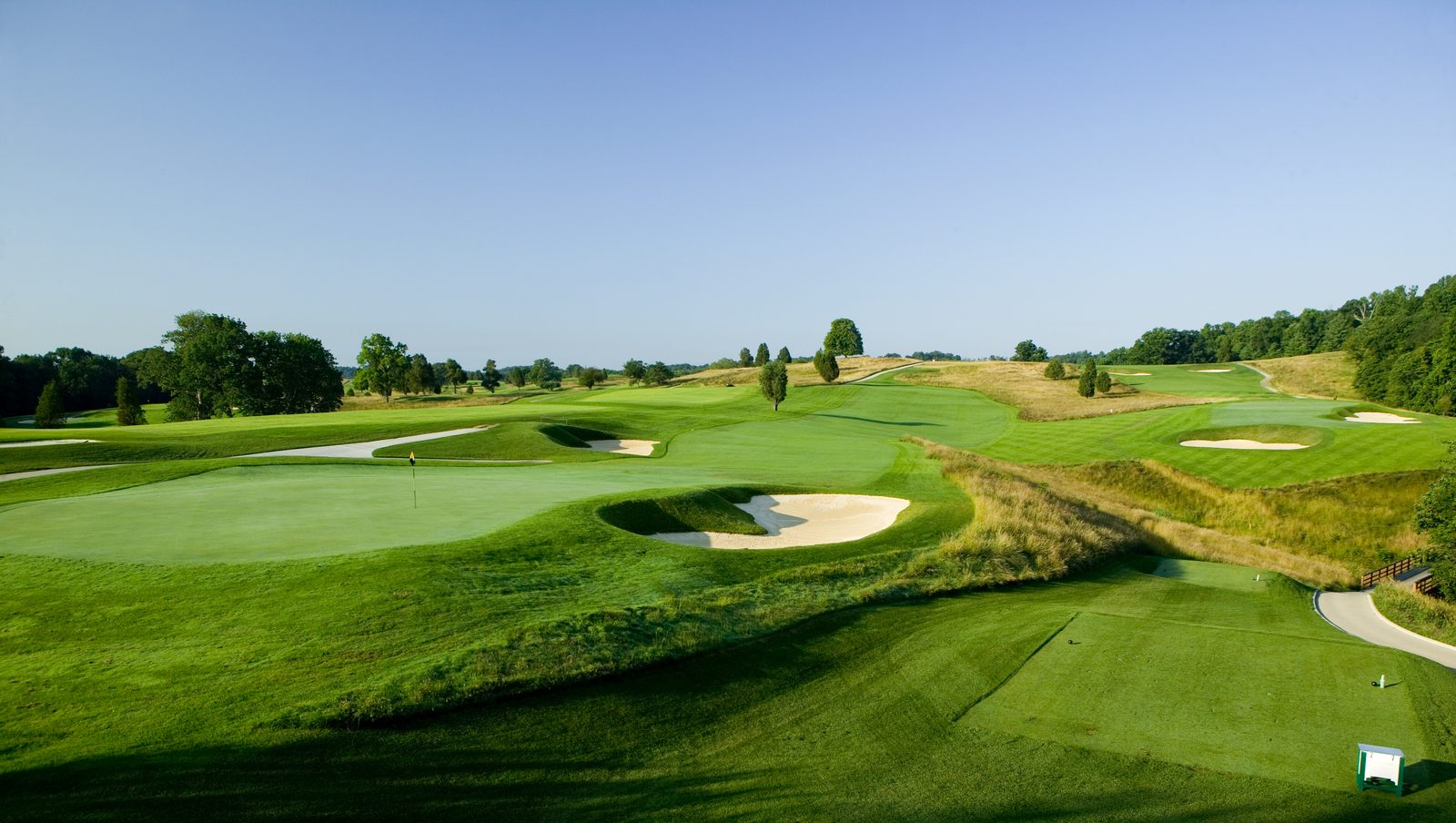
This is Donald Ross in his prime, on Indiana hill country, essentially as he left it. The Donald Ross Course at French Lick, built in 1917 as the resort's Hill Course, is the older and, for the architecture faithful, the greater of the resort's two famous courses, a 7,030-yard par-70 examination of tiered, severely sloped greens and hill lies that Walter Hagen himself validated by winning the 1924 PGA Championship on these fairways. We rank it second among Indiana courses you can play, behind only its younger sibling across the property, and Golfweek has placed it second on its Indiana public list every year since 2011.
The Ross Course is the anti-modern round. Par 70 means the par 5s are rationed to two, the par 4s carry the examination, and the greens, contoured in tiers and tilts that shrug off the indifferent approach, turn every two-putt into a small victory. Almost no lie on the property is flat, the routing climbs and falls through the southern Indiana hills without a wasted step, and a $5 million restoration in 2006 under Lee Schmidt returned the course to its Ross bones, bunkers, green edges and all. Golfers who find modern resort golf over-watered and over-explained tend to fall for this course completely.
The pairing is the story of the trip. The Pete Dye Course, our Indiana No. 1 and already reviewed in full on this site, sits on the resort's other hill in a blaze of manufactured drama. The Ross Course is the connoisseur's counter-argument, drama that was simply there, arranged by the master of the previous century. Play both over two days and you hold Indiana's whole golf argument in your hands. Start here, with history, and finish on Dye's mountain.
The Scorecard
The card below shows the Medal tees, the back set, from the club's published scorecard. It plays 7,030 yards at par 70, rated 74.7 with a slope of 135, and it foots exactly, 3,526 yards out and 3,504 home. Par 70 is the design's whole argument in one number. With only two par 5s, the 538-yard 7th and the 665-yard 15th, the par 4s do the examining, and the card's symmetry, two nines within 22 yards of each other, shows a routing that never lets either side rest.
By the Numbers
From the scorecard below: Medal tees.
From the Medal tees it plays to a slope of 135, rating 74.7, steeper than about 29% of the 182 courses in our database with a published slope.
| Front nine | Par | Yards |
|---|---|---|
| Hole 1 | 4 | 422 |
| Hole 2 | 4 | 419 |
| Hole 3 | 4 | 424 |
| Hole 4 | 3 | 240 |
| Hole 5 | 4 | 476 |
| Hole 6 | 3 | 249 |
| Hole 7 | 5 | 538 |
| Hole 8 | 4 | 392 |
| Hole 9 | 4 | 366 |
| Total | 35 | 3,526 |
| Back nine | Par | Yards |
|---|---|---|
| Hole 10 | 4 | 383 |
| Hole 11 | 4 | 367 |
| Hole 12 | 4 | 435 |
| Hole 13 | 3 | 252 |
| Hole 14 | 4 | 452 |
| Hole 15 | 5 | 665 |
| Hole 16 | 3 | 151 |
| Hole 17 | 4 | 379 |
| Hole 18 | 4 | 420 |
| Total | 35 | 3,504 |
Read this card as a correction to modern habits. The par 3s swing from the 151-yard 16th to the 252-yard 13th, a hundred yards of range inside one set, because Ross cared about the shot, not the symmetry. The par 4s bulk between 366 and 476 yards, the band where the hill lies and tiered greens live, and both nines close with proper finishing holes under 430 yards that reward position over power. It is the most instructive card in Indiana, and after a round here the modern resort course's by-the-numbers design is hard to unsee.
Green Fees
- Daily rate (resort published)$185
- Shoulder season, October 26 to November 28 (resort published)$125
- Replay rate, daily season (resort published)$125
- Replay rate, shoulder season (resort published)$100
- LocationFrench Lick, Indiana
- Par / Yardage70 / 7,030 yards (Medal tees)
French Lick publishes per-course rates on its own rates page, and the table above is that published card for the Ross Course. The daily rate is $185 with cart, the shoulder season from October 26 to November 28 is $125, and replays run $125 in the daily season and $100 in the shoulder, with cart required and walking not offered. Overnight resort guests hold priority access, and non-guests book by phone. Golf Digest's $150 listing and the $175 visitor report this page once quoted both sit below the resort's own published daily rate. Correction, November 22, 2026: an earlier version of this page said the resort does not publish tidy per-course rack rates online. It does, on its rates and packages page, so the page now prints the resort's figures.
The Story
French Lick's mineral springs made it a famous resort long before golf, the Pluto Water era drawing the wealthy and the ailing to the southern Indiana hills through the nineteenth century. The resort's first course was Tom Bendelow's Valley layout of 1907, and in 1917 Donald Ross, then at the height of his powers, built the Hill Course on the higher ground, the rugged routing of tiered greens and sidehill tests that stands today. The course announced itself nationally in 1924, when Walter Hagen won the PGA Championship here, beating Jim Barnes in the final during the heart of Hagen's match-play reign, a title the resort's own Pete Dye page still proudly records.
The Hill Course faded with the resort's middle decades and returned with its revival. The resort's restoration era brought a $5 million renewal of the Ross Course in 2006, executed with Lee Schmidt, that restored the classic features and playing character, and the course, renamed for its architect, has since been a fixture of the national conversation, Golfweek ranking it Indiana's No. 2 public course every year from 2011 onward. The Bendelow valley nine survives beside it as the resort's gentle third option. What the visitor gets in 2026 is the rarest of American resort products, a championship Ross, essentially intact, on its original hills.
Signature Holes
Hole 8 - Par 4 - 392 yards
The outward nine's strategic centerpiece. The front side at the Ross Course goes out in 35 with only one par 5, which loads the examination onto the two-shotters, and the 392-yard 8th is the one regulars describe first, a mid-length par 4 where the tiered green, pitched in sections like a staircase, makes the approach's landing zone a matter of feet. Ross built a career on greens that grade your iron play rather than your luck, and this is his Indiana classroom. Land on the correct tier or spend the next two putts apologizing.
Hole 15 - Par 5 - 665 yards
One of only two par 5s on the card and the longest hole in Indiana resort golf. The 665-yard 15th, the Medal card's exact figure, is a genuine three-shotter for every golfer alive, climbing through the hills with the lie changing at every step. On a par-70 course the par 5s are events, and this one is the main event, the hole where Ross spends his length budget in a single grand gesture. Bogeys are made here by impatience long before they are made by execution.
Hole 13 - Par 3 - 252 yards
The examination's cruellest single question. The 252-yard par-3 13th is one of the longest one-shotters in American Golden Age golf, a full wood for most players to a green defended in the classic manner, and it arrives just before the 665-yard 15th, so the back nine's middle stretch asks for your longest iron and then your longest everything. Two holes later the card offers the 151-yard 16th by way of apology, and the finish, 379 and 420-yard par 4s, closes the argument in Ross's favor.
Par 70 Puts the Long Game on Trial
Par 70 sounds like a scoring invitation until the arithmetic lands. With only two par 5s on the Medal card, the 538-yard 7th and the 665-yard 15th, there are just two holes where a long hitter can expect the card to give anything back. The other sixteen holes at French Lick ask questions, and twelve of them are par 4s stretching from 366 to 476 yards at 7,030 yards overall, rated 74.7 with a slope of 135. That is the whole Ross argument in southern Indiana. Take away the easy birdie chances, load the examination onto the two-shotters, and let tiered greens grade every approach that arrives even slightly indifferent.
The par 3s refuse to provide the usual breather, and their spread tells the story better than any single hole. The 13th plays 252 yards, among the longest one-shotters of the Golden Age and a full wood for most players, while the 16th plays just 151 yards. A hundred yards of range inside one set of short holes means club selection never settles into a groove. Add the hill country reality that almost no lie on the property is flat, and the long game becomes a test of trajectory and landing spot rather than distance alone. A well-struck shot to the wrong tier is simply a well-struck shot in the wrong place.
The 392-yard 8th shows how Ross collects his toll. The yardage looks friendly, almost modest among those longer par 4s, but the green is pitched in sections like a staircase and the correct landing zone shrinks to a matter of feet. Land on the correct tier and a two-putt feels routine. Land a tier away and the next two putts become an apology tour. Then the 665-yard 15th spends the entire length budget in one grand gesture, a genuine three-shotter where bogeys come from impatience long before execution. Patient iron players thrive here. Golfers waiting for the card to hand them a hole wait a long time.
Practical Info
The Donald Ross Course sits at the French Lick Resort in the southern Indiana hills, about an hour northwest of Louisville. The resort publishes the Ross Course rates on its rates page, $185 daily and $125 in the shoulder season from October 26 to November 28, so book through the resort's golf booking link or by phone and confirm your date's price against that card. Stay and play packages fold a round here or on the Dye Course into a hotel night at the French Lick Springs or West Baden Springs hotels, and the Pete Dye Course day, range included over there, is the natural partner round. One useful surprise, there is no driving range on the Ross side. Loosen up at the Dye facility or accept the old-school walk to the first tee that Ross's golfers managed without complaint.
Make it a two-hotel, two-course trip. West Baden Springs, with its famous domed atrium, is the architectural pilgrimage's lodging, French Lick Springs the livelier base, and the two courses split the golf days between the centuries. Our full review of the Pete Dye Course covers the sibling in detail, and it is linked from this page. Southern Indiana in the fall, hills in color and a Ross course playing firm, is one of the Midwest's genuinely great golf weekends, and it still flies under the national radar far more than it should.
Questions, Answered
How much does it cost to play the Donald Ross Course at French Lick?
The resort publishes the Ross Course rates on its own rates page. The daily rate is $185 with cart, the shoulder season from October 26 to November 28 is $125, and replays are $125 in the daily season and $100 in the shoulder. Cart is required and walking is not offered. Overnight guests hold priority access, non-guests book by phone, and the resort also sells stay and play packages that fold a round here or on the Pete Dye Course into a hotel night.
What happened at French Lick in 1924?
Walter Hagen won the PGA Championship on this course, then called the Hill Course, defeating Jim Barnes in the match-play final. It was one of Hagen's four consecutive PGA titles in the 1920s and the championship pedigree the resort's modern courses still trade on. The fact is recorded in the resort's own materials for its Pete Dye Course, which also notes Donald Ross built the Hill Course in 1917.
Who designed the Donald Ross Course and has it been restored?
Donald Ross designed it in 1917 as the resort's Hill Course, his championship layout above Tom Bendelow's 1907 valley course. A $5 million restoration in 2006, executed with Lee Schmidt, returned the Ross features, bunkers, green contours and playing character, and the course is now named for its architect. Golfweek has ranked it the No. 2 public course in Indiana every year since 2011.
How hard is the Donald Ross Course?
From the Medal tees, 7,030 yards at par 70, rated 74.7 with a slope of 135. The difficulty is classic Ross difficulty, severely sloped and tiered greens, angled approaches and almost no flat lies in the Indiana hills, rather than water or forced carries. With only two par 5s the par 4s carry the test, and the 252-yard par-3 13th is among the longest one-shotters of the Golden Age. Choose tees honestly. The hills add a club everywhere.
Keep Exploring Indiana
Read our Indiana Golf Guide for more top courses, green fees, and trip planning across the state.
French Lick Resort (Donald Ross Course) features in our ranking of the 15 Best Golf Courses in Indiana.
More Indiana course guides: French Lick Resort (Pete Dye Course).
More course guides: Pinehurst No. 2 and Bandon Dunes.