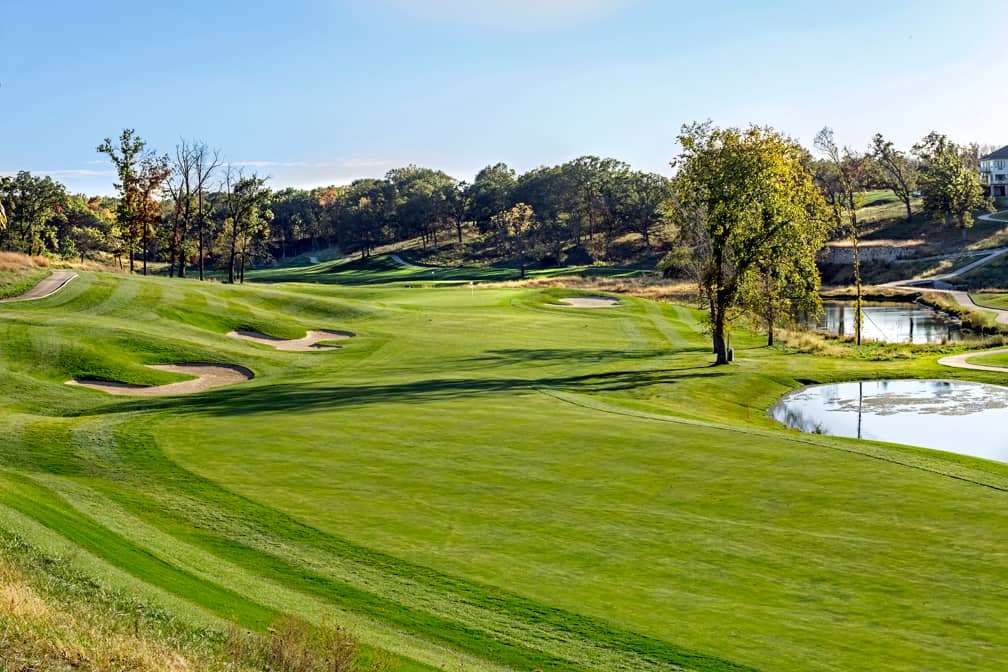
The first tee tells you what kind of day this is going to be. Your opening shot plunges more than 100 feet into a river valley, the fairway bending left below you, and from there Spirit Hollow keeps tumbling up and down the Mississippi River hills south of Burlington for four hours. This is the course Golfweek's panel ranks first among Iowa courses you can play, and Golf Digest placed it second among every course in the state, public and private together, in the state rankings reported in 2016. Big talk for a former cattle ranch in the southeast corner of Iowa. The ground backs it up.
The numbers are championship size. From the Gold tees the card runs 7,550 yards at par 72, rated 74.8 with a 134 slope, and the club hosted the Iowa Amateur in its opening year of 2000 and again in 2012, plus U.S. Open and U.S. Amateur qualifiers and a long run of the Golfweek Conference Challenge for the University of Iowa. Yet the place never feels like an examination hall. Bentgrass runs tee to green, streams wander through eleven holes by the club's count, and the routing keeps handing you elevated tees, valley floors and specimen oaks in rotation. Play it once to learn where the ground moves. Play it again because the first round will not have been enough.
The Scorecard
The card below shows the Gold tees from the club's own hole-by-hole tour, the back set at Spirit Hollow. It foots exactly to the club's published totals, 3,742 yards out and 3,808 back for 7,550, par 36 on each side, with the 74.8 rating and 134 slope the University of Iowa's athletics site also prints for this set. The step down is dramatic. The Black tees play 6,589 yards, the White 6,040 and the Rust 5,053, and the angles and elevation change as much as the distance does, so the shorter sets are a different and friendlier course rather than the same one with shorter walks.
By the Numbers
From the scorecard below: Gold tees.
Slope 134 from the Gold tees, rating 74.8 - a sterner test than about 24% of the 182 courses in our database with a published slope.
| Front nine | Par | Yards |
|---|---|---|
| Hole 1 | 4 | 426 |
| Hole 2 | 5 | 607 |
| Hole 3 | 3 | 183 |
| Hole 4 | 5 | 607 |
| Hole 5 | 4 | 468 |
| Hole 6 | 4 | 445 |
| Hole 7 | 3 | 165 |
| Hole 8 | 4 | 431 |
| Hole 9 | 4 | 410 |
| Total | 36 | 3,742 |
| Back nine | Par | Yards |
|---|---|---|
| Hole 10 | 5 | 575 |
| Hole 11 | 4 | 352 |
| Hole 12 | 3 | 210 |
| Hole 13 | 4 | 480 |
| Hole 14 | 4 | 467 |
| Hole 15 | 3 | 215 |
| Hole 16 | 4 | 434 |
| Hole 17 | 4 | 496 |
| Hole 18 | 5 | 579 |
| Total | 36 | 3,808 |
Two par 5s of 607 yards anchor the front nine, an early statement that the Gold tees mean business, and the back nine answers with length of a different kind. The par 3s stretch to 210 and 215 yards at the 12th and 15th, the 17th is a 496-yard par 4 exposed to the wind at the edge of the property, and the 13th runs 480 as the second-longest par 4 on the card. Relief exists, mostly at the 352-yard 11th, where the club asks for a short club off the tee and a stream crossing twice on the way home. The through line is elevation. Yardages here are starting points, and the ground gets a vote on nearly every shot.
Green Fees
- LocationBurlington, Iowa
- Par / Yardage72 / 7,550 yards (Gold tees)
Spirit Hollow now publishes its own 2026 rate card, and the headline numbers are friendly for a course of this standing. A single round runs $100 on weekdays and $110 on Fridays, Saturdays, Sundays and holidays, with all-day play at $125 and $135, and every round includes a cart and the driving range, tax extra. On weekdays seniors pay $75, juniors $45 after noon and a 9-hole round runs $55. The outside estimates that used to carry this section land in the same place, with Golf Digest's course page listing $135 and GolfLink estimating $125 with cart. Stay-and-play packages and season passes do much of the selling beyond the daily card, and frequent players get their own math from the season pass and the 20-round punch card.
The Story
Burlington businessman Randy Winegard grew up exploring a 400-acre cattle ranch in the river hills and never really got the place out of his head. When the land came up for sale in 1991, he bought it, sketched his own ideas for a golf course on it, and interviewed three architects to build the thing. Rick Jacobson got the job, by Winegard's own telling, because he was the only one bold enough to tell him his design was bad. Jacobson was a Jack Nicklaus protege striking out on his own, and the canvas he took on was the Mississippi River valley itself, all rolling hills, natural streams, rock outcroppings and mature oaks.
The course opened in 2000 and the championship calendar arrived almost immediately. The Iowa Amateur came that first year and returned in 2012, when Jon Olson closed with a course-record 64 to win it. U.S. Amateur qualifying followed in 2007, a U.S. Open local qualifier in 2017, and the Golfweek Conference Challenge brought top college programs to Burlington year after year with the University of Iowa as host. The club's description counts more than 15,000 trees lining the fairways, planted as a tribute to Winegard's father and his love of forestry, and water in play on eleven holes. For a course built on a working ranch, it took remarkably little time to become the address Iowa golf uses to test itself.
The second act turned a day trip into a destination. The Lodge at Spirit Hollow added eight guest rooms wrapped around a great room with a fireplace, a poker table and a library of golf books, and the Champions and Medalists cabins sleep up to eight guests each, with a competition court of shuffleboard, bocce and horseshoes around a fire pit between the buildings. Lambo's restaurant moved into the Lodge, and the Shankopotamus Golf Academy bolted seven climate-controlled Toptracer suites onto the fun, which means the golf in Burlington no longer ends at dark or in November. The ranch became a resort without ever sanding down the golf course that justified it.
Signature Holes
Hole 1 - Par 4 - 426 yards
The opener and the postcard. The tee shot drops more than 100 feet into the river valley as the fairway doglegs left, and the club itself will tell you the driver can stay in the bag. A fairway wood, hybrid or long iron leaves a mid-to-short iron from a downhill lie into a large green guarded by a bunker on the right. Plenty of courses ease you in. This one shows you the whole property in a single swing and asks whether you came to play safe. As introductions go, it is a beauty.
Hole 13 - Par 4 - 480 yards
The most photographed hole on the course, according to the club's head professional, and at 480 yards from the Gold tees it is also the second-longest par 4 on the card. The drive wants the left side of the fairway, from where a middle iron reaches a green the club warns putts fast toward the clubhouse even when the read looks uphill. Scenery and severity in the same hole is the Spirit Hollow formula in miniature. Bring the camera. Then forget it and hit the drive.
Hole 18 - Par 5 - 579 yards
A closer built for a story. The elevated tee plays to an effective yardage closer to 500 than the card's 579, and the drive has to stay right of the tree standing in the fairway. Miss left of it instead and the play is to stay left of the stream that bisects the fairway, which leaves a manageable approach into a contoured green that acts as a backstop. The club reckons a fair chance at eagle and birdie lives here for the brave. Par at the last is a fine finish, and everybody walking off knows it.
When the Ground Gets a Vote
Yardages at Spirit Hollow are starting points, and the ground gets a vote on nearly every shot. The Gold tees stretch to 7,550 yards at par 72, rated 74.8 with a slope of 134, out in 3,742 and home in 3,808, across Mississippi River hills where elevated tees, valley floors and streams on eleven holes keep changing what a number on the card actually means. Two par 5s of 607 yards anchor the front nine, the 2nd and the 4th, an early statement that the back tees mean business. The back nine answers with length of a different kind, par 3s stretching to 210 yards at the 12th and 215 at the 15th, plus the 496 yard 17th, a par 4 exposed to the wind at the edge of the property.
The opener teaches the lesson before the scorecard has a mark on it. The 426 yard 1st plunges more than 100 feet into the river valley as the fairway doglegs left, and the club itself notes that the driver can stay in the bag, with a fairway wood, hybrid or long iron leaving a mid to short iron from a downhill lie into a large green guarded by a bunker on the right. Plenty of courses ease a golfer in. This one shows the whole property in a single swing and asks whether the safe play is the smart one. Relief, when it comes, carries its own puzzle at the 352 yard 11th, where a short club off the tee still has to deal with a stream crossing twice on the way home.
The closing argument returns to elevation as strategy. The 480 yard 13th, the second longest par 4 on the card, wants the drive on the left side of the fairway, from where a middle iron reaches a green that putts fast toward the clubhouse even when the read looks uphill. The 579 yard 18th plays from an elevated tee to an effective yardage closer to 500, with a tree standing in the fairway splitting the decision and a stream bisecting the ground for anyone who misses left of it. Spirit Hollow rewards golfers who choose tees and lines for the terrain rather than the total, which is why the Black tees at 6,589 yards and the White at 6,040 keep every drop and angle while giving the round back its fun.
Practical Info
Spirit Hollow sits at 5592 Clubhouse Drive in Burlington, and tee times run through the club at 319-752-0004 and online. Come ready to practice properly. The range is a two-tiered affair with bentgrass tees and five target greens, and when the weather turns, the Shankopotamus Golf Academy at Lambo's runs seven climate-controlled Toptracer suites with food and drink served in the bay. Staying over is the move the property begs for. The Lodge holds eight guest rooms and Lambo's restaurant, the Champions and Medalists cabins sleep eight apiece, and stay-and-play packages bundle the rooms with unlimited golf in season. Burlington itself is a genuine Mississippi River town, so the trip pairs the round with riverfront wandering rather than a parking lot exit.
Choose your tees with the elevation in mind, not just the yardage. The Gold set at 7,550 yards is a championship test built for elite amateurs and college fields, and most visiting groups will have the better day from the Black tees at 6,589 or the White at 6,040, where the drops, streams and angles still show up in full. The cart earns its keep on the climbs back out of the valley. Play the course twice if the schedule allows, once from a forward set to enjoy it and once from further back to respect it, and save an hour after the round for Lambo's, because the 1st tee story and the 18th hole argument both improve with a table and a view.
Questions, Answered
What is the best golf course in Iowa?
Among courses the public can book, Spirit Hollow is the consensus answer at the moment. Golfweek's panel ranks it No. 1 among Iowa public-access courses on its 2026 list, a position it has held since 2023, and Golf Digest placed it No. 2 among all Iowa courses, public and private together, in the state rankings reported in 2016. We rank it No. 1 in Iowa as well. The Harvester Club in Rhodes is its historic rival for the state's top honor but has gone fully private, so Spirit Hollow is the best Iowa course with a tee time for sale.
How much does it cost to play Spirit Hollow?
The club's own 2026 rate card puts a single round at $100 on weekdays and $110 on Fridays, Saturdays, Sundays and holidays, with all-day play at $125 and $135 and every round including a cart and the driving range, tax extra. On weekdays seniors pay $75, juniors $45 after noon and 9 holes run $55. The outside estimates agree, with Golf Digest's course page listing $135 and GolfLink estimating $125 with cart. The club also sells stay-and-play packages, a season pass and a 20-round punch card for golfers who come back often. Confirm your day's rate when you book.
Who designed Spirit Hollow and when did it open?
Rick Jacobson, a Jack Nicklaus protege who built the course as an early statement of his own practice, on land Burlington businessman Randy Winegard bought in 1991. Winegard interviewed three architects and hired Jacobson, by his own account, because Jacobson was the only one who told him his homemade design was bad. The course opened in 2000 and hosted the Iowa Amateur that same year, then again in 2012.
Keep Exploring Iowa
Read our Iowa Golf Guide for more top courses, green fees, and trip planning across the state.
Spirit Hollow Golf Course features in our ranking of the 12 Best Golf Courses in Iowa.
More course guides: TPC Sawgrass - Stadium Course, Whistling Straits - Straits Course and Pebble Beach Golf Links.