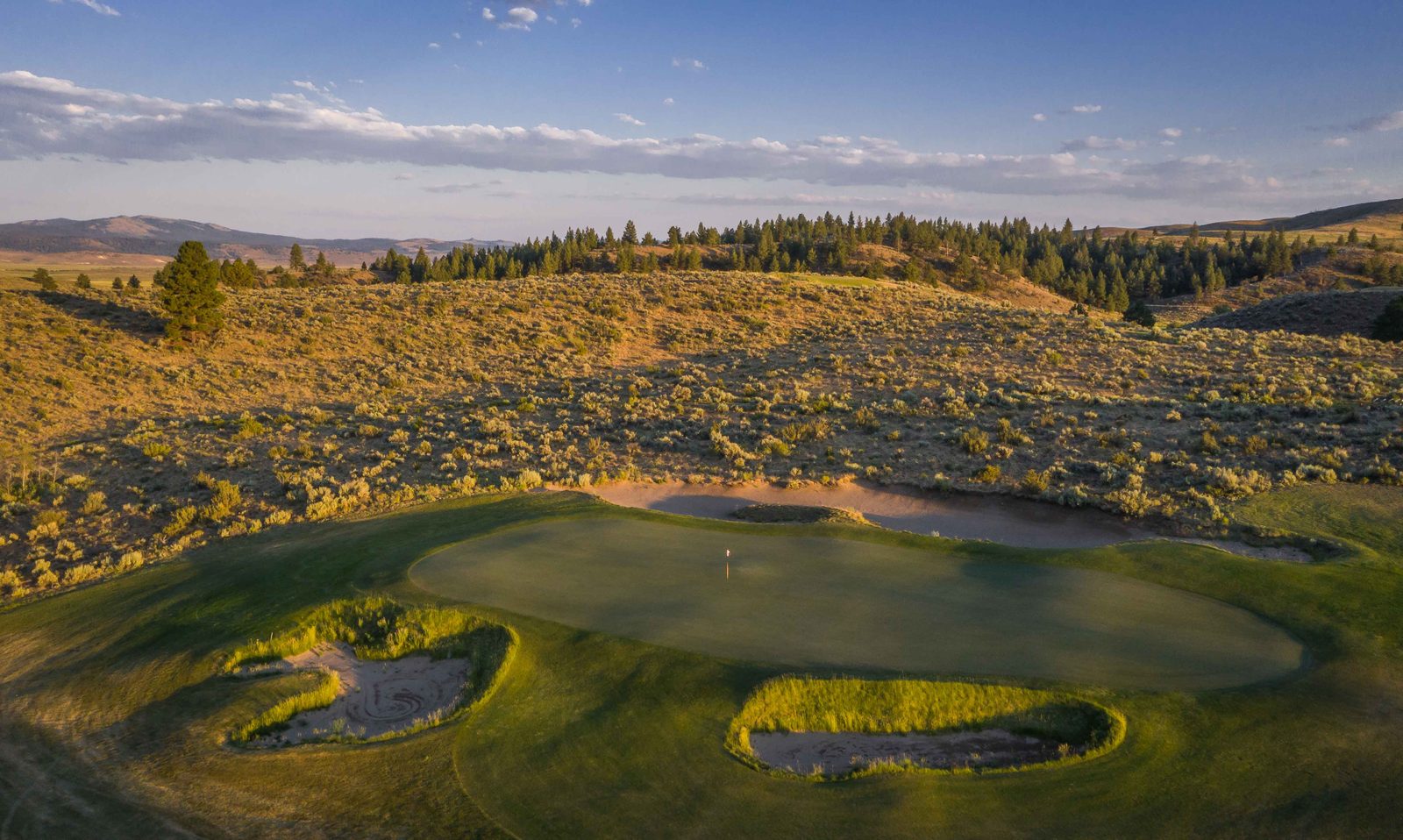
Silvies Valley Ranch holds the most original idea in American golf, one golf course that plays in two directions. Architect Dan Hixson wove 36 holes through 27 greens and 16 shared fairways across a working cattle ranch in Oregon's high desert, and the routing reverses on a daily rhythm. On odd numbered days guests play the Hankins Course. On even days the same ground becomes the Craddock Course, running the other way. Fairways that were targets yesterday are crossroads today, and greens approached from the east are approached from the west.
The Hankins, the original direction, stretches 7,075 yards at par 72 from the back tees, and at elevations up to nearly 4,900 feet the ball flies as free as the landscape looks. This is golf inside a ranch of some 140,000 acres, ponderosa and juniper, meadow and rimrock, cattle on the horizon, and fairways as wide as 235 feet at their broadest. Dan Hixson, an Oregon architect, proposed the reversible concept around 2010 after being inspired by the Old Course at St Andrews, and the ranch that opened it in 2017 has been collecting national attention ever since.
The Scorecard
The card below is the Back set for the Hankins direction, as transcribed hole by hole from the club's yardage book. It goes out in 3,650 and comes home in 3,425, for 7,075 yards at par 72, and the yardages sum exactly to the printed Back total. One disclosure the club's own literature makes necessary. The summary table in that yardage book mislabels the 490-yard 16th as a par 5, while the book's hole-by-hole heading calls it a par 4, as does an independent published account, and every other record prints par 72 for the course, which is only possible with the 16th as a par 4. The card follows that reading. No rating or slope for the Hankins tees has been published by a solid source, so none is printed. The same ground plays as the Craddock Course on even days, with its own card.
By the Numbers
From the scorecard below: Back.
| Front nine | Par | Yards |
|---|---|---|
| Hole 1 | 4 | 415 |
| Hole 2 | 3 | 150 |
| Hole 3 | 5 | 590 |
| Hole 4 | 4 | 370 |
| Hole 5 | 5 | 550 |
| Hole 6 | 4 | 465 |
| Hole 7 | 3 | 200 |
| Hole 8 | 4 | 410 |
| Hole 9 | 4 | 500 |
| Total | 36 | 3,650 |
| Back nine | Par | Yards |
|---|---|---|
| Hole 10 | 4 | 445 |
| Hole 11 | 4 | 305 |
| Hole 12 | 4 | 445 |
| Hole 13 | 3 | 140 |
| Hole 14 | 5 | 505 |
| Hole 15 | 3 | 175 |
| Hole 16 | 4 | 490 |
| Hole 17 | 4 | 330 |
| Hole 18 | 5 | 590 |
| Total | 36 | 3,425 |
The Hankins card is a genuine tale of two nines. A front side of 3,650 yards holds the 590-yard 3rd, the 550-yard 5th and the 500-yard 9th, against a back side 225 yards shorter whose own 590-yard par 5, the 18th, closes the round, trading raw length for the 490-yard 16th and a run of mid-length par 4s. Five of the eighteen holes exceed 490 yards, yet the shortest par 4, the 305-yard 11th, is the one players discuss at dinner. At altitude, every number on the card plays a club or two shorter than it reads, which is part of the fun of scoring here.
Green Fees
- LocationSeneca, Oregon
- Par / Yardage72 / 7,075 yards (Back)
Golf at Silvies Valley Ranch is arranged as part of a ranch stay rather than sold off a rack rate card, and the ranch publishes no current static green fee for the Hankins Course. The most recent published figures are from the course's first seasons and no longer agree with each other. Budget for golf to be quoted with lodging when booking, and treat any single number found on a directory site as an estimate. The reversible layout means a two-day stay plays both directions of the same ground, which is the real value here.
The Story
The setting is older than the state fairways around it. The ranch was founded in 1883, and the two course names honor the Hankins and Craddock families, pioneer homesteaders who settled this Silvies Valley ground in that same year. The Campbell family, whose roots in the valley reach back further still, bought the ranch in 2007 and spent a decade restoring its streams, meadows and forests before adding a retreat of luxury cabins, a lodge and, at the heart of the plan, the reversible golf course.
Hixson's pitch was audacious. Reverse the golf course, as St Andrews once did, and double the golf without doubling the footprint. The ranch agreed, and construction produced a routing complex enough that the shared fairways carry no yardage markers at all, since half the holes crossing them belong to the other direction. A rangefinder quickly becomes a guest's best friend. The Hankins direction, working name Grant during design, opened with the resort in July 2017. The Craddock, working name Harney, plays the ground in reverse, with a nine-hole par-3 course and a seven-hole challenge course, complete with trained goat caddies, rounding out the ranch's golf.
Signature Holes
Hole 18 - Par 5, 590 yards
The Hankins finish is built for one swing of glory. The 590-yard 18th drops about 100 feet from the tee to the fairway, runs downwind, and carries the ranch's longest-drive markers in the short grass, daring guests to take a run at the number in the thin mountain air. Match the markers and the second shot turns a par 5 into an adventure. Miss and the hole still offers its length honestly. Few closing holes anywhere invite a gallery like this one, and the drive contest gives every group a story for dinner.
Hole 7 - Par 3, 200 yards
The 7th plays from the highest golf ground in Oregon. Its tee complex, shared with the Craddock Course's 13th, stands at 4,887 feet above sea level, the highest point for golf in the state, and the 200-yard one-shotter fires across the high meadow to a green shared in the reversible web. Everything about the shot is amplified by altitude and exposure. The ball sails, the wind speaks, and the view takes in a working ranch that runs to the horizon in every direction.
Hole 3 - Par 5, 590 yards
At 590 yards the 3rd is the co-longest hole on the Hankins card and the early statement of the reversible idea. Its fairway and its huge green are shared with traffic from the other direction, and a tee shot here is aimed at ground another hole will cross tomorrow. Shared bunkering and the sheer width of the corridor, this is the course's widest stretch of country, mean the hole plays as pure positioning golf, the second shot choosing which side of the shared green complex to attack.
Practical Info
Silvies Valley Ranch sits at 10000 Rendezvous Lane near Seneca, in Grant County in eastern Oregon, roughly an hour from Burns and a half-day drive from Bend or Boise. Golf is for ranch guests, and in the relaxed ranch way there are no rigid tee times. Play is organized by the day and the direction, Hankins on odd days and Craddock on even, so a stay of two nights or more is the way to experience both routings. The ranch also runs a nine-hole par-3 course and the seven-hole Gauntlet, where the caddies are trained goats, an only-at-Silvies pleasure.
Pack for elevation and range. Mornings at 4,600 feet and higher run cool even in summer, the desert sun is strong by noon, and there are no yardage markers on the shared fairways, so a rangefinder earns its place in the bag. Ranch life is the other half of the visit. Horseback rides, cattle drives, fishing and shooting sports fill the hours the reversible course is not being walked, and the ranch's own beef anchors the table at dinner.
Questions, Answered
How does the reversible golf course work?
Dan Hixson designed 36 holes of golf on 27 greens and 16 shared fairways. Played one way it is the Hankins Course, 7,075 yards. Reverse the direction and the same ground becomes the Craddock Course, 7,035 yards. The ranch alternates daily, Hankins on odd numbered days and Craddock on even days, so consecutive days of a stay deliver two genuinely different courses.
Who were Hankins and Craddock?
The courses are named for pioneer homesteading families who settled the Silvies Valley site in 1883, the same year the ranch itself was founded. Naming the two directions for the valley's first families ties the newest idea in American golf directly to the ranch's own history.
Can the public play the Hankins Course without staying at the ranch?
Play is arranged for ranch guests as part of a stay, with no formal tee time sheet in the usual resort sense. GolfPass listed the layout as semi-private in its early seasons, but the working model is guest golf booked with lodging, and rates are quoted with the stay rather than published on a static card.
Keep Exploring Oregon
Read our Oregon Golf Guide for more top courses, green fees, and trip planning across the state.
Silvies Valley Ranch (Hankins Course) features in our ranking of the 15 Best Golf Courses in Oregon.
More Oregon course guides: Pacific Dunes, Bandon Trails, Old Macdonald, Sheep Ranch, Crosswater Club, Pumpkin Ridge (Ghost Creek), Juniper Preserve - Pronghorn (Nicklaus Course), Brasada Ranch (Brasada Canyons), Gearhart Golf Links, Langdon Farms Golf Club, Tetherow Golf Club, Bar Run Golf Club and Bandon Dunes.