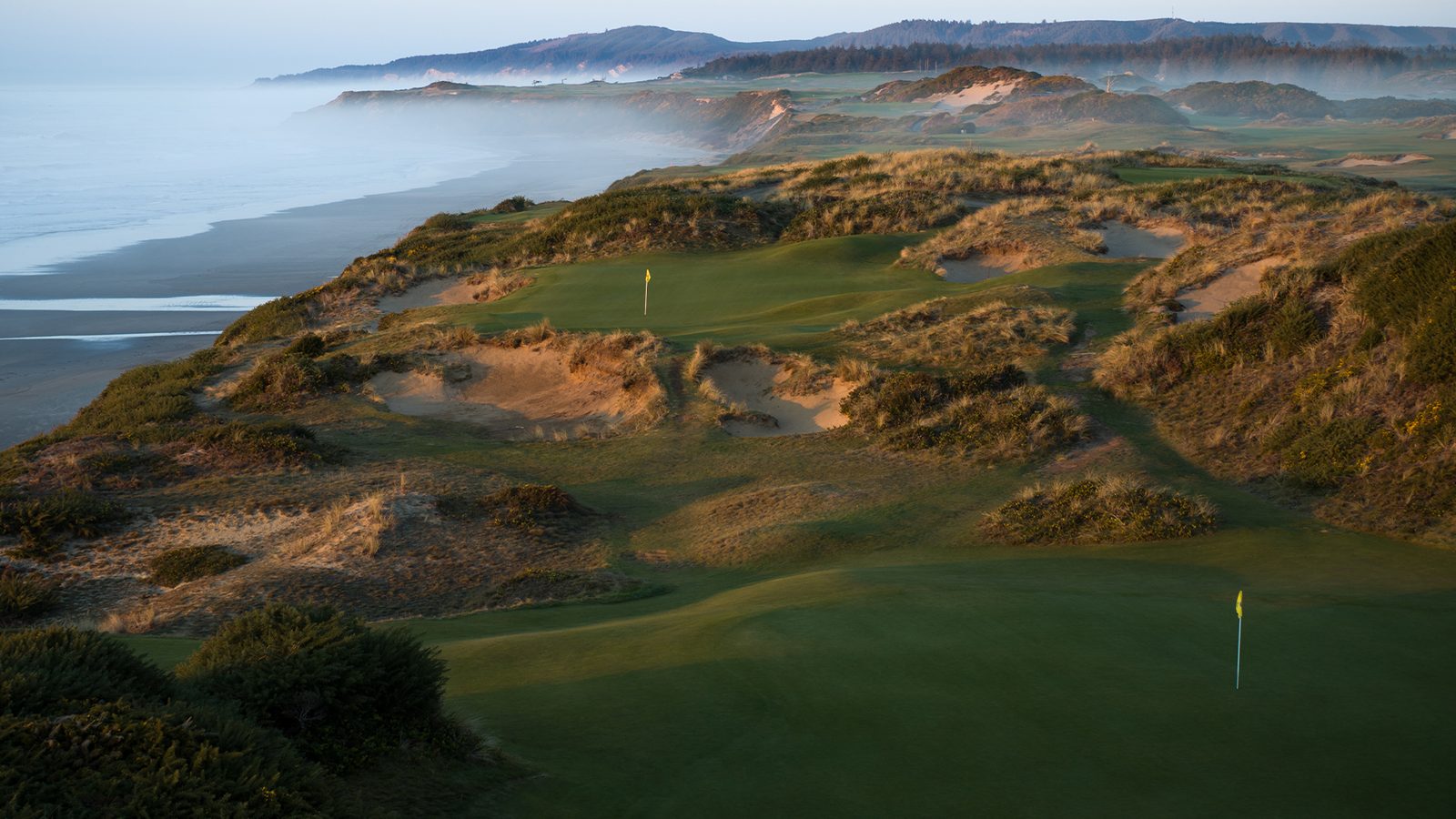
Some courses were built. This one looks discovered. Pacific Dunes is the great American example of a course that seems to have been found rather than made, routed by Tom Doak in 2001 through the blowout dunes and shore pines just north of the original Bandon Dunes course. The holes emerge from the ground instead of sitting on it. Fairways follow the sand's own contours, bunkers look eroded rather than dug, and greens tuck into hollows the wind had already made. Stand on the 4th tee with the Pacific spread out below and it is hard to believe the place is barely a generation old.
The numbers undersell it, and on purpose. At 6,633 yards from the Black tees and par 71, Pacific Dunes is the shortest full examination at the resort. Give it a 25-mile-an-hour wind and it can feel like the longest. Doak saved his strangest and most delightful ideas for the inward half, where four par 3s arrive in nine holes and the routing keeps turning you toward the cliff edge, away from it and then along it. Golf Digest has ranked it first in Oregon since 2003 and second among all public courses in America. One walk around it tends to settle the argument about why.
The Scorecard
The card below is the Black set as published hole by hole in the resort's own hole-by-hole breakdown of Pacific Dunes. It goes out in 3,485 and comes home in 3,148, for 6,633 yards at par 71, and the hole figures match the resort's printed Black total exactly. The rating of 73.0 and the slope of 142 are the pair published for the Black set by several solid sources. Note the shape before the numbers blur together. There is one par 3 on the front nine and four on the back, and the 9th hole's two alternate greens, upper and lower, are both served by this same card.
By the Numbers
From the scorecard below: Black.
Slope 142 from the Black, rating 73.0 - a sterner test than about 64% of the 182 courses in our database with a published slope.
| Front nine | Par | Yards |
|---|---|---|
| Hole 1 | 4 | 370 |
| Hole 2 | 4 | 368 |
| Hole 3 | 5 | 499 |
| Hole 4 | 4 | 463 |
| Hole 5 | 3 | 199 |
| Hole 6 | 4 | 316 |
| Hole 7 | 4 | 464 |
| Hole 8 | 4 | 400 |
| Hole 9 | 4 | 406 |
| Total | 36 | 3,485 |
| Back nine | Par | Yards |
|---|---|---|
| Hole 10 | 3 | 206 |
| Hole 11 | 3 | 148 |
| Hole 12 | 5 | 529 |
| Hole 13 | 4 | 444 |
| Hole 14 | 3 | 145 |
| Hole 15 | 5 | 539 |
| Hole 16 | 4 | 338 |
| Hole 17 | 3 | 208 |
| Hole 18 | 5 | 591 |
| Total | 35 | 3,148 |
The finish is a study in contrasts. The 591-yard 18th is the longest hole at the resort and a genuine three-shot par 5 for nearly everyone, while right before it the 208-yard 17th stands as the longest of the five par 3s. The outward nine leans on the 499-yard 3rd and the mighty 463-yard 4th. Down at the other end of the scale, the shortest par 4 on the card is the 316-yard 6th, whose slender, dangerously sloping green has been ruining confident scorecards since 2001. Nothing here wins by length. Everything wins by angle, contour and wind.
Green Fees
- Green fee, peak season (June to September, resort guests)$375
- Green fee, peak season (day guests)$425
- Green fee, winter (January and December, resort guests)$130
- Replay, peak season (resort guests)$190
- LocationBandon, Oregon
- Par / Yardage71 / 6,633 yards (Black)
Bandon Dunes Golf Resort charges one green fee schedule across all five of its 18-hole courses, Pacific Dunes included, and the rows above are its 2026 card. Resort guests pay $375 from June through September and $130 in January and December. Day guests pay $425 at peak, and a same-day replay for a resort guest costs $190 at peak. Rates step through the shoulder months between those poles. Caddie fees run on top, and most walkers here happily pay them. For the current card in any given month, the resort's own rates page is the place to check.
The Story
Pacific Dunes was the second course at Mike Keiser's young resort. It opened in 2001, two years after David McLay Kidd's Bandon Dunes had proved that American golfers would travel to a remote stretch of the Oregon coast for pure links golf. Keiser handed the commission to Doak, who at the time was known more for his writing and his minimal-earthmoving philosophy than for a portfolio of hits. The response became the defining statement of modern minimalist design. Move almost nothing. Find the holes the land already holds. Let the wind do the defending.
The championship record began early and keeps growing. Pacific Dunes hosted the 2006 Curtis Cup, where the United States beat Great Britain and Ireland 11.5 to 6.5 over its dunes, and USGA championships have returned to the resort's courses ever since. The quirks are now famous. The par-4 9th keeps two greens, an upper and a lower, used on different days, and the choice changes the tee and the character of the par-3 10th that follows. This is a course that reveals itself over repeat plays, which is exactly the habit the resort was built to encourage.
Signature Holes
Hole 4 - Par 4, 463 yards
The 4th runs its whole length along the bluffs above the Pacific, with the ocean in view from tee to green and the wind doing whatever it pleases. The resort's own advice is to aim just right of the left fairway bunkers and hit it long, then favor the left side of the green, where a slope in front feeds the ball to the right. At 463 yards into a coastal breeze it rates among the strongest par 4s in American golf. The view makes concentrating on any of that a genuine act of will.
Hole 13 - Par 4, 444 yards
This is the hole golfers describe on the flight home. The 13th ventures into the prevailing wind along the coast, with far more room to the right than the tee suggests, and finishes at a deep, slightly elevated green whose hole location has to be studied before the approach is even considered. The resort calls it a hole you will never forget, and that is simply accurate. Cliff on one side. A vast natural dune guarding the other. And 444 yards of weather in between.
Hole 11 - Par 3, 148 yards
The resort fondly calls the 11th a real sweetheart, and it may be one of the most loved par 3s in the country. At 148 yards it is nearly the shortest hole on the course, just three yards longer than the 145-yard 14th, and it plays straight at the Pacific. The green is the smallest at Pacific Dunes and sits in the dunes surrounded by native beach grass, bunkers and gorse. Forget the flag entirely and aim for the center of the putting surface, because that is the only sane strategy here. In the wind, a short iron turns into an examination in nerve and trajectory control.
Angles Into the Weather
Pacific Dunes asks golfers to stop trusting the card almost immediately. At 6,633 yards and par 71 from the Black tees it is the shortest full examination at the resort, yet a rating of 73.0 and a slope of 142 say the test is real, and a strong coastal wind can stretch those modest numbers until the course feels like the longest walk on the property. The defense lives in angle, contour and weather rather than raw distance. Fairways follow the sand contours through blowout dunes and shore pines, bunkers look eroded rather than dug, and greens tuck into hollows the wind had already shaped.
The shape of the card sharpens that point. The front nine runs 3,485 yards with a single par 3, while the back nine comes home in 3,148 yards with four par 3s tucked into nine holes. That imbalance changes the rhythm completely. Short work such as the 316-yard 6th, with its slender and dangerously sloping green, offers a scoring chance that punishes overconfidence, then the inward half keeps handing over a different one-shot club, from the 145-yard 14th to the 208-yard 17th, the longest of the five par 3s. Even the 9th refuses to sit still, with upper and lower alternate greens served by the same card and a choice that changes the character of the par 3 that follows.
Two long par 4s show how the pressure builds along the ocean. The 463-yard 4th runs its whole length along the bluffs above the Pacific and rates among the strongest par 4s in American golf, while the 444-yard 13th ventures into the prevailing wind toward a deep and slightly elevated green with cliff on one side and a vast natural dune guarding the other. Between those examinations sits the 148-yard 11th, played straight at the Pacific to the smallest green on the course, where the sound plan is the center of the surface and nothing bolder. Golfers who control trajectory and pick the brave angle get rewarded here. Golfers who chase flags into the wind tend to watch a tidy card unravel in about three holes.
Practical Info
Pacific Dunes sits at Bandon Dunes Golf Resort, 57744 Round Lake Road in Bandon, on Oregon's south coast. That is roughly a five-hour drive from Portland, or a short hop to the nearby regional airports the resort serves with shuttles. Golf at Bandon is walking only, with caddies and push carts available, and the resort strongly encourages the caddie route on a first visit. Local knowledge about which green the 9th is using and where the wind is taking the 13th is worth real strokes.
Booking runs through the resort, and lodging guests hold the inside track. The resort takes lodging reservations far into the future, while day guests may book golf-only tee times a limited number of days ahead during the April to mid-November season, at a premium rate. Most trips play Pacific Dunes at least twice across a stay, once early to learn it and once late to enjoy knowing it. The half-price rhythm of replay rounds makes 36-hole days the house tradition.
Questions, Answered
Who designed Pacific Dunes and when did it open?
Tom Doak designed Pacific Dunes, and it opened in 2001 as the second course at Bandon Dunes Golf Resort. It was the breakthrough work of modern minimalist design in America, and Golf Digest has ranked it first in Oregon since 2003.
Why does Pacific Dunes have four par 3s on the back nine?
Because Doak followed the ocean frontage and the dune formations where they led. The ground on the inward half offered a run of natural one-shot holes at the 10th, 11th, 14th and 17th, and he took all of them. The result is a par of 36 out and 35 home, one of the most recognizable scorecard shapes in golf.
How much does it cost to play Pacific Dunes?
The resort prices all five of its 18-hole courses on one schedule. In 2026 a resort guest pays $375 from June through September and $130 in January and December, with day guests at $425 at peak. Same-day replays run at roughly half the first-round rate.
Keep Exploring Oregon
Read our Oregon Golf Guide for more top courses, green fees, and trip planning across the state.
Pacific Dunes features in our ranking of the 15 Best Golf Courses in Oregon.
More Oregon course guides: Bandon Trails, Old Macdonald, Sheep Ranch, Silvies Valley Ranch (Hankins Course), Crosswater Club, Pumpkin Ridge (Ghost Creek), Juniper Preserve - Pronghorn (Nicklaus Course), Brasada Ranch (Brasada Canyons), Gearhart Golf Links, Langdon Farms Golf Club, Tetherow Golf Club, Bar Run Golf Club and Bandon Dunes.