Mauna Kea Golf Course
The original Hawaiian resort course, Robert Trent Jones Sr.'s 1964 lava-field masterpiece on the Kohala Coast, renewed for its next sixty years.
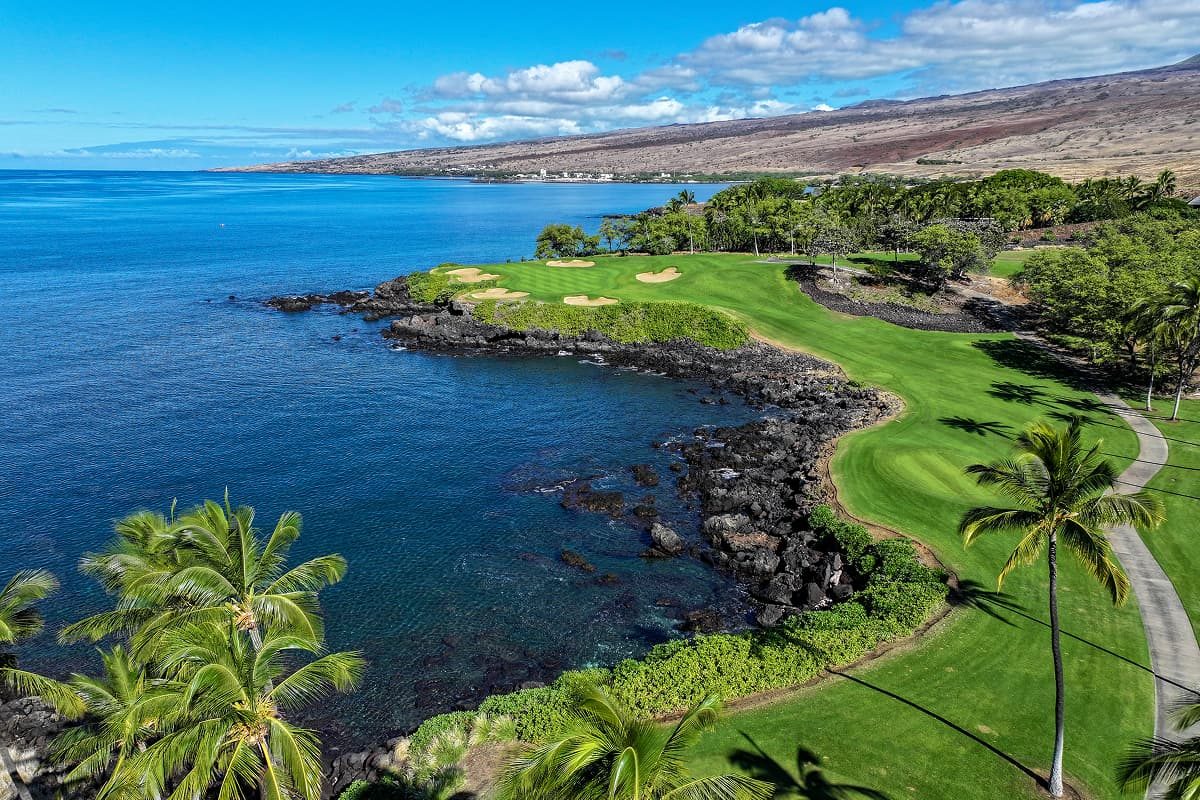
Every Hawaiian resort course that followed is a footnote to this one. Mauna Kea opened in 1964, built by Robert Trent Jones Sr. across raw black lava on the Kohala Coast for Laurance Rockefeller's Mauna Kea Beach Hotel, and it invented the genre on the spot, championship golf as the anchor of a luxury island resort. Sixty years on, freshly renovated and reopened in December 2024, it remains the Big Island's essential round. We rank it fourth among Hawaii courses you can play, and Golf Digest places it 43rd on its list of America's 100 greatest public courses.
The signature is the 3rd, a par 3 across a crashing ocean cove that has been photographed as much as any hole in American golf, 272 yards from the championship tees over open water. But the course around it is no supporting act. At 7,370 yards, rated 76.8 with a slope of 143 on the resort's post-renovation figures, Mauna Kea is a full championship examination, lava and bunkering and coastal wind arranged by the man who defined the modern championship course. The renovation lineage is unique in the game. Jones Sr. built it, his son Rees Jones updated it in 2008, and his other son Robert Trent Jones Jr. led the 2024 renovation, three generations of one family shaping the same ground.
The Kohala Coast setting does the rest. Mauna Kea sits on the driest, sunniest shore in Hawaii, where rain is a rumor and the trades cool the afternoons, fronting one of the finest natural beaches in the islands at Kauna'oa Bay. It is the complete original article, the resort, the beach and the golf course designed as one idea in 1964 and still working as one today.
The Scorecard
The card below shows the Championship tees, the back set, from the club's published scorecard. It plays 7,370 yards at par 72 and foots exactly, 3,597 yards out and 3,773 back. The rating pair needs a note. The resort's own 2026 fact sheet prints 76.8 and 143 for the championship set after the 2024 renovation, and that is the figure used here. The 77.2 and 136 in older sources belongs to the pre-renovation course.
By the Numbers
From the scorecard below: Championship tees.
Slope 143 from the Championship tees, rating 76.8 - harder than about 69% of the 182 courses in our database with a published slope.
| Front nine | Par | Yards |
|---|---|---|
| Hole 1 | 4 | 374 |
| Hole 2 | 4 | 380 |
| Hole 3 | 3 | 272 |
| Hole 4 | 4 | 438 |
| Hole 5 | 5 | 600 |
| Hole 6 | 4 | 338 |
| Hole 7 | 3 | 218 |
| Hole 8 | 5 | 547 |
| Hole 9 | 4 | 430 |
| Total | 36 | 3,597 |
| Back nine | Par | Yards |
|---|---|---|
| Hole 10 | 5 | 567 |
| Hole 11 | 3 | 250 |
| Hole 12 | 4 | 392 |
| Hole 13 | 4 | 374 |
| Hole 14 | 4 | 425 |
| Hole 15 | 3 | 211 |
| Hole 16 | 4 | 484 |
| Hole 17 | 5 | 620 |
| Hole 18 | 4 | 450 |
| Total | 36 | 3,773 |
This is a heavyweight's card with a poet's moments. The par 5s are all genuine, 547 to 620 yards, the par 3s are the longest set in Hawaiian resort golf, and the par 4s run 338 to 484 yards, the band where Jones Sr. did his strategic work. The back nine out-measures the front by 176 yards, so the round stiffens as the trade wind builds, a championship rhythm the architect understood completely. Resort and forward sets step down through 6,806 and 6,358 yards, and choosing them is not surrender. It is how the course was meant to be enjoyed by the golfers it was built for.
Green Fees
- Outside guest$345
- Hotel guest$315
- Twilight, outside guest (after 12 pm)$270
- Twilight, hotel guest (after 12 pm)$245
- LocationWaimea, Hawaii
- Par / Yardage72 / 7,370 yards (Championship tees)
The resort's own 2026 fact sheet publishes the full ladder, and a second source that checked the figures against the resort's booking system in August 2026 quotes them identically. Outside guests pay $345 in the morning and $270 from noon, hotel guests $315 and $245, replays run $200 and $185, and juniors under 18 pay $120 and $110. Kama'aina rates for Hawaii residents are reported around $125 with resident ID. One caution for comparison shoppers. Some guides carry a lower band of $185 to $295 that conflicts with the resort's own published fact sheet, and the fact sheet governs. Public tee times open 60 days out, with the earliest morning slots held for resort guests and members.
The Story
Laurance Rockefeller chose this remote Kohala Coast lava field for a hotel the critics said could never work, no fresh water, no roads to speak of, nothing but black rock and a perfect crescent beach. Robert Trent Jones Sr. built the golf course first, in 1964, carving fairways out of the lava and creating the over-the-ocean 3rd that became the resort's emblem, and the Mauna Kea Beach Hotel opened in July 1965 to immediate acclaim. Hawaii had beach hotels before. It had never had this, a destination resort built around a championship course, and the template spread across the islands for decades.
The course's care passed down the Jones family in a way no other course can claim. Rees Jones led an update in 2008, and Robert Trent Jones Jr. directed the comprehensive renovation that closed the course through much of 2024, rebuilding bunkers, renewing fairways and greens and sharpening the original design's lines, before a December 2024 reopening. The resort's own 2026 fact sheet tells the lineage plainly and prints the renewed figures, 7,370 yards from the championship tees with a rating of 76.8 and a slope of 143. Sources showing 77.2 and 136 are quoting the pre-renovation course and are out of date.
Signature Holes
Hole 3 - Par 3 - 272 yards
The most photographed hole in Hawaii, and maybe in American resort golf. The 3rd plays across an ocean cove, tee and green on lava headlands with the surf breaking in the chasm between, and from the championship tees the carry alone runs most of 272 yards over open water. It is one of the longest ocean carries in the game and the image that sold the world on Hawaiian golf in 1964. Every golfer who makes the trip walks to this tee with a camera already out, and the hole still manages to be bigger in person.
Hole 11 - Par 3 - 250 yards
The second ocean test, and no breather. The 11th returns to the coast at 250 yards, another long one-shotter where the Pacific does the defending and the trade wind edits every calculation. Mauna Kea's par 3s are a championship set in their own right, 272, 250, 218 and 211 yards from the back tees, and the 11th is the one that catches golfers out, arriving mid-round when the swing has loosened and the respect has not yet fully formed.
Hole 17 - Par 5 - 620 yards
The longest hole on the course, a 620-yard par 5 that carries the round toward its finish across the lava country. The back nine at Mauna Kea is the longer and harder side at 3,773 yards, and the 17th is its full stop, a genuine three-shot hole for every mortal, played with the mountain rising inland and the ocean at your back. Birdies here are earned the old way, three good shots and a putt.
Practical Info
Mauna Kea Golf Course is at 62-100 Mauna Kea Beach Drive in Waimea on the Kohala Coast, about 45 minutes north of Kona's airport. The resort sells public tee times with no stay required, opening 60 days out, with the earliest morning slots held for resort guests and members. Morning rates are $345 for outside guests and $315 for hotel guests, dropping to $270 and $245 from noon, with juniors at $120 and $110. The Kohala Coast is the sunniest address in Hawaii, so the practical advice is simple, sunscreen, the early time for calm air on the 3rd, and at least one unhurried hour afterward for Kauna'oa Beach, the crescent the whole resort was built around.
Base on the Kohala Coast and the Big Island's golf clusters around you. Mauna Kea pairs naturally with the Mauna Lani courses and Hapuna within minutes, and Waikoloa's 36 holes just south, which makes a four-course week with almost no driving. The island rewards a slower trip than Oahu or Maui. Play Mauna Kea first while the sense of occasion is fresh, then again at twilight rates late in the stay, when the 3rd hole in low sun justifies every penny of the return.
Questions, Answered
How much does it cost to play Mauna Kea?
The resort's published 2026 rates put outside guests at $345 for a morning round and $270 from noon, with hotel guests at $315 and $245. Replays run $200 and $185, juniors under 18 pay $120 and $110, and Hawaii residents can ask about kama'aina rates, reported around $125 with ID. A second source verified the same figures against the resort's booking system in August 2026. Public tee times open 60 days out.
Why is Mauna Kea historically important?
It is the original Hawaiian resort course. Robert Trent Jones Sr. built it in 1964 on a Kohala Coast lava field for Laurance Rockefeller, a year before the Mauna Kea Beach Hotel opened in 1965, and together they invented the model of championship golf anchoring a luxury island resort. Its par-3 3rd across the ocean cove became the emblem of Hawaiian golf. The family lineage continued with Rees Jones's 2008 update and Robert Trent Jones Jr.'s 2024 renovation.
When was Mauna Kea renovated?
The most recent renovation, led by Robert Trent Jones Jr., ran through 2024 and the course reopened that December with rebuilt bunkers and renewed fairways and greens. The resort's 2026 fact sheet prints the current championship figures, 7,370 yards with a 76.8 rating and 143 slope. Older sources showing 77.2 and 136 describe the pre-renovation course.
How hard is Mauna Kea?
From the championship tees, 7,370 yards at par 72, rated 76.8 with a slope of 143. The par 3s are the famous difficulty, 272 yards over the ocean at the 3rd and 250 at the 11th, and the back nine is the longer side at 3,773 yards. The Tournament set at 6,806 yards and the Resort set at 6,358 take the exam down to a fair test, and the Kohala Coast's reliable sun makes it the most weather-certain hard course in Hawaii.
Keep Exploring Hawaii
Read our Hawaii Golf Guide for more top courses, green fees, and trip planning across the state.
Mauna Kea Golf Course features in our ranking of the 15 Best Golf Courses in Hawaii.
More Hawaii course guides: Kapalua Plantation Course and Princeville Makai Golf Club.
More course guides: Pebble Beach Golf Links.