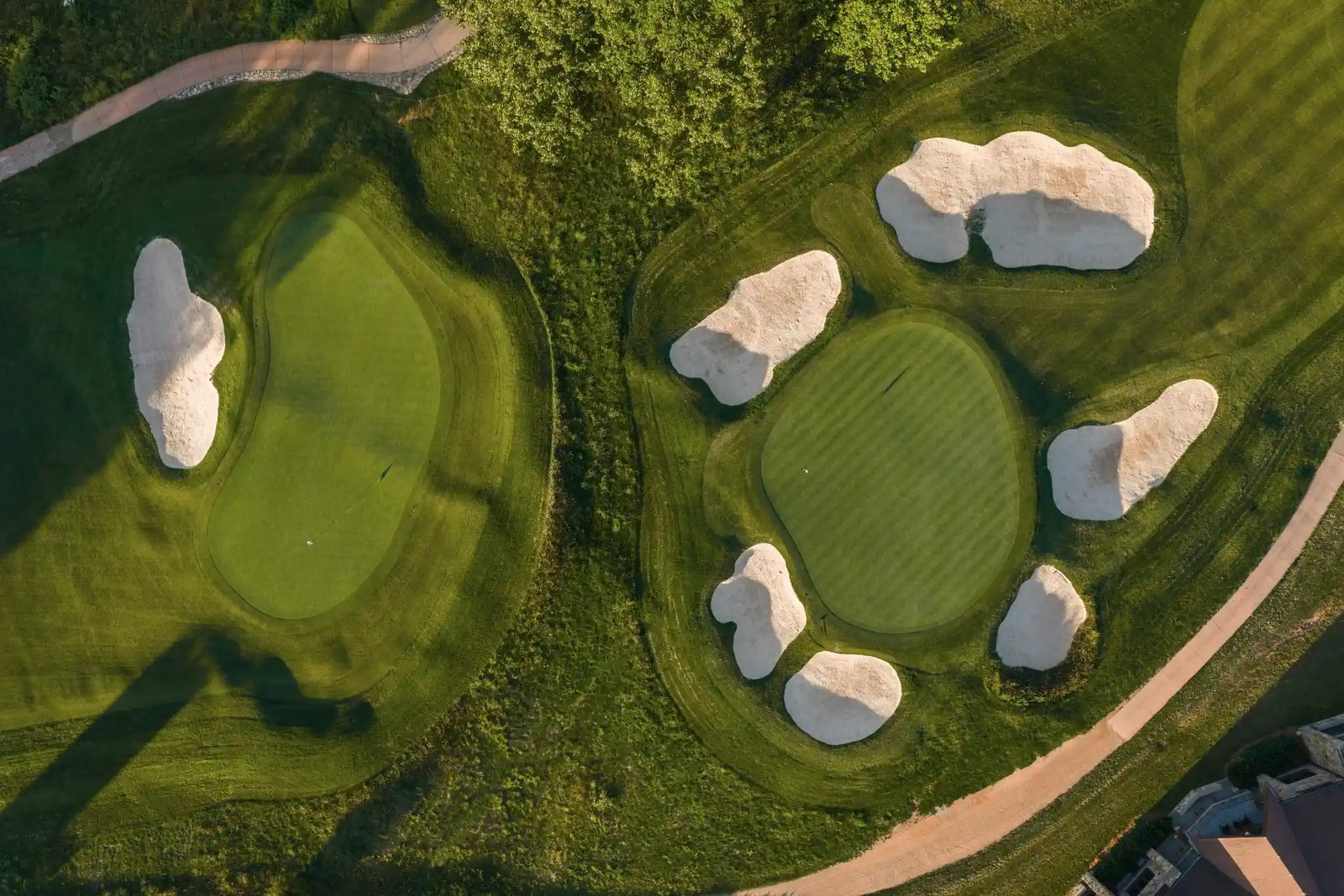
Nine holes of golf have been played since 1915 on the western rim of the Cumberland Plateau, where the University of the South spreads its stone campus across a 13,000-acre domain. The Course at Sewanee began as Bishop Albion Knight's handiwork, laid out with mules and the university football team. The routing he found among the plateau woods and valley overlooks still governs play more than a century later. The rankings have noticed. Golfweek's 2026 panel ranks it second among Tennessee courses you can play, Golf's website places it among America's ten best nine-hole courses, and Golf Digest included it in its ranking of the 25 greatest college courses in America.
What makes Sewanee essential rather than merely historic is the second architect. In 2013 Gil Hanse and Jim Wagner rebuilt all nine green complexes, refreshed the bunkering and the grassing, and added alternate tees, all while leaving Knight's routing untouched. Those alternate tees are the masterstroke. The second loop plays from different angles and lengths, and two holes even change par, so an 18-hole round here becomes a genuine two-act round rather than a repeat. Template ideas from the classic British and Scottish holes run through the design, from a Road Hole-flavored finisher to an Alps-style second.
The Scorecard
Nine holes, eighteen entries. Hanse's alternate tees mean the two loops at Sewanee are no photocopy of each other. The card below follows the published hole-by-hole tour that documents both loops from the back tees, with the first loop as holes 1 to 9 and the alternate-tee second loop as holes 10 to 18. One quirk deserves a mention. That tour states an 18-hole total of 6,672 yards, while its own eighteen published hole yardages sum to 6,708, and 6,708 is the yardage used here because it matches the card exactly. GolfPass lists the nine-hole back tees at 3,279 yards with a 36.0 rating and a 129 slope. Because the loops mix pars and lengths, no single 18-hole rating and slope pair is published for this exact card, so the card below carries none.
By the Numbers
From the scorecard below: Back tees (two loops).
| Front nine | Par | Yards |
|---|---|---|
| Hole 1 | 4 | 461 |
| Hole 2 | 5 | 548 |
| Hole 3 | 3 | 187 |
| Hole 4 | 4 | 246 |
| Hole 5 | 3 | 218 |
| Hole 6 | 4 | 437 |
| Hole 7 | 4 | 402 |
| Hole 8 | 4 | 315 |
| Hole 9 | 5 | 513 |
| Total | 36 | 3,327 |
| Back nine | Par | Yards |
|---|---|---|
| Hole 10 | 5 | 556 |
| Hole 11 | 5 | 513 |
| Hole 12 | 3 | 177 |
| Hole 13 | 4 | 264 |
| Hole 14 | 3 | 200 |
| Hole 15 | 4 | 427 |
| Hole 16 | 4 | 417 |
| Hole 17 | 4 | 371 |
| Hole 18 | 4 | 456 |
| Total | 36 | 3,381 |
Read the pars as carefully as the yardages. The first hole gains a shot on the second loop, going from par 4 to par 5, and the ninth gives one back as it moves from par 5 to par 4, so both loops total par 36 by different routes and the 18-hole card balances at 72. The two par 3s, the 3rd and the 5th, both play along the rim with valley views beyond their greens, and both shorten slightly on the second loop. The 8th stretches from 315 to 371 yards and turns from a teaser into a test. It is the most thoughtfully doubled nine in the South.
Green Fees
- LocationSewanee, Tennessee
- Par / Yardage72 / 6,708 yards (Back tees (two loops))
The Course at Sewanee sells tee times through GolfNow and the university, but it posts no fixed rate card of its own, and the figures in circulation disagree too much for any single fee to be stated. GolfLink carries an $85 directory estimate for nine holes. Golfer reports on GolfPass range from $31 to $41 walking for 18 holes and also include $49 for nine holes with cart and $100 charged for one 18-hole round. Check the live tee sheet for your date and take the price there as the real one.
The Story
The university itself dates to 1857. Golf arrived in 1915, when Bishop Albion W. Knight, a university figure with no formal design training, organized faculty, staff, students and local residents to build a course on the domain. The football team and the mule teams did the heavy work. The result was the oldest golf course in Franklin County, beloved from the start for its plateau setting. For generations it served as the students' scruffy nine, charming and a little rough around the edges.
Scottish professional Jack Cowan made later revisions, but the transformation came when a group of alumni raised a reported $3.5 million to restore the course properly and hired Gil Hanse, then fresh from winning the Olympic course commission. Hanse and Jim Wagner kept Knight's routing as an act of respect and rebuilt everything inside it. Nine new green complexes went in. The bunkering came back in a mix of pot, conventional and waste styles, alongside fresh grassing and tree work that reopened the valley views. A new practice facility completed the job.
The renovated course reopened in 2013 to a new life. It hosts Tennessee state events, including the 2016 Girls State Junior, the 2018 Women's Mid-Amateur and Senior-Amateur and the 2021 Challenge Cup. The Sewanee Inn and a golf lodge now give visiting golfers a base beside the course. A century after a bishop and a football team built it, Sewanee stands as the elder statesman of Tennessee's nine-hole golden age. It is proof that Hanse's generation of architects saw in Knight's routing exactly what Knight saw in the land.
Signature Holes
Hole 1 - Par 4 - 461 yards
The opener borrows its soul from the most famous hole in golf. Sewanee's first is its Road Hole essay, played to an elevated green wider than it is deep. A center-line bunker and a mounded landform force a line to be chosen off the tee, and the approach runs blind on the par-4 first loop. Then the hole transforms. On the second loop it stretches to 556 yards and plays as a par 5, the same green approached with entirely different expectations.
Hole 5 - Par 3 - 218 yards
They call the fifth The Edge, and the name is literal. This long one-shotter plays along the plateau rim to a green set at the property's edge, the land falling away beyond it into the valley below, in the infinity manner that makes Sewanee's two par 3s so memorable. Hanse's reshaped tee frames the whole composition, and the Sewanee Inn's telling of the hole treats this tee as the place where his talent announces itself.
Hole 9 - Par 5 - 513 yards
The home hole runs straight back toward the clubhouse, and it saves its own transformation for last. A 513-yard par 5 on the first loop becomes a demanding 456-yard par 4 on the second, its green complex modeled with a wink at the Road Hole. Closing a match here means solving the same ground twice in two different keys. That is Sewanee's whole argument in a single hole.
One Routing, Two Different Rounds
Repetition is the usual tax on a nine-hole course. Sewanee refunds it. Gil Hanse and Jim Wagner kept the 1915 routing by Albion Knight intact during the 2013 rebuild on the Cumberland Plateau and added alternate tees instead, so the second loop plays from different angles and lengths across the same ground. The doubled card totals par 72 at 6,708 yards, split 3,327 yards out and 3,381 yards back, and those 54 yards of difference hide a much larger shift in character. Shots that felt settled on the first loop need rethinking on the second, often with a different club and a different target line.
Two holes change par outright, and they bookend the experience. The 1st plays 461 yards as a par 4 on the first loop, with a center-line bunker and a mounded landform forcing a line off the tee and a blind approach to an elevated green wider than it is deep. On the second loop the same hole stretches to 556 yards as a par 5 and becomes the longest hole on the card. The 9th runs the exchange in reverse, moving from a 513-yard par 5 to a demanding 456-yard par 4 on the way home. Both loops total par 36 by different routes, a neat piece of arithmetic that feels anything but neat under pressure.
Other holes simply grow teeth. The 8th stretches from 315 yards to 371 yards and turns from a teaser into a test, while the two par 3s along the rim, the 3rd and the 5th, both shorten slightly on the second loop without losing their valley views. The 218-yard 5th, called The Edge, plays along the plateau rim to a green with the land falling away beyond it. Golfers who enjoy solving the same ground twice in two different keys will love the format. Golfers who memorize a course by yardage alone get exposed politely and repeatedly.
Practical Info
The Course at Sewanee is at 444 Greens View Road, Sewanee, TN 37375, on the University of the South campus near Monteagle. It sits off Interstate 24 at Exit 134, roughly midway between Nashville and Chattanooga and about 30 to 45 minutes from Sweetens Cove. Play is fully public. Book through the club or GolfNow, and note that an 18-hole round is booked as two tee times, one for each loop, so the turn runs on schedule. Green's View Grill handles food at the course, and the Sewanee Inn, overlooking the golf, is the natural stay.
Give the setting its due. The campus, all Gothic stone and forest, rewards a slow arrival, and the plateau air runs cooler than the valley floor in summer. The course is an easy and lovely walk, with the rim holes asking you to pause whether you planned to or not. Sewanee pairs with Sweetens Cove into the finest nine-hole double in America, and the two together make a complete Tennessee golf weekend. Take Hanse in the morning and King and Collins after lunch, or the other way around.
Questions, Answered
Who designed the Course at Sewanee?
Bishop Albion Knight laid out the original course in 1915 with help from university staff, students and the football team. Gil Hanse and Jim Wagner rebuilt every green complex, the bunkering and the grassing in 2013 and added alternate tees, while preserving Knight's routing intact.
How does an 18-hole round work on a nine-hole course?
You play the nine holes twice, and the second loop uses alternate tees that change lengths and angles throughout. Two holes even change par. The 1st plays as a par 5 the second time around and the 9th as a par 4, so the loops feel like two related but distinct nines.
What are Sewanee's most famous holes?
The 5th, called The Edge, is the signature. It is a long par 3 along the plateau rim, with the valley falling away beyond the green. The 1st and the 9th borrow from the Road Hole at St Andrews, and the 2nd works an Alps theme, part of Hanse's set of classic template ideas woven through the nine.
Keep Exploring Tennessee
Read our Tennessee Golf Guide for more top courses, green fees, and trip planning across the state.
The Course at Sewanee features in our ranking of the 15 Best Golf Courses in Tennessee.
More Tennessee course guides: Sweetens Cove Golf Club, Stonehenge at Fairfield Glade, Gaylord Springs Golf Links, Heatherhurst Brae at Fairfield Glade, Bear Trace at Harrison Bay, Hermitage Golf Course (President's Reserve), Bear Trace at Cumberland Mountain, GreyStone Golf Club, Mirimichi Golf Course, Island Pointe Golf Club, Sevierville Golf Club (River Course), Dorchester Golf Club at Fairfield Glade and Landmark Golf Club at Avalon.