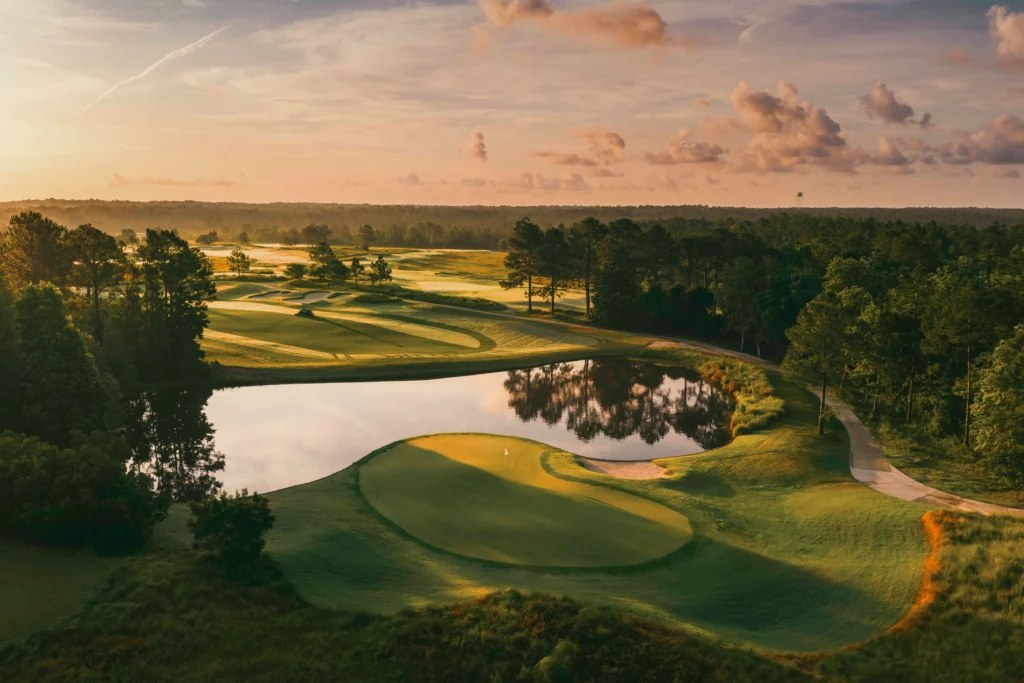
Every course you can play - from a Fazio masterpiece behind a casino gate in the De Soto pines to a Palmer course played on bridges over the marsh, by way of twin Fazio and Pate courses in Choctaw country and a McCumber double in the Pine Belt. Public, resort and semi-private only: if a course will not sell you a tee time, it is not on this list.
12Courses You Can Play
144Golf Courses Statewide
7Gulf Coast Courses On The List
3Jerry Pate Courses On The List
Mississippi golf is casino golf, and played at this level it is a compliment. The state's bookable top end was built by gaming money and architectural ambition: MGM hired Tom Fazio to build a Shadow Creek for the Gulf Coast, the Mississippi Band of Choctaw Indians hired Fazio and Jerry Pate together for 36 holes in the pine hills, and Jack Nicklaus, Arnold Palmer and Davis Love III all signed courses along one 60-mile shoreline. Seven of the twelve courses here sit on or just off the Gulf Coast, Jerry Pate has a hand in three of them, and Mark McCumber, the Tour player turned architect, built two more an hour apart. The honest headline runs the other way as well: the state's two most famous courses, Old Waverly and Mossy Oak in West Point, went fully private in 2024 and cannot be booked at any price, so this list is what Mississippi golf actually offers a visitor today - and it offers plenty. These are the twelve bookable courses worth planning a trip around.
How we chose them
Our twelve starts with Golfweek's 2026 Best Courses You Can Play panel for Mississippi, which publishes exactly ten courses for the state - Fallen Oak first, The Preserve second, Dancing Rabbit's Oaks course third, Grand Bear fourth, Shell Landing fifth, Dancing Rabbit's Azaleas course sixth, Canebrake seventh, Windance eighth, Timberton ninth and The Oaks tenth - and we keep the panel's order for every ranked course it covers. One panel course is not ranked: Canebrake Country Club in Hattiesburg, a Jerry Pate design the panel places seventh, presents itself today as a membership club - its own website offers membership information and no public tee-time booking, and GolfLink classifies it Private - so under our playable-only rule it sits in the honorable mentions with its full story and a call-ahead note until a public tee sheet is clear again. Ranks 10-12 blend Golf Digest's Mississippi record, which places The Bridges in the state's top ten and has recognized Kirkwood National since its 1995 opening, Golf Inc.'s Renovations of the Year honor and GolfPass's 2026 Editors' Choice selection for The Refuge in Flowood, Mississippi Magazine's Super Seven, which includes Kirkwood, and GolfPass's 2026 Golfers' Choice list, on which everyday golfers put Grand Bear first in the state. Access calls, stated plainly: Fallen Oak is reserved exclusively for guests of the Beau Rivage Resort & Casino and is tagged Resort on that basis; The Preserve, both Dancing Rabbit courses, Grand Bear and The Bridges are casino courses whose tee sheets are open to anyone, with no stay required, and are tagged Public on the Firekeeper basis; Windance, Timberton and Kirkwood National are semi-private clubs whose members and daily-fee guests share a tee sheet; and Old Waverly and Mossy Oak, the former public-access headliners in West Point, went fully private under new ownership in 2024 and are named only in the absent-on-purpose note. Every other course sells daily-fee tee times to anyone. No green fees appear on this page: Mississippi's casino courses price by season, day and player tier, and its resort headliner is sold only inside a hotel stay, so no fee on this list is a single static, club-published number. No Mississippi course is in our national top 25 yet: Fallen Oak, the panel's state No. 1, holds the strongest claim, and it is the leading candidate for a future national list.
Access key: Public anyone can book · Resort bookable with a stay or as a resort guest · Semi-private members plus public tee times
Fallen Oak
Resort
Saucier - Tom Fazio (2006)
Mississippi's cathedral of casino golf, hidden in the pines at the edge of the De Soto National Forest. When MGM built the Beau Rivage in Biloxi, its Bellagio of the East, it hired Tom Fazio to do on the Gulf Coast what he had done at Shadow Creek in Las Vegas: conjure a mature, private-feeling masterpiece out of raw land, this time 510 acres of streams, lakes, marshes and century oaks. Fazio found a sprawling 300-year-old live oak with a fallen limb on an early walk of the site and named the course for it, and more than 1,000 trees were transplanted to make a course that opened in November 2006 looking a century old. The numbers are championship grade - 7,487 yards of par 72 across five sets of tees - and the conditioning is protected by the door: play is reserved exclusively for guests of the Beau Rivage, shuttled up from the Biloxi waterfront, and a busy day here is a quiet day anywhere else. The pros certified it for a decade: the PGA Tour Champions made Fallen Oak the home of the Mississippi Gulf Resort Classic, later the Rapiscan Systems Classic, from the event's first playing in 2010 until the tournament's final edition moved down the road in 2022. Golfweek's panel puts it first among Mississippi courses you can play and second among casino courses in America, and Golf Digest ranks it the best course in the state. Book the hotel night, and the tee time is the finest in Mississippi.
Pure golf, in Jerry Pate's own philosophy, eighteen miles northeast of Biloxi. The 1976 U.S. Open champion built The Preserve in 2006 on a sandy bluff of 245 acres above the coastal plain, and the golf course is the small part of the property: around it stretch 1,800 acres of dedicated nature preserve, longleaf pine savanna, cypress swamp, live oak groves and native coastal grass prairie that the routing threads without disturbing. The Preserve is the only Mississippi course certified through Audubon International's Signature Program, holding Certified Silver Signature Sanctuary status, and the golf matches the setting for restraint: 6,774 yards of par 71, generous fairways that tighten around the greens, and a closing hole that plays over water beneath the clubhouse patio. The Palace Casino Resort in Biloxi owns the property, but the casino never intrudes - there is no hotel on site and no stay is required, just a public tee sheet that Golfweek's panel ranks second in the state and ninth among casino courses in America. On a coast of casino headliners, The Preserve is the connoisseur's round: Pate's belief that a course should enhance the land it sits on, kept literally. Read our course guide.
Dancing Rabbit Golf Club (Oaks)
Public
Philadelphia - Tom Fazio & Jerry Pate (1999)
The second of Tom Fazio and Jerry Pate's twin masterpieces for the Mississippi Band of Choctaw Indians, in the pine hills an hour and a half northeast of Jackson. The Oaks opened in 1999, two years after its sister course, across the pair's shared 700 acres of red clay hills slashed by spring-fed streams - more than five miles of them cross the property. Where the Azaleas performs, the Oaks broods: grand old oak trees decorate the holes, the fairways run through pines and scattered hardwoods, and the Champion Bermuda greens and zoysia fairways play firm and quick. The card runs 7,076 yards of par 72, and the current panels prefer it of the two: Golfweek places it third in the state on the 2026 panel and twentieth among casino courses in America. The Pearl River Resort's Golden Moon and Silver Star casinos sit a short drive away with the hotels and restaurants, but the golf itself is sold to anyone: resort guests, club members and the golfing public share the same tee sheet, which is exactly how a casino course earns a public ranking here. Play the Oaks in the morning and the Azaleas after lunch and the comparison argument lasts the whole drive home.
Grand Bear Golf Club
Public
Saucier - Jack Nicklaus (1999)
A Jack Nicklaus Signature course with no houses, no neighbors and no noise but the pines. Grand Bear opened in 1999 six miles inside the De Soto National Forest north of Gulfport, routed along the Big Biloxi and Little Biloxi rivers through towering pines and cypress wetlands, and the isolation is the design's first feature: holes never run parallel, fairways are wide before the woods take over, and the river builds the finish - the par-3 14th through a chute of trees to a green guarded by the water, the 17th played over the river and then alongside it, and a long uphill 18th back to the lodge-style clubhouse. The card runs 7,204 yards of par 72 with a 143 slope, and the championship proof arrived in 2022, when the PGA Tour Champions brought the Rapiscan Systems Classic here for its final edition after a decade at Fallen Oak. The property is a Caesars-affiliated, VICI-owned course managed by Cabot, and Harrah's Gulf Coast guests ride the shuttle - but the tee sheet is public, Golf Digest and GolfLink both classify it so, and everyday golfers made it their No. 1 course in Mississippi in GolfPass's 2026 Golfers' Choice list. The panel's fourth is the people's first: both verdicts are easy to understand from the first tee.
Shell Landing Golf Club
Public
Gautier - Davis Love III (2000)
Davis Love III on the marsh, a mile from the Gulf of Mexico in Gautier. Shell Landing opened in 2000 as the Sea Island pro's coastal Mississippi statement, and it announced itself nationally at once: Golf Digest ranked it No. 5 among America's Best New Upscale Public Courses, the only course in the top five located in the South. The routing wraps around wetlands and natural areas on the flat coastal plain, with water in play on eight holes, 64 bunkers, wide fairways and large, undulating TifEagle greens across 7,024 yards of par 72 - target golf that stays honest rather than cruel, with the par-4 6th, a tee shot over marsh to a fairway ringed on three sides by water, the hole everyone retells. Shell Landing is the coast's independent: no casino owns it and no resort gates it, the club sells memberships and a loyalty card alongside a public tee sheet anyone can book online, and it has held its place on the state lists for a quarter century on the golf alone. Between the casino headliners at Biloxi and the Alabama line, it is the round the locals steer visitors to first.
Dancing Rabbit Golf Club (Azaleas)
Public
Philadelphia - Tom Fazio & Jerry Pate (1997)
The original Dancing Rabbit, and still the famous one - the course golfers call the Augusta you can play. Tom Fazio and Jerry Pate opened the Azaleas in July 1997 for the Mississippi Band of Choctaw Indians, the first half of a 36-hole statement that helped invent tribal casino golf in the South: flower-banked fairways through towering pines, spring-fed streams in play across the property, and conditioning modeled unabashedly on Augusta National, down to the azaleas that blaze along the holes each spring. The first greens were bentgrass, which the Mississippi summer famously killed within a year; the course today puts on TifEagle ultradwarf Bermuda, and at 7,128 yards of par 72 it remains a full championship test, host of the 2023 PGA University Championship. History gives the Azaleas the bigger name; the raters give its sister the edge, and Golfweek's 2026 panel places the Azaleas sixth in the state and thirty-seventh among casino courses in America, two places behind no course it should be embarrassed by. The club's own record says the club offers its courses to resort guests, members and the golfing public alike, and a 36-hole day here, one course in the morning and one after lunch, is the essential inland Mississippi golf trip.
Windance Country Club
Semi-private
Gulfport - Mark McCumber (1986)
The elder statesman of Mississippi casino golf, and the hardest-working championship course on the coast. Mark McCumber, the ten-time PGA Tour winner turned architect, built Windance in 1986 on rolling ground a few miles from the Gulf of Mexico in Gulfport - terrain with more movement than the coastal plain usually allows, stretched to 6,659 yards of par 72 with tight fairways and water worked through the routing. The tour record is the headline: Windance hosted the Ben Hogan Tour and the Nike Tour in their day, with fields that produced winners including future U.S. Open champion Jim Furyk, Tom Lehman and Alan Doyle, and developmental tour golf still calls here for the Adams Golf Pro Tour's Island View Casino championship event. Island View Casino Resort bought the club in 2007 and remodeled it completely, and the semi-private structure has never changed: members, resort guests and daily-fee golfers share one tee sheet. Golfweek has named it one of America's best courses you can play for years running, Golf Digest gives it four stars, and at forty years old it remains what it has always been - the coast's honest, affordable championship round.
Timberton Golf Club
Semi-private
Hattiesburg - Mark McCumber (1991)
Mark McCumber's second Mississippi design, and Hattiesburg's championship survivor. Timberton opened in July 1991 with eighteen holes across two nines of very different temperaments - the open, hilly Creekside nine and the Valley nine, with water in play on twelve holes between them - and added a third nine, Lakeview, in 1998 to make a 27-hole facility whose championship course runs 7,003 yards of par 72 at a 135 slope. The honors have been consistent since opening day: a four-and-a-half-star rating from Golf Digest, a standing as the leader in championship golf in South Mississippi on its own record, and a tournament calendar that has brought PGA Tour qualifying, the state open and the state amateur championships to its fairways. The semi-private structure suits a college town: members and the public share the tee sheet, Southern Miss gold runs through the clubhouse, and in a city whose other big courses have closed or gone private across the decades, Timberton is the round that endured. Paired with its McCumber brother at Windance, an hour south on the coast, it makes the Pine Belt leg of a Mississippi trip a two-course argument about which brother did it better.
The Oaks Golf Club
Public
Pass Christian - Stephen Caplinger & Chris Cole (1998)
The little course that would not die, in the town where Hurricane Katrina made landfall. The Oaks opened in 1998 in the timberlands and native wetlands of Pass Christian, designed in-house by Landmark Land's own team of Stephen Caplinger and Chris Cole, and it was a tour course almost immediately: the Nike Tour and its successor the Buy.com Tour played the Mississippi Gulf Coast Open here in 1999 and 2000. Then, in August 2005, the eye of Katrina passed over Pass Christian and the course lost more than 3,000 trees. What grew back is the Oaks of today: a serene, meandering 6,885 yards of par 72 through hardwoods, pines and wetlands, strategic bunkering and dramatic green complexes, at a daily-fee price with no casino attached and a door open to everyone. Golf Digest gives it four and a half stars in its Best Places to Play, the National Golf Course Owners Association named it Golf Course of the Year for the Mississippi Gulf Coast, and Golfweek's panel still ranks it in the state's top ten. Every coast trip should include one round that is purely about the golf and the place; on the Mississippi coast, this is that round.
The Bridges Golf Club at Hollywood Casino
Public
Bay St. Louis - Arnold Palmer & Ed Seay (2006)
Arnold Palmer's Mississippi solo, played on bridges over the marsh. The Bridges opened in 2006 at Hollywood Casino in Bay St. Louis as the state's only Arnold Palmer Signature course, built with his longtime partner Ed Seay, and its name is literal: 21 wooden bridges span almost a mile of the property, carrying golfers over 17 lakes and acres of marsh and wetland between island fairways and greens. It was the first resort course in the world granted Audubon International's Certified Silver Signature status, and the golf is hopscotch with consequences - forced carries over water or wetland on shot after shot, moss-draped live oaks and saltwater marsh framing every hole, across 6,841 yards of par 72. Golf Digest places it in the state's top ten, and the door is a public one: tee times sell online to anyone, with platinum memberships offered alongside for locals. On the western end of the coast, forty minutes from the Biloxi headliners, The Bridges is the trip's exclamation point - the course that proves Mississippi's casino golf runs the full length of its shoreline, not just its famous middle.
The Next Two
Ranks 11-12 complete the picture: a city-owned Jackson course reborn in an award-winning redesign and a semi-private stay-and-play in the northern hills. Mississippi's bookable bench is honest about its depth - twelve courses carry genuine panel, national or championship credentials, and the honorable mentions below are where the next wave starts rather than where this list pads out.
The Refuge Golf Course
Public
Flowood - Roy Case (1998)
Jackson's reborn municipal, and the comeback story of Mississippi golf. Roy Case built The Refuge in 1998 on 200 acres of Flowood wetlands, and it was acclaimed on opening as the best purely public course in Mississippi - then the trees closed in, play suffered, and the City of Flowood shut its own course in 2017 for a full redesign. Nathan Crace, a Mississippi architect, rebuilt it: three new holes, rerouted holes, corridors widened, bunkers rebuilt, greens regrassed in TifEagle Bermuda, and lengths from 4,439 to 7,013 yards of par 72. The Refuge reopened on April 19, 2021 under Troon management, with a new Sheraton hotel and conference center beside it, and Golf Inc. named the work one of its Renovations of the Year; GolfPass made it an Editors' Choice in its 2026 Mississippi list. The capital city finally has a public course worth traveling for, and it is a city course anyone can book.
Kirkwood National Golf Club
Semi-private
Holly Springs - Greg Connor (1995)
North Mississippi's stay-and-play secret, in the hills southeast of Memphis. Greg Connor built Kirkwood National in 1995 across rolling, wooded ground outside Holly Springs - seven lakes, 45 bunkers, creeks and elevation changes that flat-Delta golfers drive an hour to feel - and the 7,129 yards of par 72 have collected honors ever since: high rankings from Golf Digest since opening, a four-and-a-half-star Places to Play record, and a place among Mississippi Magazine's Super Seven courses statewide. The club's own billing is semi-private, with daily-fee play for visitors and four-bedroom cottages on the course for groups who want to stay over, and its fifth hole is spoken of locally as one of the hardest par 5s in the Southeast. Between Memphis and Oxford, it is the Hills region's essential round.
Honorable Mentions
Canebrake Country Club in Hattiesburg (Jerry Pate, 1998) is the near-miss that needs explaining first: Golfweek's 2026 panel ranks it seventh in the state, and its pedigree is real - a par-71 course of 7,003 yards around a 250-acre lake and native bamboo stands, named the No. 2 Best New Affordable Public Course in America by Golf Digest on its opening. But the club's own website today is a membership site with no public tee-time booking on it, GolfLink classifies it Private, and no genuine public tee sheet could be verified for it this season, so it waits here under this site's playable-only rule; call the club before traveling, because a confirmed public door puts Canebrake straight back into this ranking. Behind it, Tunica National Golf & Tennis in Tunica Resorts (Mark McCumber, 2004) is the strongest course not ranked here - a Tunica County-owned public course with a 360-degree driving range and an indoor tennis center, host of the 2006 Mississippi State Open, the 2007 State Amateur and U.S. Open sectional qualifying, and seventh in the state in GolfPass's 2026 Golfers' Choice list - followed by The Club at Diamondhead's Cardinal Course in Diamondhead (Earl Stone, 1979), the semi-private half of a 36-hole club whose facility GolfPass golfers placed in the state's top five in 2026, Mallard Pointe Golf Course on Sardis Lake, River Bend Links in Tunica Resorts, Great Southern Golf Club in Gulfport, Patrick Farms Golf Club in Pearl, Shadow Ridge Golf Club in Hattiesburg, The Ole Miss Golf Course in Oxford and Sunkist Country Club in Biloxi. Absent on purpose: Old Waverly Golf Club in West Point (Bob Cupp and Jerry Pate, 1988) and its sister course across the road, Mossy Oak Golf Club (Gil Hanse, 2016) - for years Mississippi's two most celebrated public-access courses, hosts of the 1999 U.S. Women's Open and the 2019 U.S. Women's Amateur, and the top two courses on GOLF Magazine's last public-access state list - went fully private under new ownership in 2024; Mossy Oak closed for a Jerry Pate renovation in January 2025 and reopened that October as a members' course, and neither course appears on Golfweek's 2026 public-access panel. They are joined behind gates by Annandale Golf Club in Madison (Jack Nicklaus), the Country Club of Jackson, Reunion Golf & Country Club in Madison, Hattiesburg Country Club and Laurel Country Club - Mississippi keeps a deep private bench, but none of those clubs will sell you a tee time, and Mulliganist only ranks courses you can actually play.