Every course you can play - from a Begay and Brauer prairie masterpiece north of Topeka to a Garden City municipal reborn in the sand hills, by way of a USGA championship railroad course, the longest walk in the Flint Hills and a 1960s giant in Kansas City. Public, resort and semi-private only: if a course will not sell you a tee time, it is not on this list.
12Courses You Can Play
240Golf Courses Statewide
7City-Owned Courses On The List
4Jeff Brauer Designs On The List
Kansas golf is big-sky golf, and its bookable top end is far better than the flyover jokes suggest. The state's most famous course, Prairie Dunes, sits behind a private gate in Hutchinson, but what remains open to everyone is a remarkable public game. North of Topeka, Notah Begay III and Jeff Brauer built the state's modern No. 1 on tribal land across the road from a casino resort. In Garden City, a city crew rebuilt its own municipal course into a prairie-links that national panelists now rank second in the state. Newton keeps a USGA championship course with railroad-track tee markers, Manhattan keeps the longest and hardest university course in the region, and Kansas City stacks a Hurdzan municipal, two Colbert designs and a 1960s giant inside one metro. Seven of the twelve courses here are city-owned, most of the rest are priced like it, and Jeff Brauer's hand is on four of them. These are the twelve bookable courses worth planning a trip around.
How we chose them
Our twelve starts with Golfweek's 2026 Best Courses You Can Play panel for Kansas, which publishes exactly five courses for the state - Firekeeper first, Buffalo Dunes second, Sand Creek Station third, Colbert Hills fourth and Iron Horse fifth, every one with a public booking link - and we keep the panel's order exactly for ranks 1-5. Ranks 6-12 blend Golf Digest's Kansas record, which ranked Sycamore Ridge the state's No. 1 public course for six straight years on the club's published record, placed Dub's Dread in the state's top 10 in 1996 and counts Buffalo Dunes the No. 1 municipally owned course in Kansas, GOLF Magazine's Kansas list, on which Sand Creek Station stands as the only public-access course in the state's top five, and the city and championship record, from Auburn Hills' standing as Wichita's premier municipal course and the only Perry Dye design in Kansas, to Mariah Hills' NJCAA Division I National Championships of 2004 and 2005 and Quail Ridge's long Golf Digest Places to Play record. Access calls, stated plainly: Firekeeper is a casino resort course whose tee sheet is open to anyone online - the resort's own record confirms no stay is required - and is tagged Public on that basis; Ironhorse is the club's own spelling of the name Golfweek lists as Iron Horse, and it is a City of Leawood municipal course managed by Troon; Cottonwood Hills, Nick Faldo's award-winning Hutchinson design, is not ranked, because its operating history of closures, bankruptcy and bank ownership means no current public tee sheet could be verified for it this season, and it leads the honorable mentions with its full story; Canyon Farms in Lenexa, long semi-private, now presents itself in private-club terms and is likewise held out; and Prairie Dunes, Flint Hills National and Kansas City Country Club are private and are named only in the absent-on-purpose note. Every other course sells daily-fee tee times to anyone. No green fees appear on this page: Kansas's top end prices by season, day, residency and pass tier, so no fee on this list is a single static, club-published number. No Kansas course is in our national top 25 yet: Firekeeper, the panel's state No. 1, holds the strongest claim, and it is the leading candidate for a future national list.
Access key: Public anyone can book · Resort bookable with a stay or as a resort guest · Semi-private members plus public tee times
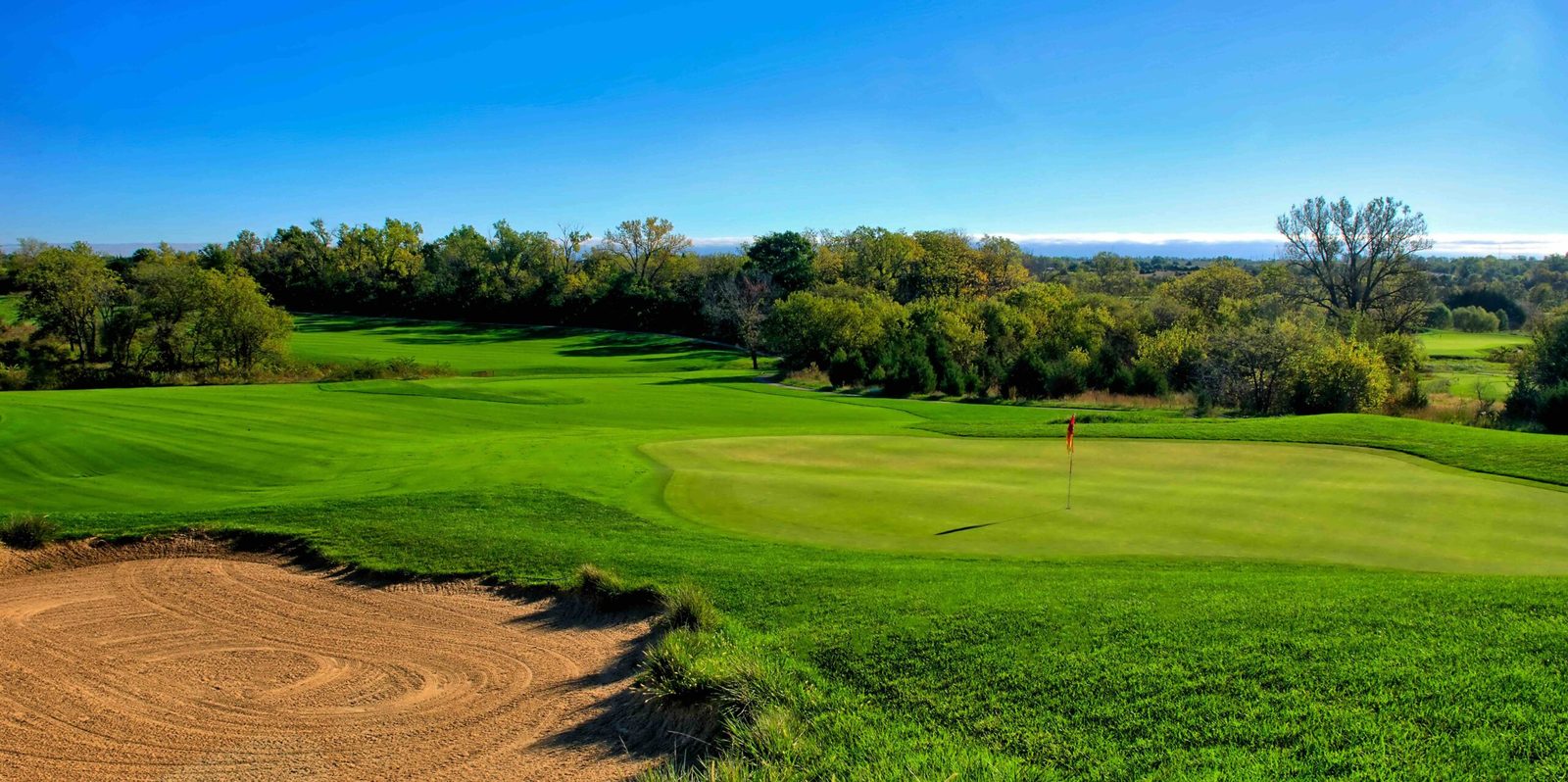
Kansas's modern pilgrimage round, on Prairie Band Potawatomi Nation land twenty minutes north of Topeka. Firekeeper is the first signature course of Notah Begay III, the four-time PGA Tour winner and the only full-blooded Native American to play the PGA Tour, designed in partnership with Jeff Brauer, the lead architect, who has called it his best work. The routing crosses three landscapes with minimal disturbance to the land: the first seven holes run open through the prairie, and the last eleven turn into creek country, rolling hills and scattered trees, with bentgrass from tee to green, fescue rough and not a house in sight. Five sets of tees stretch from 4,790 yards to 7,560 yards of par 72, and the par-5 4th, with its blind tee shot and a long coffin bunker running to the green, sets the tone early. The course opened in spring 2011 to best-new-course notice and has held the top of the state lists since; Golfweek's panel puts it first among Kansas courses you can play. The Prairie Band Casino & Resort sits across the road with its hotel, steakhouse and stay-and-play packages, but no stay is required - anyone can book a tee time, which is exactly how it ranks first in Kansas here. Read our course guide.
Buffalo Dunes Golf Course
Public
Garden City - Frank Hummel (1976)
The municipal miracle of the High Plains, six miles south of Garden City in the historic sand hills. Buffalo Dunes opened in 1976 on land donated by E.C. Brookover, a Frank Hummel design that Golf Digest has long called the public player's Prairie Dunes and the No. 1 municipally owned course in Kansas - and its second act is the story. Since about 2018, superintendent Clay Payne and his in-house crew, assisted by architects Todd Clark and Zach Varty, have transformed the course in phases while it stayed open: most of the planted trees removed, every green complex rebuilt, bunkers reshaped and added, five new holes built, and more than 20 acres of irrigated turf converted to native grasses that save the city millions of gallons of water a year, all on a budget of about $100,000. By the end of the 2025 season all 18 new greens were in play, and the course celebrates its 50th anniversary in 2026 as a firm, fast prairie-links of about 6,800 yards, par 72, that Golf Digest counts among the country's most exciting affordable public courses, playable for less than $40. Golfweek's panel ranks it second in the state - a city-owned course, rebuilt by its own crew, keeping company with the best in Kansas.
Sand Creek Station Golf Course
Public
Newton - Jeff Brauer (2006)
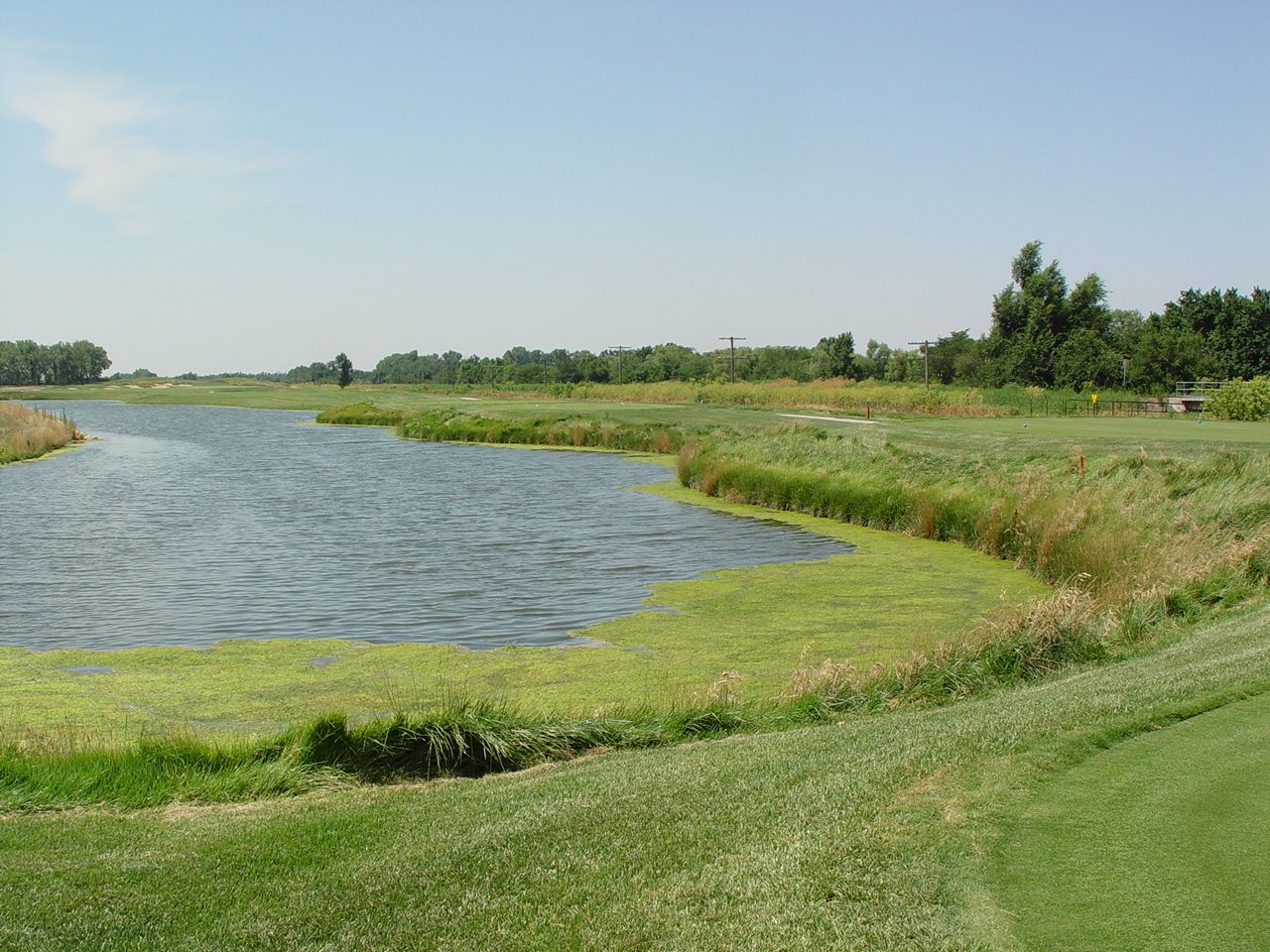
A USGA championship municipal with a railroad soul, twenty-seven miles north of Wichita. The City of Newton built Sand Creek Station in 2006 on corn and alfalfa fields, and Jeff Brauer answered the flat site with a manufactured classic: his own account describes a version of the Alps, a Road Hole tribute, a Redan, a sideways Biarritz at the 4th and a Postage Stamp green at the 9th, with Sand Creek itself in play on four holes and an active BNSF rail line separating the two nines. The clubhouse is styled as a train depot and the tee markers are cut from railroad track. GOLF Magazine named it a Top 10 New Course You Can Play in 2006, and on GOLF's Kansas list it stands as the only public-access course in the state's top five. The championship record is unmatched in Kansas public golf: the 2014 U.S. Amateur Public Links, the 89th and final edition of that championship, won by Byron Meth over Doug Ghim in 37 holes, and the 2024 U.S. Adaptive Open, the first held away from Pinehurst. The tips play close to 7,500 yards of par 72, and close to 40,000 rounds a year make it the beating heart of south-central Kansas golf.
Colbert Hills Golf Course
Public
Manhattan - Jim Colbert & Jeff Brauer (2000)
The really big course out in Kansas, in the Flint Hills northwest of Manhattan. Colbert Hills was the dream of Jim Colbert, the Kansas State alumnus who won eight times on the PGA Tour: a home for the K-State golf teams, a living laboratory for the university's turfgrass research and management programs, and - from the first sketch - a public daily-fee course where anyone could test the same game. Colbert and Jeff Brauer laid out the $11 million course across more than 300 acres of native tallgrass prairie, and it opened in May 2000 with Colbert, Lee Trevino, Raymond Floyd and Annika Sorenstam in the founders' pro-am. The numbers still startle: 7,525 yards of par 72 from the back tees, a 77.5 rating and a 152 slope, more than 100 bunkers, and the signature 7th, a 600-yard par 5 that begins with a 90-foot drop from tee to fairway. The course hosted the 2003 NCAA Men's Central Regional, Golf Digest placed it in the country's top 10 college courses, and on big Kansas State football weekends the sand in the bunkers turns purple. It is the longest, hardest walk in Kansas public golf, and one of its proudest.
Ironhorse Golf Club
Public
Leawood - Michael Hurdzan (1995)
Kansas City's suburban championship muni, owned by the City of Leawood and run by Troon in the heart of Johnson County. Michael Hurdzan, the environmental design pioneer who later co-designed Erin Hills, built Ironhorse in 1995 along an abandoned railroad right-of-way that gives the club its name (Golfweek's panel lists it as Iron Horse; the club spells it as one word). A meandering creek enters the story on 17 of the 18 holes, limestone outcroppings frame the fairways, and the zoysia layout runs 6,889 yards of par 72 with a 140 slope - a complete examination at a municipal address. The honors came immediately: Golf Digest ranked it the No. 1 public course in Kansas on opening and the No. 3 Best New Affordable Golf Course in the United States after the 1996 season, and GOLF Magazine has kept it in the state's top five courses you can play. The practice facility, with its three-hole practice course, has just completed the club's most significant upgrade since 2022. Twenty minutes from downtown Kansas City, it is the metro's polished, tree-lined counterpoint to the prairie courses that lead this list.
Sycamore Ridge Golf Club
Public
Spring Hill - Jim Colbert & Baxter Spann (2000)
Two courses in one at the south edge of Johnson County, and for years the state's public standard. Jim Colbert, building here with Baxter Spann of Finger Dye Spann, opened Sycamore Ridge in 2000 with a split personality golfers across Kansas City still talk about: the front nine rolls open in links style across gently moving ground, and the back nine climbs into mature woodlands, carved out of the trees from elevated tees. The card from the back is a serious test - 7,055 yards of par 72, a 76.2 rating and a 150 slope on bent grass - and the signature par-4 12th, played from an elevated tee to a guarded green, is the hole everyone remembers. The honors on the club's published record are the headline: Golf Digest ranked Sycamore Ridge the No. 1 public golf course in Kansas six years running, and Zagat concurred with its own No. 1 public ranking in 2009. A generation of Kansas City golfers learned what championship public golf felt like here, and paired with Ironhorse across the county it gives the metro's Kansas side a one-two punch of Colbert and Hurdzan designs from the same era.
Falcon Lakes Golf Club
Public
Basehor - Jay Morrish (2002)
Jay Morrish links golf west of Kansas City, minutes from the Legends shopping and stadium district. Morrish, one of the most respected routings men of his generation, built Falcon Lakes in 2002 as a links-style course for the open, breezy ground above Basehor: wide zoysia fairways, bentgrass greens averaging more than 6,000 square feet, and lakes that give the club its name and its closing drama. The club's own card plays par 71, with nine tee decks on every hole running from 4,500 yards to 6,994 at the Black tees, so the same routing welcomes a family round and a tournament field in the same week. Falcon Lakes calls itself one of Kansas City's premier public golf courses on its own course page, and the details back the claim: tournament conditioning as a stated standard, rounds that move at four and a half hours or better, and a 98 percent recommendation rate from golfers on Avid Golfer. On a metro trip stacked with Johnson County names, Falcon Lakes is the Wyandotte and Leavenworth County answer - the round that turns a Legends weekend into a golf trip.
Dub's Dread Golf Club
Public
Kansas City - Jug McSpaden (1966)
The legend of Kansas City golf, in the Piper hills of Kansas City, Kansas. The club was founded in 1964 and the course opened in 1966, laid out by Tour player Jug McSpaden at a scale nobody had attempted: 8,101 yards, proclaimed at the time the longest and toughest golf course in America, with an average par 3 of 270 yards and a course rating of 78.8. The greats came to test it - Arnold Palmer, Jack Nicklaus and Byron Nelson all played exhibition golf here in the late 1960s, on the same fairways the public plays today. The course has since been brought back to a friendlier scale, and its tees now run from about 5,200 to about 7,200 yards of par 72 across rolling, hardwood-lined terrain, but the bones of the giant remain in the long par 4s and the sweeping doglegs. Golf Digest named it one of the Top 10 golf courses in Kansas in 1996, per the club's history, and no Kansas list is complete without it: Dub's Dread is where Kansas City's public game first dreamed big, and it remains the only public course in the metro where you can follow the exhibition footsteps of Palmer and Nicklaus.
Auburn Hills Golf Course
Public
Wichita - Perry Dye (2001)
A Dye in Wichita, and the crown of the city's municipal system. Auburn Hills opened on May 24, 2001 as the fifth and newest course in the City of Wichita's golf system, and the city's own golf plan calls it Wichita's premier municipal golf course - and the only course in Kansas designed by Perry Dye. Dye, Pete Dye's son, routed the championship layout through the wetlands, rolling hills and tight corridors of a west Wichita residential development, finishing in panoramic uplands: 7,169 yards of par 72 from the back tees in the city's telling, with zoysia fairways and bentgrass greens. The tournament calendar treats it as a championship venue - the course hosts the Korn Ferry Tour's Wichita qualifying, USGA events and Kansas Golf Association championships every year. Wichita's public golf story runs deep, from Sim Park in 1919 through the five-course city system, and Auburn Hills is its modern headliner: a genuine Dye examination, bookable by anyone, at a city course address fifteen minutes from downtown.
Eagle Bend Golf Course
Public
Lawrence - Jeff Brauer (1998)
Lawrence's city-owned championship course, in the shadow of the Clinton Lake dam. Eagle Bend was the first golf course owned and operated by the City of Lawrence, and Jeff Brauer - the fourth of his designs on this list, after Firekeeper, Sand Creek Station and Colbert Hills - gave the college town a routing of two characters in 1998: the first six holes play open under the big sky below the dam, and the remaining holes turn into the woods and run alongside the Wakarusa River. The card runs 6,812 yards of par 72, and the facility doubles as the town's learning center, with a driving range of 60 practice tees. Lawrence golf carries a famous name - the old Alvamar, once the University of Kansas teams' home, is now the private Jayhawk Club - which makes Eagle Bend the championship round in town that anyone can book. Pair it with a Jayhawks game weekend, play Colbert Hills forty minutes west in Manhattan the next morning, and the Lawrence to Manhattan corridor becomes the college-town heart of a Kansas golf trip.
The Next Two
Ranks 11-12 complete the picture: a national-championship municipal in Dodge City and the beloved bargain of Winfield. Kansas's bookable bench is honest about its depth - twelve courses carry genuine panel, national or championship credentials, and the honorable mentions below are where the next wave starts rather than where this list pads out.
Mariah Hills Golf Course
Public
Dodge City - Frank Hummel (1974)
Boot Hill golf with a national championship record, in Dodge City. Golf at Mariah Hills began as an 18-hole sand-green course, and the municipal layout of today dates to 1974, when Frank Hummel's design gained bentgrass greens and fairway irrigation - the second Hummel course on this list, two years before his Buffalo Dunes opened. The par-71 layout runs past 6,800 yards across rolling bluegrass fairways and native roughs on the High Plains, requires a player to hit most every club in the bag, and carries a championship plaque few munis can match: host of the NJCAA Division I National Championships in both 2004 and 2005, and home course of the Dodge City Community College Conquistadors. It is the essential second round of a western Kansas trip, ninety minutes east of Buffalo Dunes.
Quail Ridge Golf Course
Public
Winfield - Jerry Slack (1992)
The beloved bargain of south-central Kansas. The City of Winfield's municipal course, designed by Tulsa architect Jerry Slack and opened in 1992 a mile south of town on US 77, runs 6,826 yards of par 72 across zoysia fairways with a little of everything - elevation change, a creek in play, prairie holes and wooded chutes on the back nine. Golf Digest made it a longtime Places to Play honoree and one of its recognized public bargains in America, and the city describes it as one of the top public courses in the state. Small-town Kansas golf at its most welcoming, and the natural finishing round of a Wichita and Newton trip.
Honorable Mentions
Cottonwood Hills Golf Club east of Hutchinson (Nick Faldo, with Guy Hockley as lead architect, opened in stages in 2006 and 2007) leads the next wave on design pedigree alone: a links-style course in genuine Kansas sand hills that collected top-10 national design awards from Golf Inc. and Golf Digest in 2007 and 2008. Its absence here is a matter of verification, not merit - the property has closed, reopened, passed through bankruptcy and a bank sale, and been listed for sale as a bank-owned property in the years since, and no current public tee sheet could be verified for it this season, so it waits here until its door is confirmed open again; check its status before traveling, because a confirmed-open Cottonwood Hills re-enters this ranking. Behind it sit Turkey Creek Golf Course in McPherson (Phil Smith, 1990), which GolfPass golfers placed in the state's public top five in the 2026 Golfers' Choice list, Stagg Hill Golf Club in Manhattan, a community course whose story begins with sand greens in 1930 and whose current layout dates to 1968, The Course at Carey Park in Hutchinson (1932), the municipal round in Prairie Dunes' hometown, Cherry Oaks Golf Club in Cheney, Wellington Golf Club, Rolling Meadows Golf Course in Junction City on Milford Lake, Salina Municipal Golf Course and Canyon Farms Golf Club in Lenexa (Tom Jackson and Tom Kelly, 2007), a longtime semi-private favorite that now presents itself in private-club terms and so sits out until a public tee sheet is clear again. Absent on purpose: Prairie Dunes Country Club in Hutchinson - Perry Maxwell's 1937 nine, completed by his son Press in 1957, is Kansas's consensus best course and a fixture on the national top-100 lists, but it is a private club and sells no public tee time - plus Flint Hills National Golf Club in Andover (Tom Fazio), Kansas City Country Club in Mission Hills (A.W. Tillinghast's course where a young Tom Watson grew up in the game), Wichita Country Club, Shadow Glen Golf Club in Olathe, Milburn Country Club in Overland Park, Hallbrook Country Club in Leawood and The Jayhawk Club in Lawrence, the former Alvamar, whose public course closed in 2016 when the club was reborn as a private facility, make Kansas a genuine private-golf state - but none of them will sell you a tee time, and Mulliganist only ranks courses you can actually play.