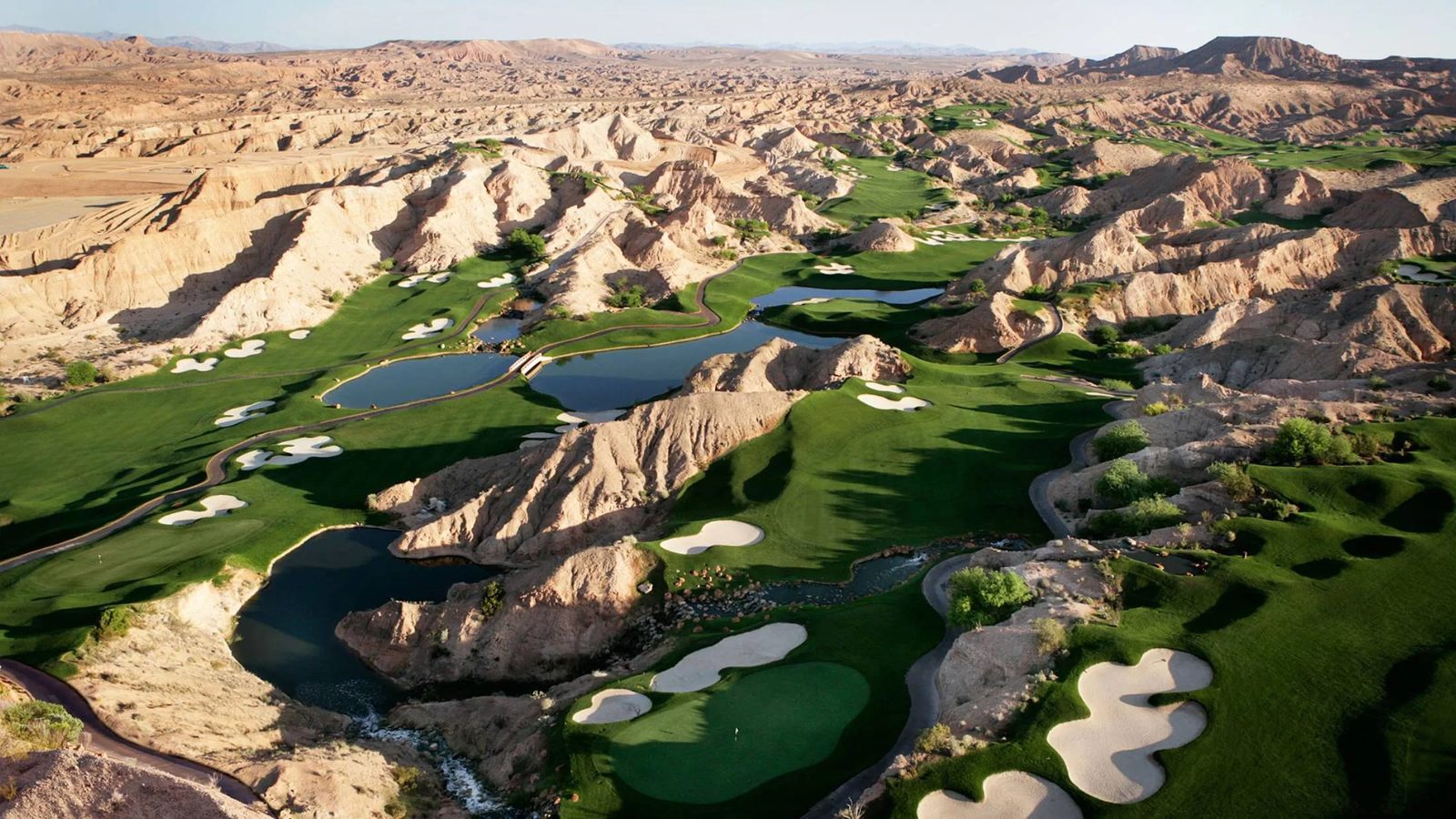
No course in America commits to theatre the way Wolf Creek does, and nothing else is particularly close. Dennis Rider and John Rider opened it in 2000 in the canyons above Mesquite, about 80 miles northeast of the Las Vegas Strip, and the routing still looks happily improbable. Tees perch on cliff edges. Fairways settle into canyon floors. Greens tuck against red-rock walls, and the ground rises or falls away on nearly every shot. A generation of golfers met the place first as the fantasy course in the Tiger Woods PGA Tour video games, where the drops and carries looked exaggerated for effect. They were not. The real course outdoes the game.
The figures match the drama. From the Challenger tees Wolf Creek measures 6,939 yards with a course rating of 75.4 and a slope of 154, near the maximum the system allows. Even the Champions card below, at 6,377 yards, crosses ground severe enough that first-time visitors are advised to move up a set of tees and simply enjoy the ride. This is target golf carved through a canyon system, played on bent grass greens and Bermuda fairways, with a fresh postcard framed by rock at every tee. Its one ambition is to be unforgettable, and it succeeds completely.
The Scorecard
The card below is the Champions set from a published hole-by-hole account of Wolf Creek, and its figures sum exactly to the printed Champions total, out in 3,127 and home in 3,250 for 6,377 yards at par 72. The Challenger back tees measure 6,939 yards at a rating of 75.4 and a slope of 154, the pair GolfPass and the account's tee table agree on. For the Champions set itself, no rating or slope is given here. The two published tee tables conflict on it, one printing 71.8/144 and the other 70.9/138 alongside a different yardage, so neither pair is carried rather than guessed at.
By the Numbers
From the scorecard below: Champions.
| Front nine | Par | Yards |
|---|---|---|
| Hole 1 | 5 | 504 |
| Hole 2 | 4 | 429 |
| Hole 3 | 3 | 175 |
| Hole 4 | 4 | 307 |
| Hole 5 | 5 | 469 |
| Hole 6 | 4 | 442 |
| Hole 7 | 4 | 281 |
| Hole 8 | 3 | 217 |
| Hole 9 | 4 | 303 |
| Total | 36 | 3,127 |
| Back nine | Par | Yards |
|---|---|---|
| Hole 10 | 4 | 446 |
| Hole 11 | 3 | 193 |
| Hole 12 | 5 | 544 |
| Hole 13 | 4 | 341 |
| Hole 14 | 4 | 411 |
| Hole 15 | 3 | 116 |
| Hole 16 | 4 | 377 |
| Hole 17 | 5 | 527 |
| Hole 18 | 4 | 295 |
| Total | 36 | 3,250 |
Nothing on the Champions card is level, numbers included, and that is exactly how the terrain feels. The back nine runs 123 yards longer than the front, powered by the two longest holes on the course, the 544-yard 12th and the 527-yard 17th. The front nine opens with the 504-yard 1st, a par 5 that plays 579 yards from the Challenger tees. The longest par 4 is the 446-yard 10th and the shortest hole the delicate 116-yard 15th, while the four par 3s span a full 101 yards from that 15th to the mighty 217-yard 8th. Ten par 4s, four par 5s and four par 3s fill the card, every one of them climbing, dropping or bending through the canyon.
Green Fees
- LocationMesquite, Nevada
- Par / Yardage72 / 6,377 yards (Champions)
Wolf Creek prices by season and demand, and the swing is the widest in Nevada golf, so the figure for a given day depends entirely on when the round falls. The published record for 2026 runs from about $95 to $125 for summer twilight play up to $390 to $420 in the February to May peak, drawn from a Mesquite tour operator's season-by-season breakdown. MyGolfSpy's published rate walk shows the same shape, with $390 in the peak spring weeks, $260 through parts of the fall, $175 in mid-winter and $130 in July. GolfLink's estimate of $390 matches the peak. Cart is included. Confirm the figure for your dates with the club.
The Story
Wolf Creek was built to put Mesquite golf on the map, and it managed that almost overnight. On a severe piece of canyon country at the edge of town, the Rider brothers refused to flatten the land into submission. They routed the course through its arroyos and along its ridges instead, accepting the drops and climbs conventional design would have avoided. When it opened in 2000 the attention was immediate and national. Here was a public course an hour and a half from the Strip that looked like nothing else in the country.
Video games gave it a second life. The Tiger Woods PGA Tour series carried Wolf Creek's canyon holes to a global audience, and the course became a bucket-list stop for golfers who had never set foot in Nevada. The pilgrims who followed found the reality matched the renderings. Mesquite has since grown into a genuine golf destination around it, with Wolf Creek as the undisputed headliner. Every Mesquite trip gets built around this round, and its photographs remain the ones nobody believes were taken on a real golf course.
Signature Holes
Hole 2 - Par 4, 429 yards
The 2nd tee is where Wolf Creek declares itself. The tee box sits some 11 stories above the fairway, one of the great elevated tee shots in golf, with the canyon spread out below and the green a distant promise beyond the arroyo country. At 429 yards from the Champions tees, and longer still from the back, the hole would be strong on flat ground. Played off a cliff, with the ball hanging in the desert air, it becomes the moment every first-time visitor understands what kind of day this is going to be.
Hole 8 - Par 3, 217 yards
The longest par 3 on the Champions card is also the signature one-shotter. It plays 217 yards from an elevated tee, across the canyon, to a green set into the far wall. From the Challenger tees it stretches to 248 yards, and at either length the shot is all carry and all commitment, with the drop between tee and green turning club selection into a genuine puzzle in any breeze. Photography made the hole famous. Standing on the tee, it is somehow bigger than its pictures.
Hole 14 - Par 4, 411 yards
Golfers regularly call the 14th the most photographed hole at Wolf Creek, and the framing explains why. This par 4 plays through the heart of the canyon country with red rock closing in on both sides. At 411 yards on the Champions card, and 444 from the Challenger tees, it is no pushover, yet its real test is concentration. Rock, desert and green compose so complete a picture that even hitting a fairway feels like theatre. If one hole explains why golfers drive 80 miles into the desert for this course, it is this one.
Target Golf at Full Volume
Elevation is the architect at Wolf Creek, whatever the card says about the Rider brothers. Dennis Rider and John Rider opened the course in 2000 in the canyons above Mesquite and refused to flatten the land into submission, so tees perch on cliff edges, fairways settle into canyon floors and greens tuck against red-rock walls. Almost nothing plays at the yardage printed beside it. A shot that drops asks for less club and more nerve, a shot that climbs asks for more of both, and the ground rises or falls away on nearly every swing. Golfers who met the course first in the Tiger Woods PGA Tour video games assumed the drops and carries were exaggerated for effect. The published review is blunt on the point. They were not, and the real course outdoes the game.
The Champions card shows the volatility in numbers alone. At 6,377 yards and par 72, out in 3,127 yards and home in 3,250, the back nine runs 123 yards longer than the front, powered by the two longest holes on the course, the 544-yard 12th and the 527-yard 17th. The four par 3s span a full 101 yards, from the delicate 116-yard 15th, the shortest hole on the card, to the mighty 217-yard 8th. Step back to the Challenger tees and the examination hardens to 6,939 yards with a rating of 75.4 and a slope of 154, near the maximum the system allows, which is why the standing advice is to move up a set of tees and enjoy the ride. Target golf this severe punishes the ego first and the swing second.
Three holes carry the whole argument. The 429-yard 2nd declares the day from a tee box some 11 stories above the fairway, with the canyon spread below and the ball hanging in the desert air on its way to a distant green. The 217-yard 8th plays from an elevated tee across the canyon to a green set into the far wall, all carry and all commitment, stretching to 248 yards from the Challenger tees. The 411-yard 14th, regularly called the most photographed hole on the course, threads through the heart of the canyon country with red rock closing in on both sides, where even hitting a fairway feels like theatre. Committed shots get rewarded spectacularly here. Tentative ones tend to find out how much air a canyon can hold.
Practical Info
Wolf Creek stands at 403 Paradise Parkway in Mesquite, about 80 miles northeast of the Las Vegas Strip, an easy interstate drive of roughly an hour and a half. Many golfers base in Mesquite itself, where the casino resorts run stay-and-play packages built around the course. However the trip is shaped, take the local advice on tees seriously. The slope from the back sets is among the highest in America, and the Champions or even the Masters set gives most visitors the full spectacle with a fairer fight. Cart, range balls and GPS yardages are included in the green fee.
Season shapes both price and experience here. Spring is peak in every sense, with the best weather and the top rates. Summer brings real desert heat, early tee times and the year's lowest prices, while fall is the connoisseur's window, good weather at shoulder rates. The course typically closes briefly for overseeding in September. Book the marquee tee times well ahead in spring, bring a camera for the tee boxes and leave extra time after the round. The drive back through the Virgin River gorge country is part of the show.
Questions, Answered
How hard is Wolf Creek, really?
From the Challenger back tees it carries a 75.4 rating and a 154 slope at 6,939 yards, close to the maximum slope the USGA system awards. The honest advice, repeated by the course and by everyone who has played it, is to move up at least one set of tees from the usual one. The Champions set at 6,377 yards delivers the full canyon spectacle with a much fairer test.
Why do people call Wolf Creek a video game course?
The Tiger Woods PGA Tour video game series featured Wolf Creek's canyon holes, and a generation of players assumed the cliffs and carries were exaggerated for the game. They were not. The 2nd tee really does sit some 11 stories above its fairway, and the par-3 8th really does play 248 yards across a canyon from the back tees.
How much does it cost to play Wolf Creek?
Rates swing widely by season. Published 2026 figures run from about $95 to $125 for summer twilight up to $390 to $420 in the February to May peak, with cart included. Fall and winter sit in between, and the club confirms the live figure for your dates when you book.
Keep Exploring Nevada
Read our Nevada Golf Guide for more top courses, green fees, and trip planning across the state.
Wolf Creek features in our ranking of the 14 Best Golf Courses in Nevada.
More Nevada course guides: Shadow Creek, Cascata, Edgewood Tahoe, Incline Village (Championship Course), Conestoga, Las Vegas Paiute (Sun Mountain) and Las Vegas Paiute (Snow Mountain).