We-Ko-Pa (Saguaro Course)
Coore & Crenshaw's desert links - Arizona's No. 1 public course, and not a house in sight.
The Case for Arizona's No. 1
Every panel that ranks Arizona public golf reaches the same conclusion. Golfweek's current public-access list puts the Saguaro Course at We-Ko-Pa first in the state - a position it has held for years - and GOLF Magazine places it No. 61 on its Top 100 Courses You Can Play in America. This is not a cult pick or a value play. It is the consensus best public course in Arizona, and the tee sheet is open to anyone.
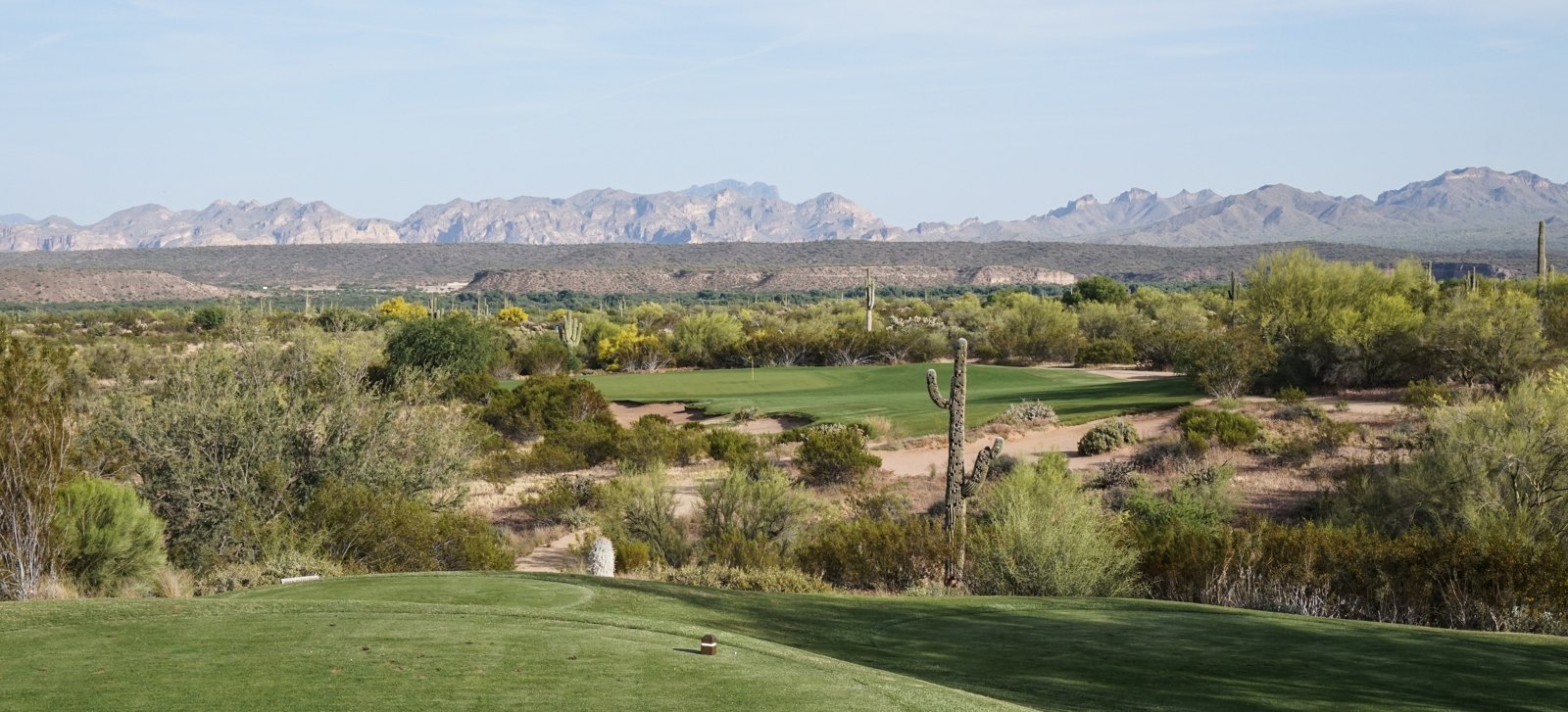
What makes the ranking remarkable is what the course refuses to do. Desert golf usually means target golf: ribbons of irrigated green threaded between rock piles and cactus, a housing development watching every swing, and a forced carry waiting whenever your concentration wanders. Bill Coore and Ben Crenshaw built the opposite. The Saguaro's fairways sit at grade and bleed straight into the desert floor, the greens are a short walk from the tees, and the whole routing was designed to be walked. It plays like linksland that happens to have saguaros - firm, wide, and won with angles and ground game rather than fear.
Then there is the sheer variety packed into par 71. Four short par 4s - the 2nd, 7th, 10th and 16th, all between 328 and 337 yards - tempt you in four different ways. The three par 5s include the 631-yard 4th, the longest hole in this corner of the Valley. The par 3s run from the 137-yard 9th to the 255-yard 15th, a full headcover shot from the back tee. And the round closes with a 508-yard par 4. Nobody walks off the Saguaro feeling they played the same hole twice.
And the setting is guaranteed. We-Ko-Pa sits on Fort McDowell Yavapai Nation land that will never be used for residential or commercial development - no rooftops behind the greens, no streets crossing the fairways, not now and not ever. In their place: the Four Peaks the club is named for, Red Mountain, the Superstitions and the McDowells, turning through the day as you turn through the routing. Arizona has louder golf, and pricier golf. It does not have better public golf.
History: Four Peaks, Tribal Land & a Different Kind of Desert Golf
We-Ko-Pa is the Yavapai word for Four Peaks, the mountain that rises east of the Fort McDowell Yavapai Nation and appears in the Nation's seal. The golf club is a tribal enterprise, built on reservation land beside the Verde River, and that ownership is the foundation of everything that follows: the land the courses occupy will never be sold off or developed, so the desert around the fairways is protected in a way no Scottsdale subdivision course can match.
The club's first course was Scott Miller's Cholla, opened in 2001 on some of the highest ground on the property - classic elevated target golf with the Superstitions as its backdrop. When the time came for a second course, the Nation hired Bill Coore and Ben Crenshaw, the design partnership behind Sand Hills and the restoration work at Pinehurst No. 2. Given the run of the property, Coore and Crenshaw gravitated to the gentler, rolling ground lower down, looking for land that was naturally suited to golf with as little alteration as possible - a deliberate contrast to Cholla's manufactured drama next door.
The Saguaro Course opened on December 16, 2006, and the honors arrived with the first scorecards. It was named one of the country's top 10 best new courses you can play in 2007, and Golfweek installed it at No. 1 on its Arizona public-access list, where it has stayed - tribal leaders, marking the club's growth in 2026, counted 18 straight years at the top of Golfweek's state ranking. GOLF Magazine's Top 100 Courses You Can Play has it at No. 61 for 2024-2025, and the two We-Ko-Pa courses together regularly sit among the top 50 resort courses in America.
Today the club anchors the We-Ko-Pa resort development - the hotel and casino across the road carry the same name - and the two courses make Fort McDowell the finest public 36-hole stop in the Valley: Cholla for elevation and target golf, Saguaro for the purist's walk. A third course has been discussed by tribal leadership, but the Saguaro's place is settled. It is the round Arizona's own raters send you to first.
Signature Holes
Hole 10 - Par 4, 337 yards
The back nine opens with the Saguaro's calling card: a 337-yard par 4 that asks a question before you have settled into the side. The green is reachable for longer hitters, but Coore and Crenshaw cut a small scar bunker directly into the putting surface - a hazard the panel writers at GOLF Magazine singled out, warning that finding it can leave you playing out sideways or backwards. The whole hole is that bunker, stretched across 337 yards: every decision on the tee is really a decision about it.
The percentage play is a long iron or hybrid to the fat of the fairway and a full wedge in, attacking the half of the green the scar bunker does not guard. The glory play is driver at the green - and on a calm morning, with the fairway running firm, it is genuinely on. What makes the hole great rather than gimmicky is that both plays are defensible, the walk up leaves you debating it, and the debate resumes at three more short par 4s before the round is done. This is the hole that explains the course.
Hole 14 - Par 5, 538 yards
The 14th is the Saguaro's strategy exam: a 538-yard par 5 whose fairway splits in two, the lanes divided by a desert wash. Each side offers its own bargain - one route shortens the hole but tightens the angle for the second shot, the other buys width at the cost of length - and the wash punishes the indecisive line down the middle. Desert courses usually make their decisions with rock and cactus; this one does it with a single ribbon of sand and scrub, and it is more interesting for it.
Get the drive in the correct lane and the hole opens up: a long second can chase toward the green, and even the layup leaves a short pitch across ground that runs at grade the whole way. Miss the wash decision and the second shot turns into recovery golf. It is the best thinking hole on the back nine, and the one the regulars argue about in the grill room - which, at a Coore and Crenshaw course, is exactly the point of a par 5.
Hole 15 - Par 3, 255 yards
Every great course keeps one hole that tests your honesty, and at the Saguaro it is the 15th: 255 yards of par 3 from the back tee, played from an elevated perch across desert scrub to a green with the Verde River valley and the Superstition Mountains spread out behind it. The panel writers singled out this tee for the views alone. The shot itself is a fairway wood or driver for most of us, with no apology attached - the scorecard simply asks for the longest one-shotter in the Phoenix area and watches what you do.
The mercy is that the hole scales honestly. The purple tees cut it to 233 yards and the whites to 209, still a full long iron or hybrid, and the ground around the green is at grade, so a shot that lands short can run on rather than dying in a forced carry. Play one club more than pride suggests, aim at the middle of the green whatever the pin is doing, and take your par or bogey with the best view in Arizona golf as the consolation. Bogey here loses nothing to the field.
The Scorecard
The championship card: par 71, 6,966 yards, rating 72.0, slope 137. The par is built unusually - only three par 5s, four par 3s, and a back nine that plays to par 35 and closes with par 4s of 328, 402 and a mighty 508 yards.
| Front nine | Par | Yards |
|---|---|---|
| Hole 1 | 4 | 469 |
| Hole 2 | 4 | 336 |
| Hole 3 | 4 | 416 |
| Hole 4 | 5 | 631 |
| Hole 5 | 3 | 178 |
| Hole 6 | 4 | 442 |
| Hole 7 | 4 | 331 |
| Hole 8 | 5 | 515 |
| Hole 9 | 3 | 137 |
| Total | 36 | 3,455 |
| Back nine | Par | Yards |
|---|---|---|
| Hole 10 | 4 | 337 |
| Hole 11 | 3 | 197 |
| Hole 12 | 4 | 476 |
| Hole 13 | 4 | 470 |
| Hole 14 | 5 | 538 |
| Hole 15 | 3 | 255 |
| Hole 16 | 4 | 328 |
| Hole 17 | 4 | 402 |
| Hole 18 | 4 | 508 |
| Total | 35 | 3,511 |
Most visitors should play the white tees at 6,252 yards (rating 68.8, slope 125): the short par 4s stay tempting, the 15th becomes a playable 209 yards, and the angles Coore and Crenshaw built stay intact. The purple tees at 6,603 yards are the middle path. From any set, note what is missing from this card - there is no breather nine. The front goes out in par 36 with the 631-yard 4th as its centerpiece, and the home nine is the sterner half despite playing a shot less.
How It Plays
The Saguaro rewards the ground game more than any desert course in Arizona. Because the fairways sit at grade and run into their surrounds, the low, chasing shot is always available - bump an approach along the turf and it will keep running, where a target-style course would demand you fly everything to a number. The desert is the hazard, and it is a fairer one than it looks from the tee: a ball in the scrub is often findable and playable, but the plants guard their ground, so the smart miss is always the side where the fairway gives you width.
Single figures
Your scoring lives on the three par 5s and the four short par 4s - but the 10th's scar bunker and the 14th's wash punish greedy lines precisely because they look so gettable. Take driver at the short 4s only when the pin suits the angle you will leave. On the 15th and the 508-yard 18th, par is a genuinely good score: play them as such and let the field donate shots there.
Mid handicaps (10-20)
Play the whites at 6,252 yards and make the desert your penalty, not your target: aim at the wide side of every fairway, take your medicine sideways out of the scrub rather than hero shots through cactus, and treat the four short par 4s as wedge opportunities from the fairway, not driving contests. On the 14th, pick the split fairway's wider lane and give yourself a full third shot - this course hands mid handicaps more birdie looks than its ranking suggests.
High handicaps (20+)
The composite tees at 5,786 yards keep every idea in the design and shrink the carries to friendly sizes, and the at-grade fairways mean your topped shots run instead of dying - this is one of the kindest great courses in America for a learning golfer. Play early in summer, when the rates fall and the desert is at its stillest. Budget a few balls for the scrub, walk the par 3s slowly, and enjoy the fact that Arizona's best public course was built for a golfer on foot, not a tour pro.
One last note on the walk itself: the Saguaro was routed for walking, with greens set close to the next tees, and it remains one of the few top-ranked desert courses where walking is a pleasure rather than a stunt. Ride if you like - but on a cool winter morning, carrying or pushing a cart here, with the Four Peaks turning pink ahead of you, is the round at its best.
Practical Info
We-Ko-Pa is fully public - no membership, no resort stay required. Book through the club's website or the golf shop, and book early for winter weekends: Golfweek's No. 1 public course in the state fills its tee sheet. Pricing is dynamic and seasonal. The Arizona Republic found summer midday rounds at $109 in June 2026, while the January-to-April peak runs $200 and up - confirm the live rate when you book, and treat a shoulder-season weekday as the sweet spot of price and conditioning.
Fort McDowell sits about half an hour east of Phoenix Sky Harbor airport, past Fountain Hills on the Beeline Highway - an easy anchor for a Scottsdale trip and a better first round than the stadium headliner for architecture lovers. The We-Ko-Pa Resort and casino are across the road for stay-and-play, and the natural pairing is a 36-hole day: Saguaro in the morning, Scott Miller's Cholla in the afternoon, and dinner arguing about which philosophy of desert golf won.
| Detail | Info |
|---|---|
| Green fee | Dynamic pricing - about $109 for a summer midday round (Arizona Republic, June 2026); expect $200+ in the January-April peak. Confirm the live rate when you book |
| Access | Public - anyone can book a tee time; also the anchor of We-Ko-Pa Resort stay-and-play |
| Designer | Bill Coore & Ben Crenshaw (2006) |
| Championship card | Par 71, 6,966 yards, 72.0 rating / 137 slope |
| Sister course | Cholla Course - Scott Miller (2001), par 72, 7,225 yards, No. 8 on Golfweek's Arizona public list |
| Location | 18200 Wekopa Way, Fort McDowell, Arizona |
Verdict
Worth it? 8.9/10
Yes - this is the first public round to book in Arizona, full stop. TPC Scottsdale has the fame and the Coliseum, but the Saguaro has the architecture: Coore & Crenshaw's only desert links, a walk through protected tribal desert with four mountain ranges for company, short par 4s that make you think and a closing stretch that makes you earn it. At summer prices it is one of the great values in American golf; at winter peak it is still the round your trip will be remembered by.
We-Ko-Pa (Saguaro Course) FAQs
How much does it cost to play the Saguaro Course at We-Ko-Pa?
Pricing is dynamic and seasonal. Summer midday rounds were $109 in June 2026 (Arizona Republic), while the January-to-April peak runs $200 and up. Check the club's live tee sheet for the day you want - shoulder-season weekdays are the value window, and a 36-hole day with the Cholla Course is the connoisseur's move.
Can anyone play We-Ko-Pa, or do you have to stay at the resort?
Anyone can play. We-Ko-Pa Golf Club is a fully public, daily-fee club owned by the Fort McDowell Yavapai Nation - book a tee time online or through the golf shop. The We-Ko-Pa Resort and casino across the road offer stay-and-play packages, but no stay is required.
Who designed the Saguaro Course?
Bill Coore and Ben Crenshaw, the partnership behind Sand Hills and the Pinehurst No. 2 restoration. The Saguaro opened on December 16, 2006, routed over the property's gentler ground as a deliberate contrast to Scott Miller's higher, target-style Cholla Course next door - wide, at-grade fairways, greens close to tees, and a course built to be walked.
What are the signature holes at We-Ko-Pa Saguaro?
The 10th, a 337-yard par 4 with a scar bunker cut into the green; the 14th, a 538-yard par 5 with a split fairway divided by a desert wash; and the 15th, a 255-yard par 3 from an elevated tee with the Verde River and the Superstition Mountains behind the green. The 631-yard 4th, the longest hole on the course, runs it close.
Saguaro or Cholla - which We-Ko-Pa course should I play first?
Saguaro first. It is Golfweek's No. 1 public course in Arizona, the more distinctive design, and the kinder introduction to the property - wide fairways, a walking routing, and ground-game options everywhere. Play Cholla second for the contrast: Scott Miller's 2001 course is higher, sterner target golf. Together they make the best public 36-hole day in the Valley.
Keep Exploring Arizona
Read our Arizona Golf Guide for more top courses, green fees, and trip planning across the state.
We-Ko-Pa (Saguaro Course) also features in our ranking of the 20 Best Golf Courses in Arizona.
Photos: Bernard Gagnon (CC BY-SA 3.0, via Wikimedia Commons)
_no_15.jpg)