Rush Creek Golf Club
The metro's country club for a day, a Cupp and Fought championship test through wetlands and woods in Maple Grove.
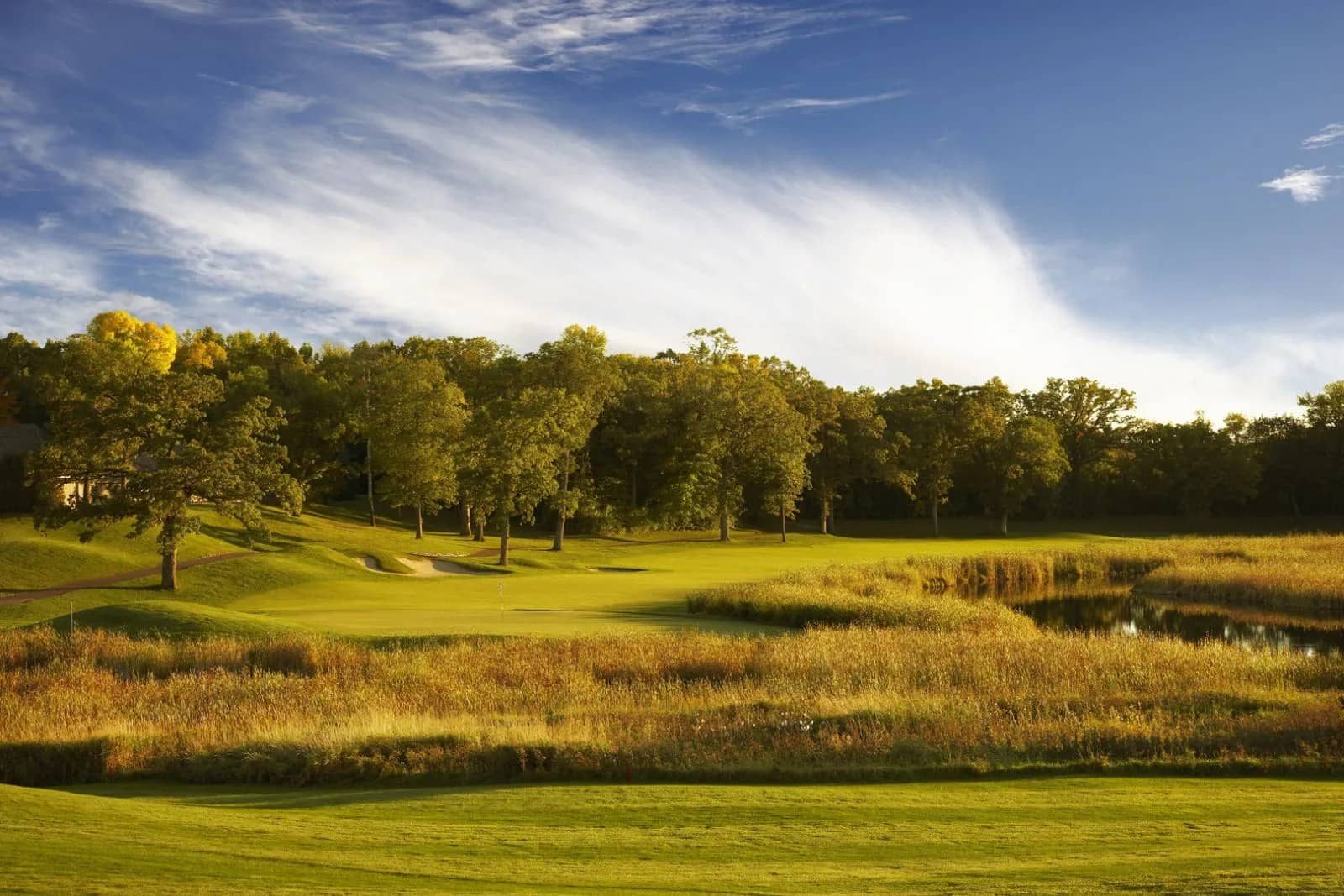
Some public courses apologize for being public. Rush Creek never got that memo. Twenty miles northwest of downtown Minneapolis in Maple Grove, it runs like a private club that simply never checks membership cards at the gate, all immaculate conditioning, wetlands and woods, and a clubhouse with a ballroom attached. Bob Cupp and John Fought laid it out as a genuine championship examination, and the record proves the ambition landed. Three LPGA Tour events in the early years. A United States Golf Association national championship in 2004. The Mulliganist ranking places it No. 11 in Minnesota, and on polish alone it argues for higher.
The numbers set the tone before a ball is struck. From the back Duncan tees the card runs 7,290 yards at par 72, with four par 5s to chase and a front nine that gives up nothing cheaply. Yet this is no brute for its own sake. The fairways are broad, the greens are quick, and the trouble tends to arrive as water and wetlands placed exactly where an aggressive line wants to go. Play it forward and the same routing turns scenic and friendly. Play it back and you are walking ground the best public-course amateurs in America once fought over. That double personality is the whole trick, and Rush Creek pulls it off better than any daily-fee course in the metro.
The Scorecard
From the Duncan blocks, bring your full bag. The back set on the club's current card runs 7,290 yards at par 72, split 3,571 out and 3,719 back, with four par 5s and four par 3s in the mix. No rating or slope is quoted for this tee here, because no source ties a verified pair to the Duncan yardage, and the varied totals other directories print belong to older or shorter cards.
By the Numbers
From the scorecard below: Duncan tees.
| Front nine | Par | Yards |
|---|---|---|
| Hole 1 | 4 | 433 |
| Hole 2 | 5 | 537 |
| Hole 3 | 3 | 201 |
| Hole 4 | 4 | 338 |
| Hole 5 | 4 | 440 |
| Hole 6 | 4 | 348 |
| Hole 7 | 3 | 203 |
| Hole 8 | 5 | 613 |
| Hole 9 | 4 | 458 |
| Total | 36 | 3,571 |
| Back nine | Par | Yards |
|---|---|---|
| Hole 10 | 5 | 580 |
| Hole 11 | 4 | 416 |
| Hole 12 | 3 | 184 |
| Hole 13 | 4 | 389 |
| Hole 14 | 4 | 492 |
| Hole 15 | 3 | 189 |
| Hole 16 | 4 | 468 |
| Hole 17 | 4 | 426 |
| Hole 18 | 5 | 575 |
| Total | 36 | 3,719 |
Patience, more than power, is what this card rewards. The length refuses to spread itself evenly. The front nine hides its muscle in the 613-yard 8th, while the back nine stacks a 580-yard opener at the 10th, the 492-yard championship 14th and the 575-yard closer into one long second act. The par 3s offer the breather, none of them stretching past 203 yards, which makes this a card that rewards the driver and the fairway wood far more than the long iron. Pick a tee set that lets the par 5s stay fun, because from the Duncan blocks they are the whole examination.
Green Fees
- 18 holes, public daily before 4 p.m.$150
- 18 holes, public twilight after 4 p.m.$89
- Half cart$25
- Junior, after 3:30 p.m. or with an adult$50
- 18 holes, Cardholder daily before 4 p.m.$65
- Mac Nine par 3 course, all ages$15
- LocationMaple Grove, Minnesota
- Par / Yardage72 / 7,290 yards (Duncan tees)
Every figure here traces to the club's published 2026 public rate card, and the club is plain that prices exclude Minnesota sales tax and that rates can change. One scheduling note matters as much as any price. The club's rates page says the championship course will be closed in April and May of 2026 for an irrigation project, so spring trip builders should aim at the rest of a season that usually runs from mid to late March into the first week of November. The public books tee times 14 days out, and the Cardholder program trims the daily round to $65 for members of that program.
The Story
Rush Creek was founded in 1996 by W. Duncan MacMillan, who took an old golf course and farm ground in Maple Grove and set out to build a first-class facility the public could actually play. The club tells that founding story itself, and Twin Cities Business tells it the same way, a country club for a day built on purpose rather than by accident. Cupp and Fought, working together, turned the wetlands and woods into a Scottish-flavored championship layout with no houses crowding the holes, and the course and its original clubhouse opened in June 1996. The MacMillan Ballroom and Banquet Center followed in 2000, giving the property its second life as one of the Twin Cities' grand event addresses.
The tournament chapter arrived fast. The LPGA Tour's Twin Cities stop moved here from Edinburgh USA and played at Rush Creek in 1997 under the First Bank and Edina Realty banner, won by Danielle Ammaccapane, then again in 1998 as the Rainbow Foods LPGA Classic, won by Hiromi Kobayashi. In 1999 the Samsung World Championship, the LPGA's limited-field showcase, came to Maple Grove and Se Ri Pak won it. Three LPGA events inside the first four seasons, a run Golf Course Industry, working from the Star Tribune's reporting, records in exactly those terms. For a public course still finding its feet, that is a remarkable early calling card.
The defining week came in July 2004, when the U.S. Amateur Public Links Championship arrived and Rush Creek played at 7,132 yards, the longest course in that championship's history to that point by the USGA's own record book. Ryan Moore won it, beating Dayton Rose 6 and 5 in the 36-hole final, on his way to one of the great amateur summers the American game has seen. The course had been sharpened for the occasion, with co-architect John Fought redesigning the 14th and 15th holes on USGA advice. The family campus kept growing afterward, and the Mac Nine par 3 course, designed by Kevin Norby and opened in 2012 by GolfLink's course record, turned Rush Creek into a place where a championship round and a child's first loop live on the same property. The honors keep coming, too. The club records a Top 10 finish in Golfweek's Best Courses You Can Play state rankings for 2023 and a Minnesota Monthly readers' choice win as the state's best public course in 2025.
Signature Holes
Hole 8 - Par 5 - 613 yards
The longest hole on the course and the front nine's great expedition. At 613 yards from the Duncan tees it stands a full 33 yards clear of the next longest par 5 on the card, and it asks the oldest question in golf in its purest form. How much of this do you dare take on? Three honest shots will do it. Two heroic ones might. The wetlands setting keeps the long way home interesting the entire walk, and a par here feels earned in a way few public-course pars ever do.
Hole 14 - Par 4 - 492 yards
The championship hole, rebuilt for a national title. The Star Tribune's account of the 2004 Public Links, carried by Golf Course Industry, tells how John Fought rerouted this hole onto fresh ground on USGA advice and stretched it into a brute with a blind, uphill drive and a downhill approach played over water to a huge green framed by a neighboring farm. The modern Duncan card reads 492 yards, the longest par 4 on the property, and the hole still carries that event-bred menace. Survive the 14th with a par and the rest of the back nine feels like a gift.
Hole 18 - Par 5 - 575 yards
The signature finish, and the club says so itself in so many words, promising that the 18th provides a magnificent finish to the round. The Star Tribune account gives the hole its shape, a demanding par 5 that wraps left around water for its entire length with out of bounds waiting on the right, so the brave line and the safe line pull in opposite directions for a full 575 yards. As closers go, it is close to perfect. The hole dares you to finish in style and happily punishes anyone who tries it carelessly.
Practical Info
Rush Creek sits at 7801 County Road 101 in Maple Grove, about 20 miles from downtown Minneapolis, and the golf shop answers at 763-494-8844. The club's published 2026 card puts the public round at $150 before 4 p.m. and $89 at twilight, with the half cart at $25, juniors at $50 and the Mac Nine par 3 course at $15 for all ages, walking only. Two warnings belong in any trip plan. Prices exclude Minnesota sales tax, and the championship course closes in April and May of 2026 for an irrigation project, per the club's own rates page. In a normal year the season runs from mid to late March to the first week of November, the public books 14 days ahead, and the golf is walkable, with tees and greens set close together and a 90-degree cart rule when riding.
The practice and event side is half the reason locals treat this as a campus rather than a course. The club's 300-yard double-ended driving range has covered stalls for bad-weather work, and its Golf Academy teaches year-round with indoor space for the Minnesota winter, a setup Hole19's course account fills out with a putting green and practice bunkers. After the round, the MacMillan Ballroom, opened in 2000, hosts weddings and banquets for crowds the club's events pages put as high as 350, with the smaller Skye Room above and views over the course and wetlands from nearly every window. Come for a championship round, by all means. Just do not be surprised when half the cars in the lot belong to a wedding.
Questions, Answered
How much does it cost to play Rush Creek?
The club's published 2026 rate card puts the public round at $150 daily before 4 p.m. and $89 for twilight after 4 p.m., with a half cart at $25 and a junior rate of $50. Golfers in the club's Cardholder program pay $65 daily, and the Mac Nine par 3 course costs $15 for all ages. Prices exclude Minnesota sales tax, and the championship course is closed in April and May of 2026 for an irrigation project, so check the calendar before building a spring trip around it.
Who designed Rush Creek and when did it open?
Bob Cupp and John Fought designed Rush Creek for founder W. Duncan MacMillan, and the course and its original clubhouse opened in June 1996 on old golf course and farm ground in Maple Grove. Fought later returned to redesign the 14th and 15th holes ahead of the 2004 U.S. Amateur Public Links. The Mac Nine par 3 course, designed by Kevin Norby, was added in 2012.
What big events has Rush Creek hosted?
The headline event is the 2004 U.S. Amateur Public Links Championship, won by Ryan Moore over Dayton Rose in the final, played on the longest course in that championship's history to that point. Before it came three LPGA Tour events, the Twin Cities stop won by Danielle Ammaccapane in 1997 and Hiromi Kobayashi in 1998, and the Samsung World Championship won by Se Ri Pak in 1999.
What are the signature holes at Rush Creek?
Three holes carry the reputation. The par-5 8th is the longest hole on the course at 613 yards from the Duncan tees. The par-4 14th, at 492 yards, was rerouted and stretched by John Fought for the 2004 Public Links, with a blind uphill drive and an approach over water. The par-5 18th is the club's own signature finish, wrapping left around water for its full 575 yards with out of bounds on the right.
Is Rush Creek good for beginners and families?
Yes, and the property seems built for exactly that mix. Played from the forward tees the championship course turns scenic and manageable, the Mac Nine par 3 course offers a gentle walking loop at $15 with no motorized carts, and the Golf Academy runs instruction year-round off a 300-yard double-ended range with covered stalls. Championship golf and a first loop for a youngster share one address here, which is rarer than it should be.
Keep Exploring Minnesota
Read our Minnesota Golf Guide for more top courses, green fees, and trip planning across the state.
Rush Creek Golf Club features in our ranking of the 15 Best Golf Courses in Minnesota.
More Minnesota course guides: The Quarry at Giants Ridge, The Wilderness at Fortune Bay, The Classic at Madden's on Gull Lake, The Pines at Grand View Lodge, The Legend at Giants Ridge, Legends Club, Cragun's Legacy Courses (Lehman 18) and Chaska Town Course.