Gamble Sands (Scarecrow)
David McLay Kidd's brand-new second course at Gamble Sands, Golf Digest's Best New Public Course of 2025, wilder and tighter than its famous sibling.
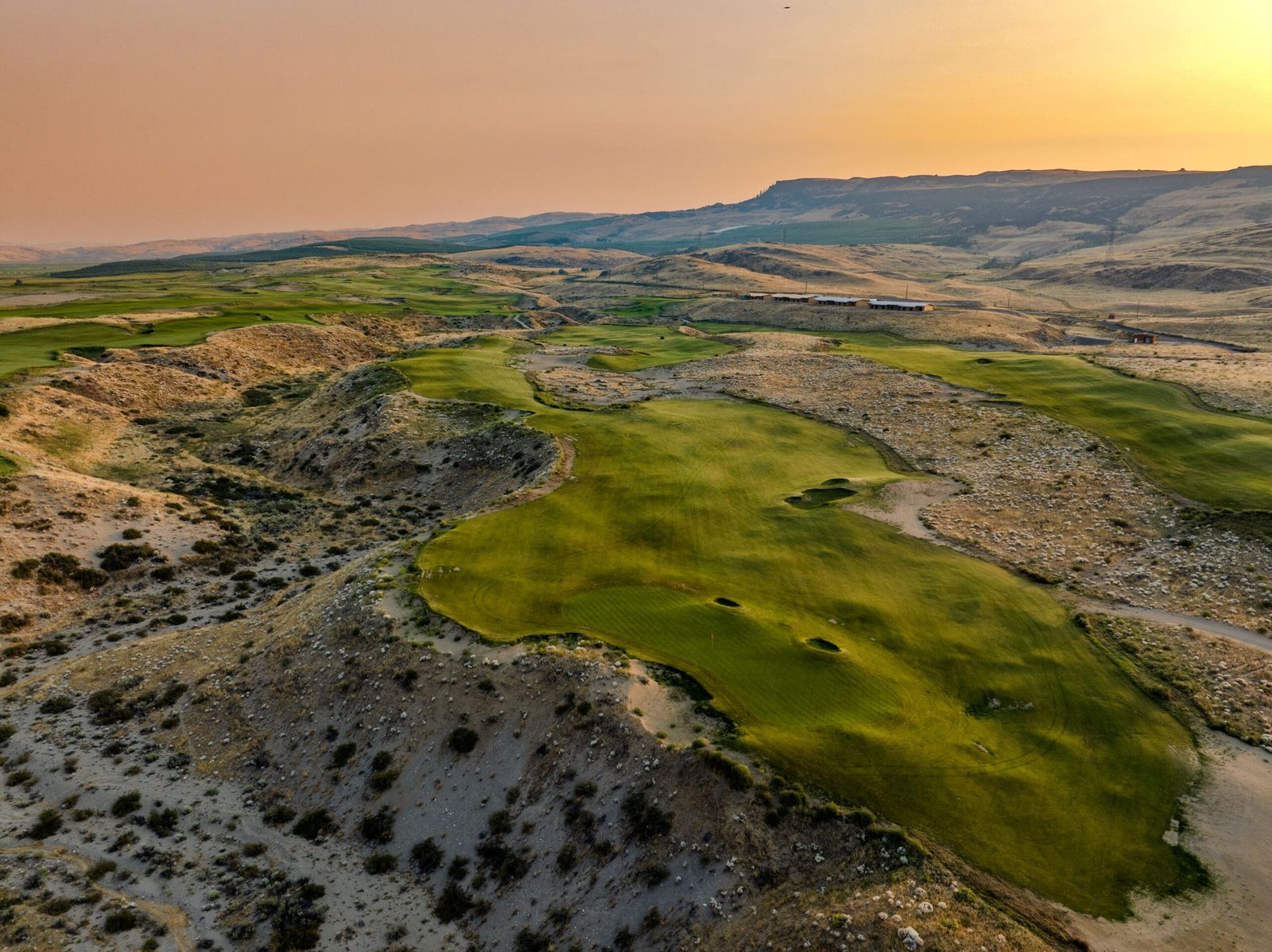
The hardest act to follow in American resort golf is your own beloved first course. Gamble Sands, David McLay Kidd's 2014 fescue playground above the Columbia River, became the Pacific Northwest's favorite modern resort course on a simple promise, width, bounce and fun. In August 2025 the resort opened its second eighteen on the same high-desert ground, and Kidd used the occasion to build the sterner sibling. Scarecrow is wilder in its movement, smaller and more contoured in its greens, and it arrived to immediate acclaim, Golf Digest naming it the Best New Public Course of 2025. We rank it fourth in Washington, a remarkable debut for a course with two seasons of history.
The differences from the original are the point. Scarecrow occupies more dramatic ground, with elevation changes up to 70 feet inside holes, plays entirely in fescue like its sibling, and asks more questions per shot. The greens are where Kidd turned the dial, smaller targets with more contour than the Sands course's famously gigantic surfaces, so the approach game sharpens and the ground game, bouncing approaches in off the fescue banks, becomes a skill rather than a suggestion. At 6,921 yards of par 71 from the Medal tees, rated 73.9 with a slope of 131, it is the thinking golfer's Gamble Sands round.
Golfweek's resort rankings put the new course at No. 73 nationally in its first season of eligibility, a debut that confirms what the early visitors reported. Scarecrow is not the spare course you play when the Sands tee sheet fills. It is a co-headliner, and the two together, 36 holes of Kidd fescue golf above the Columbia bluffs with an inn and a par-3 course on site, make Gamble Sands the most complete golf destination in the Northwest. Play both, and argue about the ranking on the drive home. That argument is the resort's whole business model.
The Scorecard
The card below shows the Medal tees, the back set, taken from the club's own scorecard proof. It plays 6,921 yards at par 71, rated 73.9 with a slope of 131, and it foots exactly, 3,310 yards out and 3,611 home. Use 6,921, not the approximately 6,900 figure from the pre-opening coverage, which the finished course's own card supersedes. The shape is Kidd's signature, a front nine that invites and a back nine that interrogates.
By the Numbers
From the scorecard below: Medal tees.
A slope of 131 from the Medal tees, rating 73.9 puts it ahead of about 11% of the 182 courses in our database with a published slope.
| Front nine | Par | Yards |
|---|---|---|
| Hole 1 | 4 | 395 |
| Hole 2 | 3 | 198 |
| Hole 3 | 5 | 547 |
| Hole 4 | 3 | 220 |
| Hole 5 | 4 | 311 |
| Hole 6 | 5 | 581 |
| Hole 7 | 4 | 422 |
| Hole 8 | 4 | 467 |
| Hole 9 | 3 | 169 |
| Total | 35 | 3,310 |
| Back nine | Par | Yards |
|---|---|---|
| Hole 10 | 4 | 478 |
| Hole 11 | 3 | 158 |
| Hole 12 | 5 | 489 |
| Hole 13 | 4 | 430 |
| Hole 14 | 4 | 500 |
| Hole 15 | 5 | 575 |
| Hole 16 | 3 | 205 |
| Hole 17 | 4 | 408 |
| Hole 18 | 4 | 368 |
| Total | 36 | 3,611 |
Read the handicap line for the designer's confession. The two hardest holes are par 4s of 422 and 500 yards, not the par 5s, which tells you Scarecrow's difficulty lives in its approach shots and green contours rather than in brute length. The par 3s run 158 to 220 yards, a proper spread, and the short par-4 5th at 311 yards is the card's invitation to mischief. The other sets step down through 6,501, 6,261 and 6,061 yards to the 4,656-yard Forward tees, and on fescue ground the shorter game loses none of the bounce that makes this place itself.
Green Fees
- Peak rate, May-September (cart included)$295
- Shoulder rate, April and October (cart included)$200
- Second 18 same day, peak$195
- LocationBrewster, Washington
- Par / Yardage71 / 6,921 yards (Medal tees)
The resort publishes one rate structure for both of its big courses, Gamble Sands and Scarecrow price identically, and the club's own 2026 rates page was re-verified at build. April and October rounds run $200, May through September $295, and the 18-hole rate includes the cart. A second 18 the same day costs $195 in peak season and $150 in the shoulder months, the par-3 QuickSands course is $75, rentals run $85, and Washington residents and Inn guests can ask about preferred rates, reported around $240. The winter months are genuinely closed, the sands rest from November through March. Golf Digest's course profile lists $285, ten dollars under the resort's own published peak rate. The resort's page governs.
The Story
Gamble Sands began as the Gebbers family's orchard-country bet, a resort built by a Washington apple-growing family on its own high-desert land above the Columbia River near Brewster. David McLay Kidd's original Sands course opened in 2014 to a rare consensus, a modern links in the desert that golfers genuinely loved playing, and the resort grew around it, the Inn, the Danny Boy restaurant and the 14-hole QuickSands short course following. A second eighteen was the obvious next step and the dangerous one, because the second course at a one-course phenomenon almost always disappoints.
Kidd, working with associate Nick Schaan, took the more dramatic ground for Scarecrow, and the course opened on August 1, 2025 to the kind of reviews resorts dream about. Golf Digest named it the Best New Public Course of 2025, the industry's headline debut honor, and Golfweek's resort list placed it at No. 73 in its first season. The name nods to the orchard country below, where scarecrows stand guard over the fruit trees, and the course's identity settled instantly as the pair's sterner, wilder half. Two seasons in, the argument over which Gamble Sands course is better is exactly the argument the Gebbers family hoped to host.
Signature Holes
Hole 7 - Par 4 - 422 yards
The No. 1 handicap hole on the card, and the statement of Scarecrow's intent. At 422 yards the 7th is not long by modern standards, which is precisely the point. On ground that moves up to 70 feet within a hole and greens that shrug off indifferent approaches, the hardest hole at Scarecrow wins on placement and nerve rather than muscle. Where the Sands course next door hands you a fairway the width of a county, this hole asks what you actually intended, and grades the answer on a small, contoured green.
Hole 14 - Par 4 - 500 yards
The No. 2 handicap hole and the card's longest par 4, a 500-yarder in the heart of the back nine. The home side at Scarecrow is a climb, 3,611 yards against the front's 3,310, and the 14th is its summit of difficulty, a two-shotter that asks for everything twice. On fescue ground with the high-desert wind up, a 500-yard par 4 plays every inch of its number, and a par here late in the round is the scorecard's badge of honor.
Hole 15 - Par 5 - 575 yards
The last of the par 5s and the back nine's scoring chance. At 575 yards the 15th is reachable in two only by the genuinely long when the fescue is running, and it sets up the finish, the 205-yard 16th, the 408-yard 17th and the 368-yard 18th home. A course designed to send golfers into the Danny Boy arguing happily about which of the two Gamble Sands courses they will play first tomorrow saves its final generosity for exactly the right place, three holes from the clubhouse with the round still live.
Practical Info
Gamble Sands sits above the Columbia River near Brewster in north-central Washington, roughly three hours from Seattle and an hour from Wenatchee, and the drive is part of the pilgrimage. The resort is seasonal in earnest, both big courses run April through October and close for the winter. Peak 18-hole rates are $295 May through September and $200 in April and October, cart included, with second rounds at $195 and $150 and the QuickSands par-3 course at $75. The Inn at Gamble Sands keeps you on site, the Danny Boy Bar and Grill feeds the argument, and the practice facility runs $30 a day in season. Book the Inn early for peak weekends. The Best New Course publicity did its work.
The trip logic is now doubled. Give Gamble Sands two full days minimum, one for each Kidd course, with QuickSands as the evening game, and note that the sibling Sands course, ranked third in our Washington list, is the gentler and wider round, so the classic pairing plays Sands first for rhythm and Scarecrow second for the exam. Any Washington loop that continues south reaches Wine Valley in Walla Walla and the Palouse Ridge course at Pullman, the state's other desert-golf pleasures, but honestly, most golfers who make the Brewster drive end up spending the whole trip on the bluff, and leave happy.
Questions, Answered
How much does it cost to play Scarecrow at Gamble Sands?
The resort's published 2026 rates price Scarecrow and the Sands course identically. April and October rounds are $200, May through September $295, cart included, with a second 18 the same day at $195 peak and $150 shoulder. The QuickSands par-3 course is $75, rentals run $85, and Washington residents and Inn guests can ask about preferred rates around $240. The courses close from November through March. Golf Digest lists $285 for the course, ten under the resort's own published peak figure, which governs.
How is Scarecrow different from the original Gamble Sands course?
Same designer, same fescue, sterner questions. Per Golf Digest's course overview, Scarecrow's ground moves more, with elevation changes up to 70 feet, and its greens are smaller and more heavily contoured than the Sands course's famously enormous surfaces, which sharpens the approach game and rewards bouncing shots in off the banks. The Sands course is wider and more forgiving, the people's favorite. Scarecrow is the connoisseur's examination, and Golf Digest named it the Best New Public Course of 2025.
When did Scarecrow open and who designed it?
David McLay Kidd designed it with associate Nick Schaan, and it opened on August 1, 2025. Kidd also designed the original Gamble Sands course on the same property, which opened in 2014, making Scarecrow the rare second course by the same hand on the same ground. Its name honors the orchard country of the Gebbers family's fruit business in the valley below the bluffs.
How hard is Scarecrow?
From the Medal tees, 6,921 yards at par 71, rated 73.9 with a slope of 131. The slope understates the real test, which is wind, elevation and approach precision into smaller, more contoured greens than its sibling's. The card's hardest holes are mid-length par 4s, the 422-yard 7th and the 500-yard 14th, so position golf beats power here. Six tee sets run down to 4,656 yards for the forward game.
Keep Exploring Washington
Read our Washington Golf Guide for more top courses, green fees, and trip planning across the state.
Gamble Sands (Scarecrow) features in our ranking of the 15 Best Golf Courses in Washington.
More course guides: Bandon Dunes, TPC Sawgrass - Stadium Course and Whistling Straits - Straits Course.