Duke University Golf Club
Robert Trent Jones Sr. built it in the Duke Forest in 1957. His son Rees came back a generation later and sharpened it.
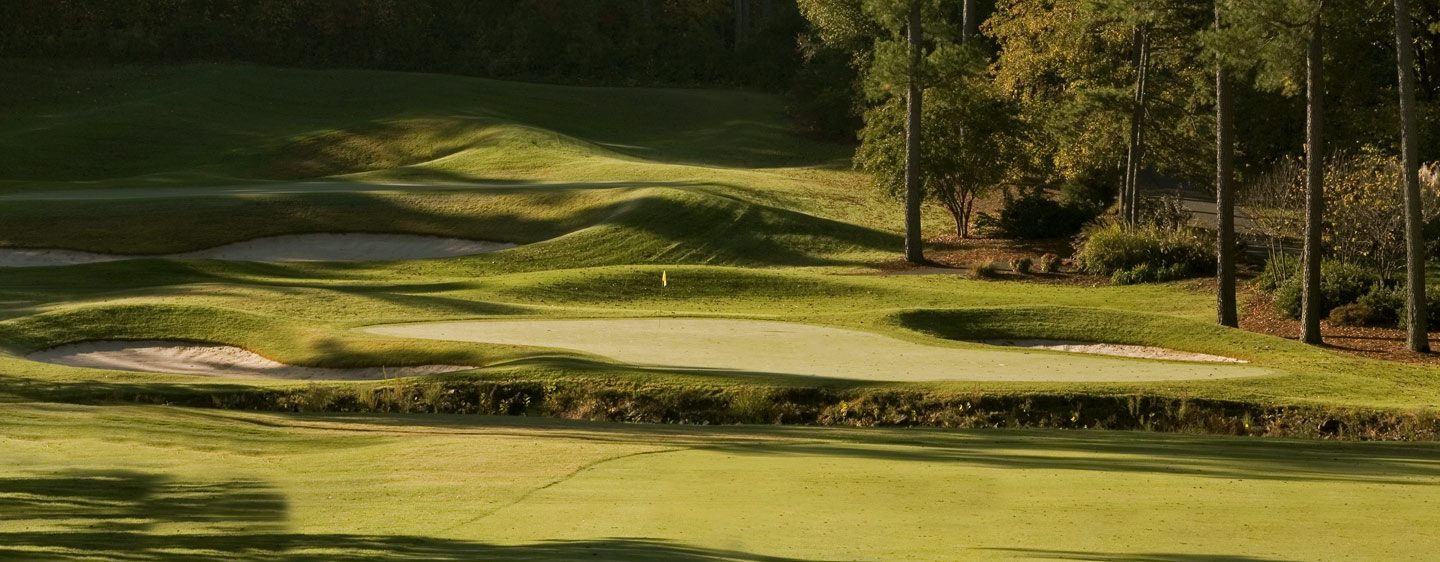
Plenty of university courses feel like an amenity tacked onto campus. This one feels like a landmark. Across 300 acres of the Duke Forest on West Campus, Robert Trent Jones Sr. built Duke a rolling parkland course in 1957, all tree-lined fairways, directional bunkering and elevated greens. It has decided the NCAA Men's Championship twice, it remains home to the Blue Devils, and it is public. Anyone can book a tee time and play ground where a national title has been settled twice.
The second signature is what makes it stick in the memory. Jones Sr. worked with the natural Piedmont terrain in the last years of the classic era, and the holes still look found rather than forced, as if the forest opened just enough and the grass followed. His son Rees had played the 1962 NCAA Championship here as a Yale golfer. When he returned in the early 1990s to renovate his father's work, he sharpened the bunkering and green complexes and left the original routing's bones alone. Father and son. One course, two signatures.
Visitors get the full package without needing a university connection. The layout carries real tournament history, Golfweek still puts it among the top 25 campus courses in the country at No. 23 on the 2026 list, and the Washington Duke Inn overlooks the property if you want to stay where you play. Downtown Durham sits minutes away. Cross the Triangle to UNC Finley in Chapel Hill and you have the other half of one of college golf's best public pairings.
The Scorecard
The Championship Tees card below comes from the official Golfstat scoring sheet for the Rod Myers Invitational, Duke's home collegiate tournament. It runs 36 out and 36 back for 7,154 yards at par 72. The club's everyday back-tee card plays a touch shorter at 7,045 yards. No rating or slope appears with this set because the published figures do not line up, with GolfPass printing 74.8/142 and GolfTheUnitedStates printing 73.9/141. Printing a contested number would help nobody.
By the Numbers
From the scorecard below: Championship Tees.
| Front nine | Par | Yards |
|---|---|---|
| Hole 1 | 4 | 456 |
| Hole 2 | 4 | 430 |
| Hole 3 | 4 | 395 |
| Hole 4 | 3 | 160 |
| Hole 5 | 4 | 399 |
| Hole 6 | 4 | 400 |
| Hole 7 | 5 | 573 |
| Hole 8 | 3 | 173 |
| Hole 9 | 5 | 493 |
| Total | 36 | 3,479 |
| Back nine | Par | Yards |
|---|---|---|
| Hole 10 | 4 | 454 |
| Hole 11 | 5 | 573 |
| Hole 12 | 3 | 181 |
| Hole 13 | 4 | 405 |
| Hole 14 | 5 | 550 |
| Hole 15 | 3 | 216 |
| Hole 16 | 4 | 402 |
| Hole 17 | 4 | 439 |
| Hole 18 | 4 | 455 |
| Total | 36 | 3,675 |
Length here is honest rather than freakish. The scoring chances sit mainly on the par 5s, three of them stretching to 550 yards or more from these tees, while the par 3s keep getting sterner as the day goes on, from 160 yards at the 4th to 216 yards at the 15th. Five tee sets bring the course back down to everyday distances. Treat the championship card as a measuring stick. Nobody is asking you to play it from back there.
Green Fees
- Patron and guest, Monday to Thursday (daily rate)$100
- Patron and guest, Friday to Sunday (daily rate)$140
- LocationDurham, North Carolina
- Par / Yardage72 / 7,154 yards (Championship Tees)
Plan around the club's own 2026 in-season card, effective September 23, 2026. Patron and guest daily rates sit in the table above, and afternoons drop to $75 Monday to Thursday and $115 Friday to Sunday. Triangle residents pay $95 and $135. Duke alumni and Washington Duke Inn guests pay $90 and $130, and a GPS golf car adds $35 per person. Golf Digest and GolfLink both publish a $170 estimate, but that is not the number the club itself is charging.
The Story
After the Second World War Duke wanted a course worthy of the university, and it went to the architect who was becoming the defining voice of postwar American golf. Robert Trent Jones Sr. opened his course through the Duke Forest on September 26, 1957. The reported construction budget was $500,000, and the holes were threaded through pine and hardwood groves on rolling ground beside what is now the Washington Duke Inn.
It did not take long to matter nationally. Kermit Zarley won the NCAA Men's Championship here in 1962, with a young Yale golfer named Rees Jones in the field. The championship came back in 2001, this time on the renovated course, and Duke's place among the great American campus layouts was settled. The Rod Myers Invitational keeps tournament golf coming back every year.
Rees Jones wrote the renovation chapter in the early 1990s. The Washington Duke Inn dates the work to 1993 and other accounts say 1994, so the early 1990s is the honest dating. He modernized the bunkering and greens while respecting what his father had drawn, and the Karcher-Ingram Golf Center followed in the fall of 2005 as a dedicated home for the Blue Devil programs. The course remains what it has been since 1957, Duke's front lawn for championship golf, open to the public.
Signature Holes
Hole 7 - Par 5 - 573 yards
At 573 yards this is the longest hole on the championship card and the hole the front nine turns on. Two confident long shots through the pines get you into position, then the approach has to find a protected green. Play it well and the whole front side feels winnable.
Hole 15 - Par 3 - 216 yards
Nothing cheap here. The 216-yard 15th is the longest of the four par 3s, a full long iron or hybrid over the rolling forest floor just as the closing stretch gets serious. Local write-ups have long made a fuss of Duke's one-shotters, and this is the stoutest of the set.
Hole 17 - Par 4 - 439 yards
The course guide saves its showcase par 4 for late. Position off the tee at the 439-yard 17th earns the angle in, and the green is guarded in classic Jones fashion. Walk off with a par, one hole from home, and you have done something.
Practical Info
Find it at 3001 Cameron Boulevard, Durham, NC 27705 on West Campus, beside the Washington Duke Inn and Golf Club. Reservations run through 919-681-2288 and the club site is golf.duke.edu.
Public tee times open 14 days ahead. Washington Duke Inn guests get 30 days, which makes the inn the smart base if the trip is planned well ahead.
The fee card rewards a close read. Rates change by day of the week and by time of day, with separate discounts for Triangle residents, Duke alumni and hotel guests, so check which row fits before you book.
Practice matches the standard of the course, with a full range, short-game areas and the Karcher-Ingram Golf Center for the university teams. Dining at the inn sits a short walk from the 18th green.
Add UNC Finley in Chapel Hill, about 20 minutes away, and the trip becomes the Triangle's classic campus double. The pairing carries a designer thread running through George Cobb's era and the Jones family.
Questions, Answered
Is Duke University Golf Club open to the public?
Yes. It is a public course owned by Duke University. Anyone can book; the public window opens 14 days ahead, and guests of the Washington Duke Inn can book 30 days ahead.
Who designed Duke University Golf Club?
Robert Trent Jones Sr. designed the original course, which opened in 1957. His son Rees Jones renovated it in the early 1990s, and the layout has hosted the NCAA Men's Championship twice, in 1962 and 2001.
How much does it cost to play Duke University Golf Club?
On the club's published 2026 in-season card, patron and guest daily rates are $100 Monday to Thursday and $140 Friday to Sunday, with afternoon rates of $75 and $115 and discounts for local residents, alumni and hotel guests.
Keep Exploring North Carolina
Read our North Carolina Golf Guide for more top courses, green fees, and trip planning across the state.
Duke University Golf Club features in our ranking of the 19 Best Golf Courses in North Carolina.
More North Carolina course guides: Pinehurst No. 10, Pinehurst No. 4, Tobacco Road Golf Club, Mid Pines Inn & Golf Club, Pine Needles Lodge & Golf Club, Pinehurst No. 8, Southern Pines Golf Club, High Hampton, Tot Hill Farm Golf Club, Lonnie Poole Golf Course, Tiger's Eye Golf Links, Thistle Golf Club, Longleaf Golf & Family Club, UNC Finley Golf Course and Pinehurst No. 2.