Cog Hill Golf & Country Club (No. 4 - Dubsdread)
Joe Jemsek's public cathedral in Lemont, a Wilson and Lee championship test that hosted the Tour all summer for two decades.
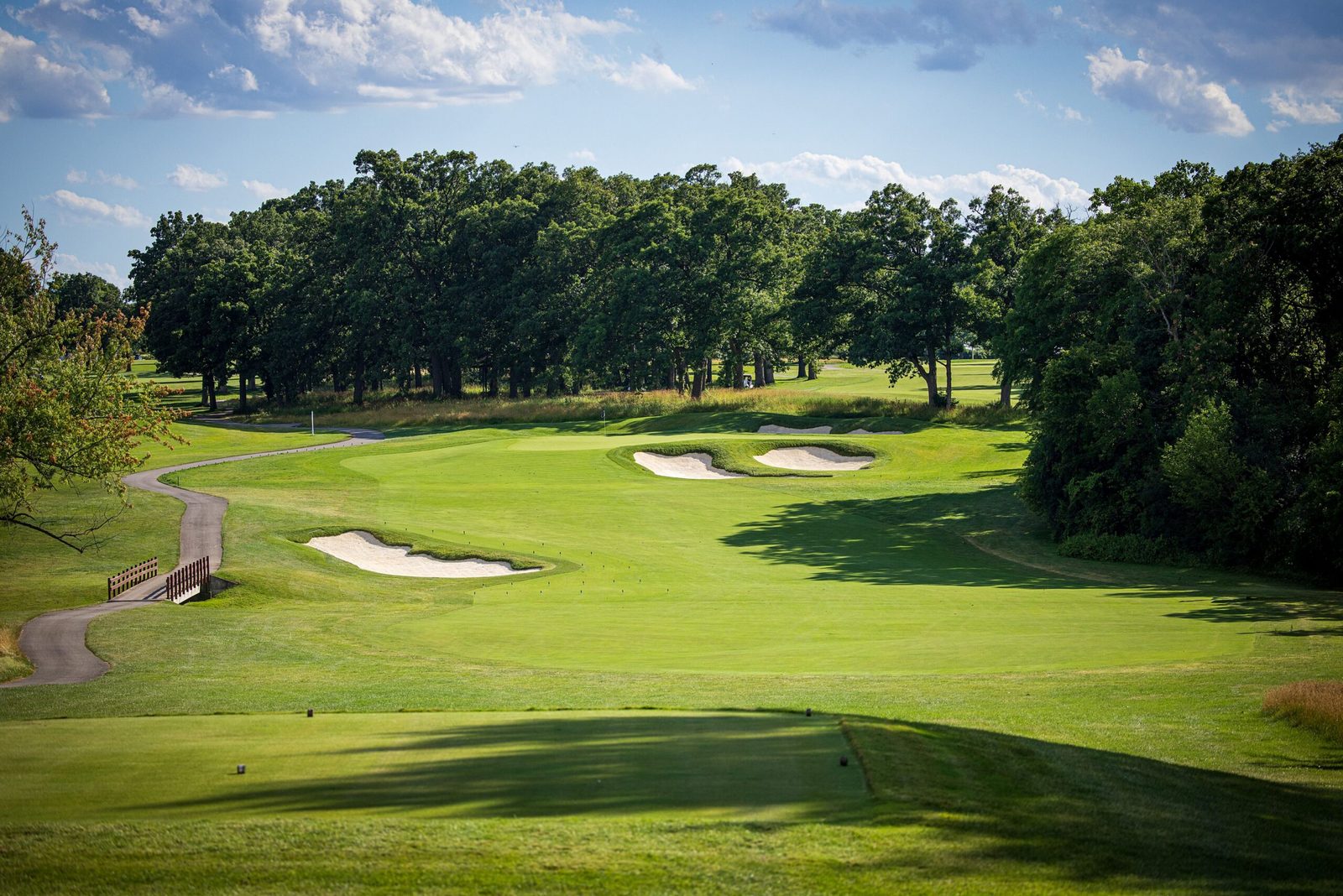
Every public golfer in America owes Joe Jemsek a debt, and Dubsdread is where he collected on his promise. Jemsek built Cog Hill's fourth course to prove that a golfer who paid at the counter deserved the same examination as a member anywhere. That meant a championship layout of more than 100 bunkers, oak-lined fairways and greens that asked Tour questions. Dick Wilson and Joe Lee delivered it in 1964, and the course has been nationally ranked ever since, the rare daily-fee layout that major golf treated as one of its own stages.
The examination is honest, and it is stern. Dubsdread places a premium on shot making, with tight landing areas pinched by bunkers and large undulating greens defended on every side. The length builds through the round too. From the Blue tees used here the card runs 6,750 yards, and the back Black tees stretch to 7,554. Nothing here is hidden. The bunkers show themselves, the greens show their tiers, and your score follows from how well the shots were struck.
What lifts Dubsdread above nostalgia is simple. The test never retired. The PGA Tour spent its Chicago summers here for two decades and Tiger Woods won on this ground five times, yet the course still anchors a 72-hole public complex that remains the beating heart of Chicago golf. The Mulliganist Illinois ranking puts it first in the state. Public golf's cathedral, still open to anyone with a tee time.
The Scorecard
The card below is the Blue set from Cog Hill's own published scorecard for Course No. 4. It goes out in 3,396 and home in 3,354, for 6,750 yards at par 72, and the hole figures sum exactly to the printed nines. The same card prints the Blue rating and slope at 73.9 and 138, figures a published played account of the Blue tees repeats exactly. The championship Black tees on the same card run to 7,554 yards at 77.8 and 151. The 5th hole carries a dual par on the printed card, a par 4 from the back markers and the par 5 used here from the Blue tees.
By the Numbers
From the scorecard below: Blue.
From the Blue it plays to a slope of 138, rating 73.9, steeper than about 42% of the 182 courses in our database with a published slope.
| Front nine | Par | Yards |
|---|---|---|
| Hole 1 | 4 | 425 |
| Hole 2 | 3 | 182 |
| Hole 3 | 4 | 407 |
| Hole 4 | 4 | 397 |
| Hole 5 | 5 | 479 |
| Hole 6 | 3 | 194 |
| Hole 7 | 4 | 385 |
| Hole 8 | 4 | 341 |
| Hole 9 | 5 | 586 |
| Total | 36 | 3,396 |
| Back nine | Par | Yards |
|---|---|---|
| Hole 10 | 4 | 353 |
| Hole 11 | 5 | 547 |
| Hole 12 | 3 | 194 |
| Hole 13 | 4 | 383 |
| Hole 14 | 3 | 184 |
| Hole 15 | 5 | 482 |
| Hole 16 | 4 | 381 |
| Hole 17 | 4 | 399 |
| Hole 18 | 4 | 431 |
| Total | 36 | 3,354 |
The Blue card shows how Dubsdread distributes its pressure. On the front nine the length hides in the par 5s, the 479-yard 5th and the 586-yard 9th, the longest hole on the course. The back nine answers with the 547-yard 11th and a closing run of par 4s that never drops below 353 yards. The par 3s are all business too, all four measuring between 182 and 194 yards over bunkered ground. From this middle set the course stays a complete championship test, scaled so a strong public golfer can stand on the same lines the Tour played.
Green Fees
- 18 holes, twilight, starting at$110
- 18 holes, junior, 17 and under$108
- LocationLemont, Illinois
- Par / Yardage72 / 6,750 yards (Blue)
These figures come from Cog Hill's own published 2026 rates page. The regular Dubsdread rate moves with demand and is published by the club as ranging from $149 to $225, with cart, tax and a warm-up range basket included. The twilight and junior figures in the table are the club's published starting points for those windows. Cog Hill sells all four of its courses to the public, and Dubsdread is priced as the flagship it is.
The Story
Cog Hill began in 1927, when the Coghill brothers built the first course on the Lemont farmland. Joe Jemsek, who had made his name running St. Andrews in West Chicago, took over in the early 1950s and turned it into public golf's showplace. Courses followed in 1929 and 1963. Jemsek saved his grandest ambition for last, a fourth course that could stand beside the finest private clubs in the country and still sell a tee time to anyone.
Wilson and Lee opened No. 4 in 1964 to immediate acclaim. Jemsek gave it its famous name, Dubsdread, borrowed from an Orlando course of his winter years and meant as a warning that a dub, a poor golfer, should dread what waited. What waited turned out to be a championship career. Dubsdread hosted the 1997 U.S. Amateur, won by Matt Kuchar, the U.S. Amateur Public Links twice and the 1987 U.S. Women's Amateur Public Links. From 1991 the Western Open made it the PGA Tour's Chicago home, a run that continued as the BMW Championship in 2007 and from 2009 to 2011. Tiger Woods won the event here five times and shot the course record, a 62, in September 2009.
Before that final BMW run, Rees Jones renovated the course across 2007 and 2008. He rebuilt all 18 greens with SubAir systems, reshaped the bunkering and added the risk-and-reward pond at the turn of the 7th hole, stretching the championship length to 7,554 yards. The Jemsek family still runs Cog Hill today. Dubsdread remains what its founder promised, a private-club examination on a public tee sheet.
Signature Holes
Hole 5 - Par 5 - 479 yards
The card's hinge hole. The printed Cog Hill card gives the 5th a dual par, a par 4 from the championship tees and a par 5 from the Blue set used here, and at 479 yards it plays as a genuine three-shot question for most public golfers. Think of it as a long, bunkered climb where position off the tee decides whether the second shot can even be played toward the green. This is where Dubsdread first shows its championship teeth.
Hole 7 - Par 4 - 385 yards
The Rees Jones renovation in miniature. Jones cut a pond at the turn of this dogleg, so the tee shot now has to be judged against water sitting exactly where a greedy line wants to land. The approach then plays to one of the rebuilt, boldly contoured greens. At 385 yards length is not what defends the 7th. The decision does, made with the pond in full view.
Hole 18 - Par 4 - 431 yards
A finishing hole with a gallery in its past. The 18th runs home past the lake that guards the green short and left, the same water that framed two decades of Western Open and BMW Championship finishes. At 431 yards from the Blue tees, and a full 497 from the championship markers, it asks for the day's straightest drive and a brave final approach. Walking up the 18th at Dubsdread means walking ground Tiger Woods closed out five titles on.
Where the Round Is Won
Nothing at Dubsdread hides, and that honesty shapes every decision. More than 100 bunkers sit in plain view, oak lined fairways pinch the landing areas, and large undulating greens defend themselves on every side. From the Blue tees at 6,750 yards, par 72, rated 73.9 with a slope of 138, the pressure spreads evenly rather than spiking at one famous hole. The front nine goes out in 3,396 yards and the back comes home in 3,354, so a golfer who survives the outward half gets no breather after the turn.
The card explains where patience pays. Length on the front hides in the par 5s, the 479 yard 5th and the 586 yard 9th, the longest hole on the course, while the back answers with the 547 yard 11th and a closing run of par 4s that never drops below 353 yards. The par 3s offer no soft option either, with all four measuring between 182 and 194 yards over bunkered ground. Even the hinge hole resists a simple label. The 5th carries a dual par on the printed card, a par 4 from the back markers and the par 5 used from the Blue tees, and at 479 yards it plays as a genuine three shot question for most public golfers, where position off the tee decides whether the second shot can even be played toward the green.
Late in the round the examination turns from length to nerve. The 7th, reshaped when Rees Jones cut a pond at the turn of the dogleg, punishes the greedy line that wants to land exactly where the water sits, and at 385 yards the defense is the decision rather than the distance. The 18th then asks for the straightest drive of the day at 431 yards, with a lake guarding the green short and left. Dubsdread rewards the golfer who strikes the ball cleanly and plays to the safe side of tiered greens. It punishes the golfer who flirts with flags beyond reach, because the bunkering that frames every target is always waiting to collect the miss.
Practical Info
Cog Hill stands at 12294 Archer Avenue in Lemont, about 30 miles southwest of downtown Chicago, and it is a full public complex. Four 18-hole courses. A famous practice ground with heated stalls. The 2 and 4 Golf Shop serving Dubsdread. Dubsdread tee times are the prize of the property and the weekend sheet fills first, so book as early as the reservation window allows.
The club's published 2026 rate card prices Dubsdread dynamically. The regular fee ranges from $149 to $225 with cart, tax and a warm-up basket included, while twilight starts at $110 and juniors pay $108. The sister courses give a trip its flexibility. No. 2, the Ravines, is a championship course in its own right at a friendlier price, and Nos. 1 and 3 are the value rounds of the complex.
Play Dubsdread with respect for its greens. The rebuilt putting surfaces are large, tiered and heavily bunkered, and approaches played to the safe side stay playable. That famous bunkering, more than 100 traps across the routing, punishes any shot that flirts with a flag it cannot reach. Walk if you can. This course was built in the walking era, and its examinations read best at ground level.
Questions, Answered
How much does it cost to play Cog Hill No. 4, Dubsdread?
Cog Hill's own published 2026 rates price Dubsdread dynamically, with the regular fee ranging from $149 to $225 including cart and tax. Twilight starts at $110, and juniors 17 and under pay $108.
Is Cog Hill Dubsdread open to the public?
Yes. Dubsdread is a fully public course, the flagship of Cog Hill's four public layouts in Lemont, and anyone can book a tee time. It hosted the PGA Tour's Western Open and BMW Championship while remaining a daily-fee course throughout.
Which scorecard is shown for Dubsdread?
The scorecard below shows the Blue tees from the club's own published scorecard, at 6,750 yards and par 72, out in 3,396 and home in 3,354, rated 73.9 with a slope of 138. The championship Black tees on the same card measure 7,554 yards.
Keep Exploring Illinois
Read our Illinois Golf Guide for more top courses, green fees, and trip planning across the state.
Cog Hill Golf & Country Club (No. 4 - Dubsdread) features in our ranking of the 15 Best Golf Courses in Illinois.
More Illinois course guides: TPC Deere Run, The Highlands of Elgin, The Preserve at Oak Meadows, Eagle Ridge Resort & Spa (The General), Stonewall Orchard Golf Club, Ravisloe Country Club, Shepherd's Crook Golf Course, The Glen Club, Mistwood Golf Club and Harborside International Golf Center (Starboard Course).