The Broadmoor (East Course)
Ross and Jones beneath Cheyenne Mountain, a century of championship golf at 6,400 feet where the putts break away from the peak.
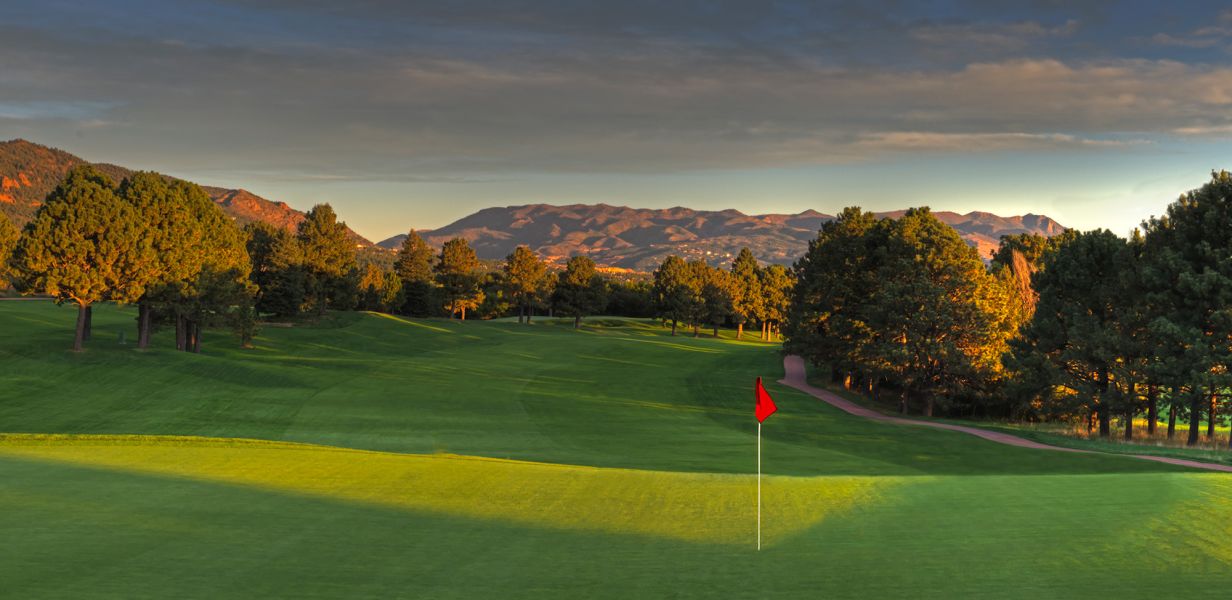
The East Course at The Broadmoor is really two Golden Age statements woven into one routing. Holes 1 through 6 and 16 through 18 are Donald Ross originals from 1918, laid out at roughly 6,400 feet in the foothills of Cheyenne Mountain. Holes 7 through 15 are Robert Trent Jones Sr.'s companion nine from 1952. The blend is seamless. Wide and tree-lined parkland fairways, expansive greens, and mountain light that changes the look of the course from morning to evening. It is the rare resort course that asks championship questions while still feeling like a walk in a grand old park.
The championship record is the deepest in Colorado. The East has hosted nine USGA championships, and its finals read like a history of the game. A 19-year-old Jack Nicklaus won his first major here at the 1959 U.S. Amateur. Annika Sorenstam won her first major at the 1995 U.S. Women's Open. The U.S. Senior Open has come three times, in 2008, 2018 and 2025. Golf Digest ranks the East 47th among America's public courses and GOLF includes it in the Top 100 You Can Play. Because The Broadmoor is a resort, all of that history is bookable with a stay.
The Scorecard
The card below is the White set, taken hole by hole from the club's own published East Course yardage table on broadmoor.com, and it foots exactly to the club's printed totals. That is 3,274 yards out, 3,377 back and 6,651 in all, with par 37 on the front and 35 on the back for 72. Two cautions for the number hunters. The club's printed Blue row does not foot to its own printed totals, so the White card is the one used here, and its figures are internally exact. And the White men's rating and slope of 70.4 and 132 are carried because two published sources, GolfCourseGurus and Tiger Golf Traveler, print the identical pair for this set.
By the Numbers
From the scorecard below: White tees.
Slope 132 from the White tees, rating 70.4 - harder than about 15% of the 182 courses in our database with a published slope.
| Front nine | Par | Yards |
|---|---|---|
| Hole 1 | 4 | 381 |
| Hole 2 | 4 | 334 |
| Hole 3 | 5 | 554 |
| Hole 4 | 3 | 145 |
| Hole 5 | 4 | 405 |
| Hole 6 | 4 | 366 |
| Hole 7 | 5 | 468 |
| Hole 8 | 3 | 145 |
| Hole 9 | 5 | 476 |
| Total | 37 | 3,274 |
| Back nine | Par | Yards |
|---|---|---|
| Hole 10 | 4 | 455 |
| Hole 11 | 4 | 377 |
| Hole 12 | 3 | 198 |
| Hole 13 | 4 | 466 |
| Hole 14 | 4 | 404 |
| Hole 15 | 4 | 397 |
| Hole 16 | 3 | 172 |
| Hole 17 | 5 | 525 |
| Hole 18 | 4 | 383 |
| Total | 35 | 3,377 |
Read as a whole, the White card is a tale of two nines. The front runs 3,274 yards at par 37, with three par 5s, the 554-yard 3rd, the 468-yard 7th and the 476-yard 9th, balanced by a pair of 145-yard par 3s at the 4th and 8th. The back runs 3,377 yards at par 35 and leans on its par 4s. The longest of them, the 466-yard 13th, sits in the heart of the Jones nine, and the lone back-nine par 5 is the 525-yard 17th. Four par 3s, four par 5s and ten par 4s make the 72, and the two nines finish within 103 yards of each other.
Green Fees
- LocationColorado Springs, Colorado
- Par / Yardage72 / 6,651 yards (White tees)
The Broadmoor posts no public rate card, and golf is reserved for registered overnight guests and Golf Club members. Published guides put high season guest golf at about $335 for 18 holes with cart, with Where2Golf updated in 2024 and other estimates in the same neighborhood. Budget in that range and confirm the current guest rate when you book your stay.
The Story
The Broadmoor opened in 1918, Spencer Penrose's grand hotel beneath Cheyenne Mountain, and Ross's course opened with it. At roughly 6,400 feet it was billed as the highest golf course in the United States, and its Ross bones still show. Raised greens. Strategic bunkering. Putting surfaces that reward the player who leaves the ball on the correct side. The local rule of thumb has survived the century intact, and putts on the East break away from Cheyenne Mountain.
In 1952 Robert Trent Jones Sr. added nine holes of his own, and the marriage of his holes, today's 7th through 15th, with nine Ross holes created the modern East. The resort's remaining Ross holes anchor today's West Course, and a third layout, the Mountain Course, closed after a 2015 rockslide, leaving the East and West to carry The Broadmoor's golf. The present East is thus a genuine collaboration across generations, with Ross's 1918 hand and Jones's postwar scale sharing one scorecard.
The trophies kept coming. Bob Dickson added the 1967 U.S. Amateur. So Yeon Ryu won the 2011 U.S. Women's Open. The Senior Open era brought victories for Eduardo Romero in 2008, David Toms in 2018 and Padraig Harrington in 2025. The USGA has already awarded the East two more Senior Opens, in 2031 and 2037, which is as clear a statement as exists that this routing still tests the best senior players in the world.
What keeps the East current, rather than merely historic, is that the test has never been softened for the resort era. It remains one of only 12 courses in North America and the Caribbean to hold a five-star rating from Golf Digest, and the resort around it has held Forbes Five-Star and AAA Five-Diamond honors for decades, so the golf is wrapped in one of the great hotel experiences in America. Guests play the same fairways the Senior Open field plays, walk the same Ross greens, and then argue about the mountain rule over dinner. Very few places in golf let a visiting player step this directly into the record books.
Signature Holes
Hole 3 - Par 5 - 554 yards
The longest hole on the White card is a Ross original, a sweeping par 5 that asks for two full shots and a precise third into one of the East's big and sloping greens. At 6,400 feet the thin air lends a hand, but 554 yards is 554 yards. This is a three-shot hole for nearly everyone, and it sets the tone for a front nine that deals out its length early, with par 5s at the 3rd, the 7th and the 9th.
Hole 4 - Par 3 - 145 yards
The postcard one-shotter. The 4th plays over water to a green set beneath Cheyenne Mountain, and at 145 yards from the White tees it ties the 8th as the shortest hole on the card. Short does not mean simple. The lake guards the front of the green, and once aboard, every putt seems to run away from the peak. This is the hole the cameras found at the 2018 U.S. Senior Open, the view across the water that the live ranking's photograph captures, and it is the frame guests reach for first.
Hole 17 - Par 5 - 525 yards
The last of the Ross holes brings the round home in style. The 17th is the back nine's only par 5, 525 yards of late-day opportunity, and it sits inside a closing run, the 16th, 17th and 18th, played entirely on Ross's 1918 ground. Championships on the East have a habit of turning on this ground. Make a birdie here and the walk to the final tee, with the clubhouse coming into view, feels earned.
Where Altitude Meets the Mountain Rule
Altitude flatters the long ball at the East and then quietly taxes the scorecard somewhere else. At roughly 6,400 feet the White card reads a modest 6,651 yards at par 72 with a rating of 70.4 and a slope of 132, numbers that suggest a manageable parkland round. The help is real because the ball carries farther than at sea level, and the published advice to take one club less captures only half of it. The other half lives on expansive greens where raised surfaces and correct-side misses matter more than raw carry, and where every putt carries the local certainty that it will break away from Cheyenne Mountain.
The card itself splits the examination into two different arguments. The front nine runs 3,274 yards at par 37 with three par 5s, including the 554-yard 3rd, while the back nine runs 103 yards longer at 3,377 yards yet gives back two shots at par 35 and leans almost entirely on its par 4s. That shape changes the rhythm completely. Birdie chances cluster early, patience gets tested late, and the lone back-nine par 5 at the 525-yard 17th arrives inside the closing run of Ross holes from the 16th through the 18th, when a round is either being protected or rescued.
Authorship reinforces the split without ever announcing itself. Donald Ross holes from 1918 bookend the round at the 1st through 6th and the 16th through 18th, while Robert Trent Jones Sr. holes from 1952 fill the middle at the 7th through 15th, including the 466-yard 13th, the longest par 4 on the card. Golfers who trust the altitude and swing freely get rewarded on the front-nine par 5s, then punished when the back nine asks for position into big, sloping greens. The short holes sharpen the point. The 145-yard 4th plays over water beneath Cheyenne Mountain and ties the 8th as the shortest hole on the card, proof that at the East the smallest number can still hold the largest consequence.
Practical Info
Play on the East is reserved for registered overnight guests of The Broadmoor and Golf Club members, so the tee time starts with the room booking. Reserve the stay, then book golf through the resort. The club sits at 1 Lake Avenue in Colorado Springs, about an hour south of Denver, and the golf season at this altitude runs roughly from spring into November. The Colorado Golf Hall of Fame museum is on site, and The Grille overlooking the course is the traditional post-round stop, likewise for guests and members.
Altitude is the East's quiet hazard and its gift. At about 6,400 feet the ball carries noticeably farther than at sea level, so take one club less and trust the flight over the number. Remember the mountain rule on the greens, that putts break away from Cheyenne Mountain, and give yourself time to adjust to the elevation if you are arriving from the flatlands. Mountain weather can turn quickly even in midsummer, so pack a layer, and take the water stations seriously. The Colorado sun at this height is strong.
Questions, Answered
Can anyone play the East Course at The Broadmoor?
Play is limited to registered overnight guests of The Broadmoor resort and to Golf Club members. Book the stay first, then reserve the tee time through the resort; there is no public daily-fee access.
Who designed the East Course?
Donald Ross designed the original course in 1918, and his holes play today as the 1st through 6th and the 16th through 18th. Robert Trent Jones Sr. added the nine holes that play as the 7th through 15th in 1952, completing the modern East.
What championships has the East Course hosted?
Nine USGA championships, including the 1959 U.S. Amateur won by Jack Nicklaus, the 1995 U.S. Women's Open won by Annika Sorenstam, the 2011 U.S. Women's Open and U.S. Senior Opens in 2008, 2018 and 2025. Two more Senior Opens are already awarded for 2031 and 2037.
Keep Exploring Colorado
Read our Colorado Golf Guide for more top courses, green fees, and trip planning across the state.
The Broadmoor (East Course) features in our ranking of the 15 Best Golf Courses in Colorado.
More Colorado course guides: Red Sky (Fazio Course), TPC Colorado, CommonGround, The Broadmoor (West Course), Fossil Trace and Riverdale Dunes.